

Construction Accounting Month-End Close Process: The 2026 Financial Leader's Checklist
What if your month-end close felt less like a forensic investigation and more like a routine confirmation of what you already knew? Most CFOs at mid-market firms realize that disconnected data between the job site and the back office is the primary driver of margin erosion. When pay apps and retainage aging live in manual spreadsheets instead of your ERP, you're essentially flying blind until the books finally close; often weeks too late to fix a failing project.
This guide provides a targeted checklist to transform your construction accounting month-end close process into a predictable 5-day cycle. By leveraging NetSuite + FullClarity, a solution built inside NetSuite, you can eliminate manual entry and align job costs with your financial ledger in real time. You'll gain the visibility needed to capture committed costs and cost-to-complete figures before they impact your bottom line.
We'll walk through a step-by-step workflow to automate WIP reporting and ensure your financial statements are built on a single source of truth that bonding companies trust. From managing complex AIA-style billing to tracking retainage, this is how you future-proof your finance department for 2026 and beyond.
Key Takeaways
- Protect your bottom line by identifying margin erosion early through the precise alignment of job costs with your financial ledger.
- Streamline your construction accounting month-end close process with a collaborative 5-day workflow that synchronizes subcontractor pay apps and field data.
- Master the WIP schedule by reconciling actual costs against cost-to-complete estimates to ensure your balance sheet reflects true project progress.
- Eliminate manual reconciliations and data silos by maintaining a single source of truth built inside NetSuite.
- Discover how NetSuite + FullClarity provides the real-time visibility needed to transition from a reactive monthly cycle to a continuous close.
The Strategic Impact of the Construction Accounting Month-End Close Process
For most mid-market firms, the construction accounting month-end close process is a race against the clock that often ends 15 days too late. A successful close is not just about balancing the books or ticking off a checklist. It's the critical window where finance leaders validate the health of every project. To understand the foundational elements of this discipline, it helps to define What is Construction Accounting? and how it differs from standard corporate finance through its reliance on job costing and progress billing.
Slow close cycles lead directly to margin erosion. When your team takes three weeks to produce a WIP report, you're making decisions based on stale data. In high-inflation environments, a 2% spike in material costs can vanish into the "unrecorded liabilities" void if field costs aren't captured immediately. By the time the CFO sees the deficit, the opportunity to issue a change order or adjust procurement has passed. NetSuite + FullClarity eliminates this lag by providing a single source of truth that reflects committed costs as they happen, not weeks later.
A fast, accurate close also builds essential bonding capacity. Sureties and lenders look for consistency and transparency. If your financial statements fluctuate wildly due to "catch-up" entries, you appear risky. Moving from reactive reporting to proactive management means you're no longer asking what happened last month; you're forecasting what will happen next month.
Why Construction Accounting is Different
Construction finance is defined by the complexity of long-term contracts and percentage-of-completion (POC) accounting. Unlike retail or SaaS, your revenue is an estimate based on the cost-to-complete. Data silos between project management and the ledger often hide the truth about a project's status. When field teams don't report pay apps or sub-tier retainage accurately, the financial statements become a work of fiction. Solutions built in NetSuite solve this by unifying the operational and financial database, ensuring that every dollar spent in the field is visible to the controller instantly.
Financial Goals for 2026: The 5-Day Close
The benchmark for high-performing mid-market firms is shifting toward a 5-day close. Achieving this requires moving away from manual spreadsheets and disconnected systems. Firms that transition to NetSuite + FullClarity frequently report a 40% improvement in accounting efficiency. This speed gives executives real-time visibility into job profitability, allowing them to pivot resources before a project goes into the red. It's time to stop chasing data and start analyzing it.
Ready to benchmark your current process? Download our Construction Finance Health Checklist to identify gaps in your month-end workflow.
Phase 1: The Core Financial Checklist (Balance Sheet & Income Statement)
A successful construction accounting month-end close process relies on a clean balance sheet. You can't accurately forecast profit if your foundational accounts are in disarray. Start by reconciling every bank and credit card statement to clear outstanding job-related expenses. This ensures that field costs, such as a $4,500 emergency material delivery, are captured in the correct period. For fixed assets, document any new equipment acquisitions, like a $180,000 excavator purchased on the 12th of the month, and update depreciation schedules immediately. This level of precision is vital for compliance with the IRS Audit Technique Guide for the Construction Industry, which demands strict adherence to cost allocation methods and contract accounting standards.
Managing Subcontractors and Pay Apps
Your accounts payable team must verify that every subcontractor pay app aligns with the physical progress on the job site. Using NetSuite + FullClarity, you can track these committed costs against your original budget to prevent budget overruns before they happen. It's essential to verify lien waivers against every payment to mitigate third-party liability and project risk. Don't overlook retainage aging; you must reconcile the 5% or 10% held back against the total retainage owed. This prevents end-of-project disputes and ensures your financial statements reflect actual liabilities rather than estimates.
Revenue Recognition and AIA Billing
Revenue recognition is where most margin erosion occurs. You must validate your over/under billings by comparing actual costs to date against the total estimated costs to complete. Confirm that all AIA-style invoices match the agreed-upon schedule of values perfectly. If your unbilled receivables exceed 15% of your total contract value, your cash flow is likely at risk. Solutions built in NetSuite allow you to see these discrepancies instantly, rather than waiting for a post-project autopsy. To streamline this, you can access our automated billing workflow guide to reduce manual entry errors. Reviewing these milestones ensures that your income statement reflects reality, not just optimistic projections. Executing this phase of the construction accounting month-end close process provides the visibility needed to maintain a 20% or higher gross margin across all active projects.
Phase 2: Reconciling WIP and Job Costing Data
The Work-In-Progress (WIP) schedule is the heart of your month-end. It's the only way to ensure your revenue recognition reflects reality. You can't rely on gut feelings or disconnected spreadsheets to manage multi-million dollar contracts. To maintain a single source of truth, your general ledger must align perfectly with your job cost sub-ledger. When these numbers diverge, you risk overbilling or underbilling, both of which cripple cash flow and mislead stakeholders. This reconciliation is the most critical step in the construction accounting month-end close process.
Identifying profit fade early is the difference between a successful project and a loss. If actual costs are climbing while your "cost-to-complete" stays stagnant, your margins are evaporating. NetSuite + FullClarity allows you to see these variances in real-time. This visibility ensures that the profit you recognized at 25% completion is still there at 90%.
Verifying Cost-to-Complete Accuracy
Precision depends on the Project Manager. They must provide updated cost-to-complete estimates for every active job. Finance teams often see 12% variances in labor burden because field data arrives late or is entered incorrectly. By using tools built in NetSuite, PMs update these estimates directly where finance sees them. This eliminates the lag that causes profit fade. During your close, verify these specific areas:
- Unallocated equipment costs that haven't hit the job yet.
- Labor hours that exceed the original bid due to site conditions.
- Mid-month change orders that haven't been factored into the remaining budget.
The Financial Impact of Change Orders
Change orders are the primary cause of margin erosion. If a PM starts work on a verbal agreement without updating the committed costs, your WIP calculation is wrong. You need to reconcile pending change orders against approved ones to see your true exposure. NetSuite + FullClarity tracks these shifts in real-time, ensuring your subcontracts and purchase orders reflect the latest scope changes. This prevents "budget surprises" that typically surface only when it's too late to fix them.
Don't let manual data entry slow down your reporting. You can download our WIP Reconciliation Checklist to streamline this phase of your close, or request a demo to see how NetSuite + FullClarity automates these workflows.
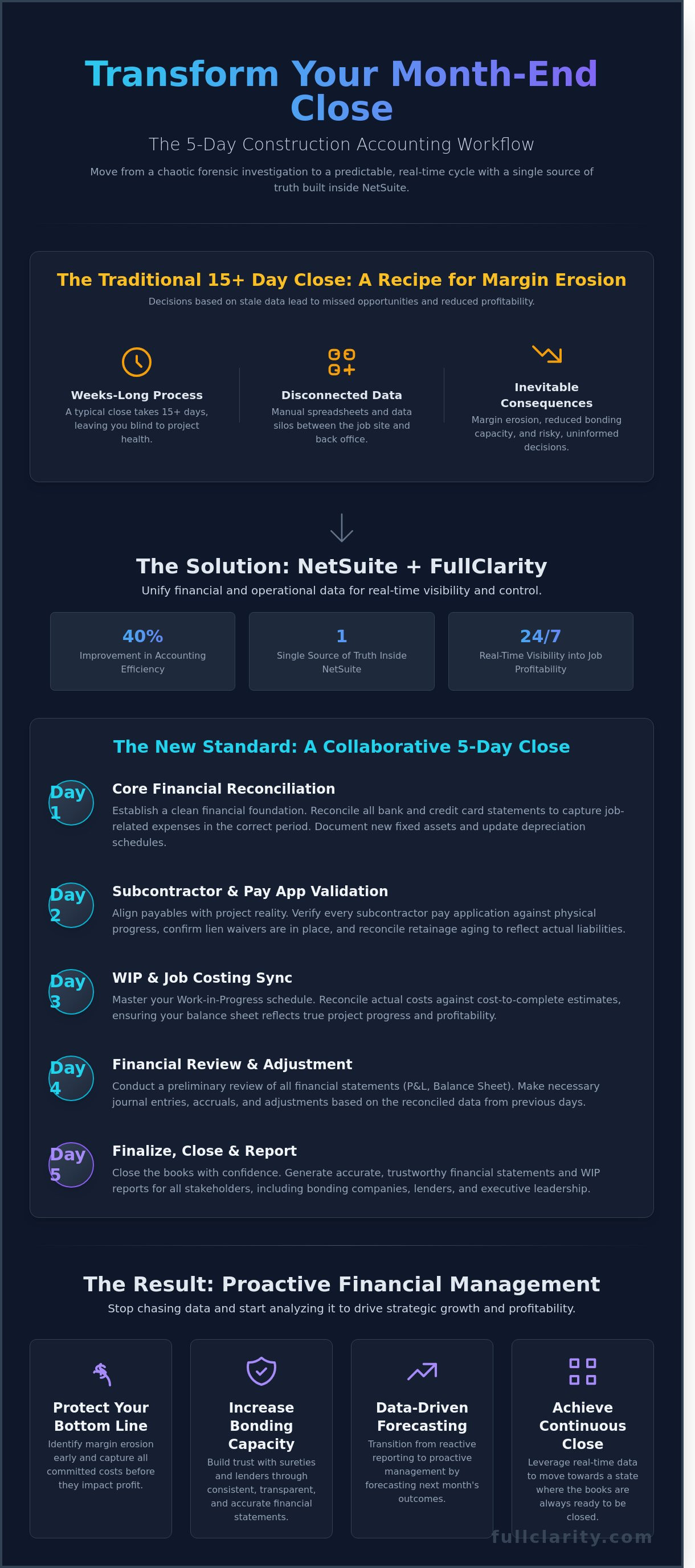
Step-by-Step Workflow: A Collaborative 5-Day Close
A standard construction accounting month-end close process often drags into the third week of the following month. This delay leaves leadership making critical decisions based on stale data. By leveraging NetSuite + FullClarity, firms condense this timeline into five business days through a structured, collaborative workflow that aligns finance and operations.
- Day 1-2: Field Data and Subcontractor Cutoff. The office sets a hard deadline for subcontractor invoices and field reports. Field teams sync all labor hours and daily logs. Because the system is built inside NetSuite, these costs hit the ledger immediately without manual entry.
- Day 3: PM Review and Cost-to-Complete. Project Managers review job costs against the budget. They update the cost-to-complete for every active task. This ensures the WIP schedule reflects the actual physical progress on-site rather than a rough estimate.
- Day 4: Controller Review and Revenue Recognition. The Controller validates the WIP schedule. They check for margin erosion and ensure over and under billings are accurate. Revenue recognition entries are generated directly from the project data.
- Day 5: CFO Final Review. The CFO performs a high-level analysis of the financial statements. With a single source of truth, they issue the final package by the close of business.
Automating the Field-to-Office Handshake
Manual re-entry of timesheets and field reports is a primary cause of closing delays. When your field data is built in NetSuite, the handshake between the job site and the accounting department is instantaneous. This eliminates the 48-hour lag typically spent chasing paper or correcting spreadsheet errors. It also reduces friction in the pay app approval process. PMs approve subcontractor invoices within the system, which automatically updates committed costs and prevents the risk of overpayment.
Reviewing Retainage and Compliance
Retainage management is often where cash flow stalls. We use automated retainage aging reports to trigger collections as soon as project milestones are met. During the close, the system verifies that 100% of certified payroll and insurance certificates are compliant for the period. Every project file is linked directly to the financial record. This level of visibility ensures that no invoice is paid unless the subcontractor's compliance is current, protecting the firm from unnecessary risk and audit exposure.
"Since moving to NetSuite + FullClarity, our team achieved a 40% efficiency improvement in our monthly reporting cycle." - Controller, Mid-Market General Contractor
Ready to accelerate your reporting? See how NetSuite + FullClarity streamlines your close.
Achieving a Continuous Close with NetSuite + FullClarity
Most construction firms lose 10 to 15 days every month just trying to sync data between project management tools and accounting software. When you use an integrated third-party tool, you're essentially managing two different sets of books. NetSuite + FullClarity changes this dynamic by operating within a single database. There's no sync because the data never leaves the system. This architecture transforms the construction accounting month-end close process from a monthly sprint into a continuous, automated flow.
The NetSuite + FullClarity Advantage
Your team needs a single source of truth to stay profitable. By using a solution built inside NetSuite, your finance and operations teams share a single login. This eliminates the manual reconciliation of committed costs and subcontracts. You can manage pay apps, retainage aging, and complex AIA-style billing without exporting a single CSV file.
This visibility is the only way to stop margin erosion before it impacts your cash flow. One FullClarity customer reported a 40% efficiency improvement by moving their project financial workflows into the ERP. Instead of waiting for a post-mortem report, you see cost-to-complete and over/under billings daily. You'll know your exact margin on a Tuesday afternoon, not just on the 20th of the following month.
- Eliminate Data Silos: Field costs and change orders flow directly into the general ledger.
- Automate Retainage: Track retainage aging automatically to ensure you're billing for every dollar earned.
- Real-Time WIP: Generate work-in-progress reports with one click, reflecting the most recent job costs and billings.
Next Steps for Financial Transformation
Scaling a construction firm requires a financial platform that grows with you. If your current construction accounting month-end close process relies on manual spreadsheets and "syncing" buttons, you're at risk of making decisions based on stale data. Start by identifying your biggest bottlenecks. Are you spending hours on manual AIA billing? Is your team struggling to track subcontractor compliance?
Moving to a native SuiteApp ensures your business is future-proof. You gain the sophisticated reporting of the world's #1 Cloud ERP combined with the practical, job-costing workflows your field teams require. It's time to move past the traditional month-end headache and embrace a continuous close.
Ready to see how a native solution can accelerate your close?
Take Control of Your 2026 Financial Close
The traditional 15-day close is a liability in a high-stakes market. Leading firms now treat the construction accounting month-end close process as a strategic advantage rather than an administrative hurdle. You've seen how reconciling WIP data and tracking retainage aging doesn't have to be a manual exercise in disconnected spreadsheets. When your financial data lives in the same database as your project costs, you eliminate the friction that causes margin erosion.
Project-based firms using NetSuite + FullClarity have already achieved a 40% efficiency improvement by removing the data silos between the field and the office. Because our solution is built natively inside NetSuite, your team works with one login and one source of truth. You gain immediate visibility into committed costs and cost-to-complete figures without waiting for manual exports. It's time to stop chasing pay apps and start driving growth with real-time financial clarity.
Request a Demo of NetSuite + FullClarity
Your team deserves a close process that provides confidence instead of stress. We're here to help you build a more profitable future.
Frequently Asked Questions
How long should the construction month-end close process take?
An efficient construction accounting month-end close process should ideally take between 5 and 7 business days. If your team spends more than 10 days closing the books, your project managers are likely making field decisions based on 40 day old data. Firms using NetSuite + FullClarity often reduce their manual data entry time by 30% compared to legacy systems, allowing for a much faster turnaround.
What is the most important report in a construction month-end close?
The Work-in-Progress (WIP) report is the most critical document in your close because it bridges the gap between the balance sheet and the field. It calculates over billings and under billings to show exactly how project margins fluctuate each month. Without a real-time WIP schedule built inside NetSuite, your CFO lacks a single source of truth for recognized revenue and final profit projections.
How do I handle unapproved change orders during the month-end close?
You should track unapproved change orders in a pending status to maintain visibility without prematurely inflating your recognized revenue. Don't recognize income on these items until you have a signed agreement; however, you must still record any costs incurred against them to avoid understating expenses. NetSuite + FullClarity allows you to link these costs to the specific potential change order, preventing profit fade before the contract is officially updated.
What is the difference between job costing and general ledger accounting?
Job costing focuses on the granular details of individual projects like labor hours and material units, while general ledger accounting tracks the high level financial health of the entire firm. In many legacy systems, these two areas are disconnected silos that require manual reconciliation. By using a solution built inside NetSuite, your job costs flow directly into your GL in real time, ensuring your project margins and financial statements always match.
How can I improve my WIP schedule accuracy?
Improve WIP accuracy by requiring project managers to update their cost-to-complete estimates at least once every 30 days. Most inaccuracies stem from stale field data or missing committed costs that haven't been factored into the total forecast. When your accounting is built in NetSuite, you eliminate the risk of manual spreadsheet errors, which can account for a 5% variance in reported profitability across a project lifecycle.
Why is retainage tracking so difficult at month-end?
Retainage tracking is difficult because it requires managing two different timelines: the work performed and the eventual release date after project completion. Many firms lose track of 2% to 5% of their total contract value because retainage is buried in manual spreadsheets or separate sub-ledgers. NetSuite + FullClarity automates this by tracking retainage at the line-item level on every pay app, ensuring your aging reports stay accurate.
What are 'committed costs' and why do they matter for the close?
Committed costs are financial obligations you've made through subcontracts or purchase orders that haven't been invoiced or paid yet. These matter during the close because they represent your true financial exposure on a project. If you don't account for these commitments, your cost-to-complete estimates will be inaccurate, leading to a false sense of profit security and sudden margin erosion when the invoices finally arrive.
Can NetSuite handle AIA-style billing and retainage natively?
Standard NetSuite does not provide AIA G702 or G703 forms or automated retainage tracking natively. However, NetSuite + FullClarity adds these essential construction workflows directly into the ERP environment. This means you can generate complex pay apps and manage retainage aging without ever leaving the system, creating a single source of truth for your finance team while eliminating the need for external billing software.