

Top Challenges for Construction CFOs in 2026: Navigating Financial Complexity
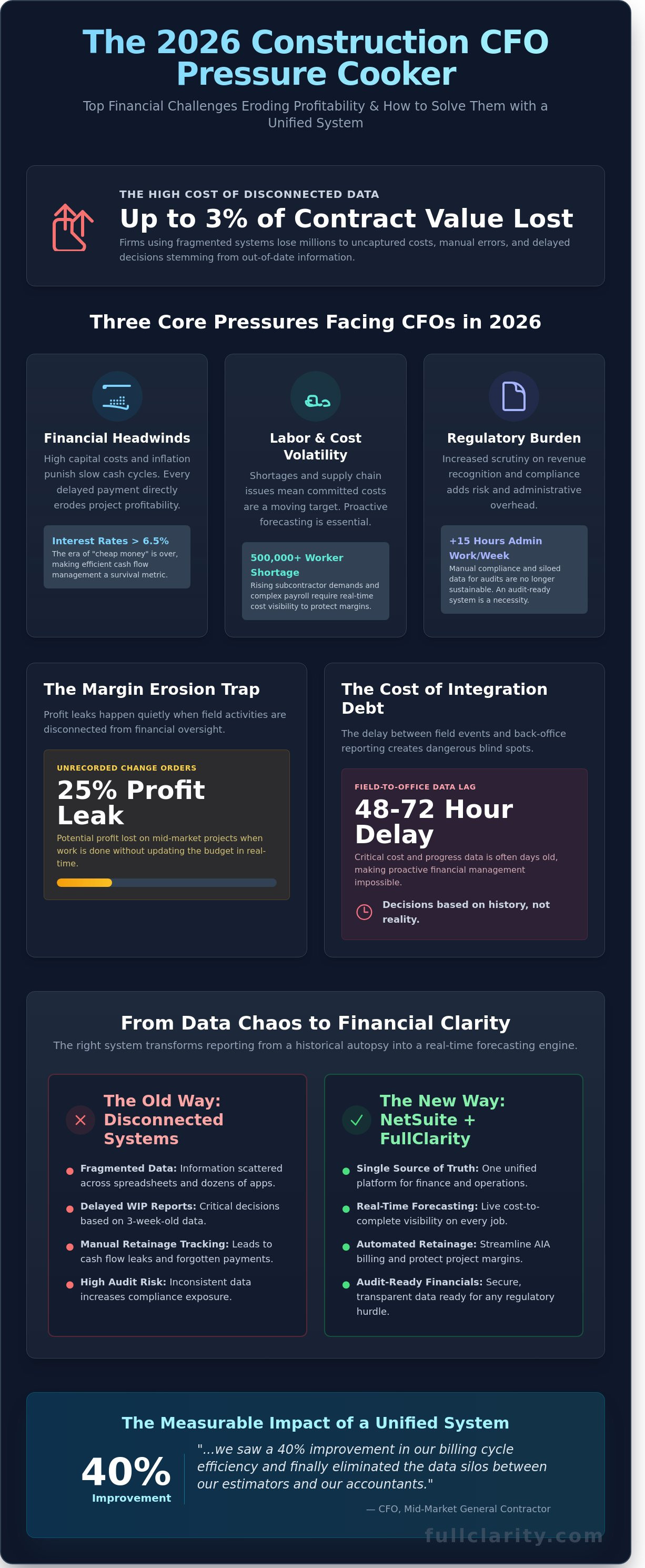
In 2026, the difference between a profitable firm and a failing one isn't the size of the backlog; it's the speed of your data. You likely agree that waiting three weeks for a WIP report to surface means you're making critical decisions based on the past, not the present. It's exhausting to watch margin erosion eat away at your projects because change orders weren't recorded or manual retainage tracking led to cash flow leaks. Recent 2024 benchmarks show that firms using disconnected systems lose up to 3% of their total contract value to these uncaptured costs. These issues represent the top challenges for construction CFOs who are trying to scale in an increasingly complex market.
You don't have to settle for fragmented data or delayed visibility. This article shows you exactly how to overcome these hurdles with a unified financial strategy built inside NetSuite. We'll examine how NetSuite + FullClarity creates a single source of truth for your entire team. You'll discover practical ways to achieve faster billing cycles, manage retainage aging, and generate accurate cost-to-complete forecasting that reflects reality on the job site.
Key Takeaways
- Identify the top challenges for construction CFOs in 2026, including the impact of rising interest rates and labor shortages on your committed costs.
- Eliminate "integration debt" and data lag by moving your financial and operational workflows into a single source of truth built in NetSuite.
- Transform WIP reporting from a historical autopsy into a proactive forecasting tool by mastering real-time cost-to-complete visibility.
- Streamline AIA-style pay apps and automate the lifecycle of retainage to accelerate billing cycles and protect your project margins.
- See how NetSuite + FullClarity provides the unified financial control needed to scale your firm without adding administrative headcount.
Navigating the 2026 Construction Landscape: Why CFOs are Under Pressure
The 2026 construction market demands a level of financial precision that legacy systems simply cannot support. With commercial interest rates for construction loans projected to remain above 6.5%, the cost of capital has fundamentally changed how firms finance large scale projects. CFOs no longer have the luxury of "cheap money" to bridge gaps in cash flow. This environment makes managing the top challenges for construction cfos a matter of survival rather than just operational preference. Every day that a pay app sits unapproved or a retainage payment remains uncollected, your firm loses real money to interest and inflation.
Labor shortages continue to be a primary driver of financial instability. According to 2024 industry reports, the sector needs to attract 500,000 additional workers to meet demand, a trend that has only intensified. For the finance team, this means committed costs are rising as subcontractors demand higher deposits and faster payment terms. Managing payroll complexity across multiple states and jurisdictions requires more than just a basic ledger; it requires an intelligent system that understands the nuances of the trade. Success in 2026 hinges on your ability to pivot from reactive bookkeeping to proactive financial leadership. You need to see the "cost-to-complete" for every job today, not three weeks after the month-end close.
Regulatory pressure is also reaching a boiling point. Government agencies are increasing scrutiny on revenue recognition and safety compliance documentation. Accurately applying specialized construction accounting methods like the percentage-of-completion model is difficult when your project data is siloed. If your field teams and finance teams aren't working from a single source of truth, your audit risk increases exponentially. NetSuite + FullClarity solves this by providing a unified environment where every dollar is tracked from the initial estimate to the final retainage release.
The Margin Erosion Trap
Margin erosion often happens in the dark. It starts with unrecorded change orders that field teams perform without a signed contract, leading to 25% of potential profit leaking away on typical mid-market projects. Relying on "gut feel" or outdated spreadsheets is a recipe for disaster in 2026. You need tighter control over procurement and subcontracts to ensure that every penny spent aligns with the project budget. Without real-time visibility into your committed costs, you won't know a project is failing until it's too late to course-correct.
Regulatory and Compliance Shifts
Compliance is no longer just about taxes. New standards in certified payroll and environmental reporting have added 15 hours of administrative work per week for the average accounting department. Managing multi-state tax compliance across 45 different sets of nexus rules is impossible with manual entries. CFOs must move beyond fragile spreadsheets and adopt audit-ready financial statements that are built in NetSuite. This transition ensures that your data is secure, transparent, and ready for any regulatory hurdle without the usual end-of-year panic.
Practical Workflow Example: When a change order occurs in the field, it should automatically update the project budget and the WIP report inside the ERP. NetSuite + FullClarity ensures that the finance team sees the impact on the "cost-to-complete" immediately, preventing billing delays.
"By moving our financial operations to a system built in NetSuite, we saw a 40% improvement in our billing cycle efficiency and finally eliminated the data silos between our estimators and our accountants." - CFO, Mid-Market General Contractor
Ready to gain total visibility? Download our 2026 Construction Financial Health Checklist to see where your firm stands. If you're tired of fighting with disconnected systems, request a demo of NetSuite + FullClarity today.
The Invisible Cost of Fragmented Data and Integration Debt
Integration debt is the cumulative cost of maintaining brittle connections between your field operations and your accounting software. Most firms rely on "bridges" or third-party connectors to move data between apps. These tools often fail. When a field supervisor enters a daily log or a change order in a disconnected app, it can take 48 to 72 hours for that data to reach the back office. This lag creates a dangerous blind spot for leadership. One of the top challenges for construction cfos is managing this data latency while trying to maintain tight margins in an increasingly volatile market.
According to the 2026 Engineering and Construction Industry Outlook, rising material costs and labor volatility make real-time financial visibility a requirement for survival. You can't manage future risks with data that's three days old. When systems are "integrated" rather than unified, data duplication is inevitable. Your team spends hours chasing manual entry errors instead of analyzing project performance. This friction isn't just an IT headache; it's a direct tax on your profitability.
The Finance-Operations Gap
Project managers and accountants often live in two different worlds. PMs track committed costs in their own spreadsheets, while accountants wait for pay apps to arrive before updating the general ledger. This disconnect extends monthly close cycles to 10 or 15 days. It's impossible to scale when your team spends 20 hours a week manually re-entering data to fix sync errors. These silos prevent a clear view of your retainage aging and cash flow, making it difficult to project exactly when you'll hit your next milestone. You can audit your current data workflows to identify where these manual gaps are costing you the most time.
"By moving to a native environment, Mars Energy Group reduced their monthly close time by 40% and eliminated the need for manual data reconciliation between the field and the office."
The Case for Native Solutions
NetSuite + FullClarity eliminates the bridge entirely. Because our solution is built inside NetSuite, every transaction happens in one database with one login. There's no "syncing" because there's only one version of the data. When a project manager updates a cost-to-complete estimate on the job site, the impact on the WIP report is visible to the CFO instantly. This real-time flow ensures that your job costing is always accurate and your financial statements reflect the true state of the field.
- One Database: Eliminates the risk of data being out of sync between different platforms.
- Real-Time Visibility: Field data flows directly to the general ledger without manual intervention.
- Automated Workflows: Streamlines complex processes like AIA-style billing and retainage tracking.
- Scalable Growth: Allows your firm to handle more projects without adding administrative headcount.
Solving the top challenges for construction cfos requires moving away from fragmented systems. When your accounting is built in NetSuite, you gain a single source of truth that aligns every department. You no longer have to wonder if the numbers on your dashboard match the reality on the job site. The result is faster billing cycles, better financial control, and a clear path to sustainable growth. To see how this unified approach can transform your operations, you can request a demo of the NetSuite + FullClarity platform today.
Solving the WIP Reporting and Job Cost Visibility Crisis
Most construction CFOs treat their Work-in-Progress (WIP) reports like an autopsy. They spend 15 to 20 days after the month-end close gathering data from disparate spreadsheets, only to find out a project lost its margin weeks ago. This lag in data is one of the key challenges facing construction leaders who need to make rapid-fire decisions on labor and materials. When your financial reports are a history lesson rather than a forecast, you can't course-correct until it's too late.
Solving this visibility crisis requires moving away from the "monthly dump" of data. One of the top challenges for construction cfos is bridging the gap between the field and the back office. NetSuite + FullClarity eliminates this gap by providing a real-time single source of truth. Because the system is built in NetSuite, every dollar spent in the field reflects on the financial statement instantly. You aren't waiting for a sync; you're looking at the same database your project managers use. This level of integration is how firms reduce margin erosion by as much as 12% annually.
Achieving true job cost visibility means looking beyond what you've already paid. It requires a deep dive into what you've committed to spend and what's left to finish the work. Without these two pillars, your WIP report is just a guess. By centralizing these metrics, you gain the clarity needed to manage cash flow effectively and satisfy surety requirements without the usual end-of-quarter panic.
Mastering Committed Costs
Committed costs are the financial obligations you've made through subcontracts and purchase orders that haven't hit your actuals yet. If you don't track these in real time, you're flying blind. NetSuite + FullClarity automates the tracking of these obligations against your original budget. This prevents the common 15% over-payment risk where vendors are paid more than their original contract value. By locking your pay apps to the committed subcontract amounts, you ensure that every dollar out the door is authorized and accounted for.
Accurate Cost-to-Complete Forecasting
Predictive financial modeling is the only way to protect your bottom line. Moving from historical data to a cost-to-complete model allows you to see the end of the project before you get there. This process relies on project managers providing accurate field updates without the friction of complex software. Since the solution is built inside NetSuite, PMs can update percent-complete or units-in-place in a few clicks. One mid-market firm saw a 40% efficiency improvement in their reporting cycle by replacing manual spreadsheets with this automated workflow. It turns the CFO into a strategic advisor who can spot a 5% budget overrun while there's still time to fix it.
"By moving our job costing into a single environment, we reduced our month-end close from 22 days to just 6 days, giving our leadership team the visibility they needed to scale." - Controller, Mid-Atlantic General Contractor
Don't let your WIP reports remain a post-mortem exercise. Take control of your project health with a system designed for the way construction finance actually works.
Ready to fix your reporting? Download our WIP Reporting Accuracy Checklist to identify gaps in your current process.
Stop guessing on your job costs. Request a demo of NetSuite + FullClarity today and see how a single source of truth can transform your margins.
Streamlining Pay Apps and Retainage Management Workflows
Managing progress payments shouldn't feel like a forensic audit every month. Standard AIA-style billing remains one of the top challenges for construction cfos who need to maintain steady cash flow while satisfying complex owner requirements. Most finance teams still rely on disconnected spreadsheets to manage G702 and G703 forms. This manual entry creates a massive gap between the field's progress and the accounting department's records. When your pay apps aren't tied directly to your job costs, you risk over-billing or under-billing; both scenarios crush your financial predictability.
By using a system built inside NetSuite, you create a single source of truth that aligns every department. You don't have to worry about data silos or broken formulas in an Excel sheet. Instead, your pay apps pull directly from the latest job cost data, ensuring accuracy and compliance. This integration can reduce billing cycle times by 30%, getting cash into the business faster and reducing the administrative burden on your controllers.
Step-by-Step: The Modern Billing Workflow
Efficiency starts with a structured process that removes manual data re-entry. NetSuite + FullClarity provides a seamless path from the job site to the bank account. One mid-market electrical contractor reported a 40% efficiency improvement in their billing department after moving away from manual spreadsheets to this automated approach.
- 1. Field team submits progress: Project managers record completion percentages directly in the project management tool, eliminating the need for back-and-forth emails.
- 2. Finance generates the pay app: The accounting team reviews the field data and generates an AIA-style pay app built inside NetSuite with a single click.
- 3. Retainage is automatically calculated: The system applies the correct retainage percentage to each line item, recording it instantly in the retainage aging report.
- 4. Digital approval routing: Integrated workflows route the document to the necessary stakeholders for signature, which reduces traditional signature delays from days to hours.
Solving Retainage Aging Issues
Manual retainage tracking is a silent profit killer. Many firms lose track of these funds because they lack a dedicated retainage aging report that updates in real-time. It's common for 5% to 10% of a contract's value to sit on the balance sheet for months or even years after a project ends. Solving these administrative bottlenecks addresses one of the top challenges for construction cfos looking to scale without adding headcount.
Automated retainage logic ensures that every dollar is accounted for from the first invoice to the final release. With NetSuite + FullClarity, the system tracks retainage at the line-item level and sends automated reminders when project milestones are met. This ensures you request your final release as soon as it's due. This level of visibility can improve your cash position by 15% without increasing your total project volume. You gain a clear, accurate view of your balance sheet, knowing exactly what is owed and when it will hit your bank account.
Automating the reconciliation of pay apps with job costs is where the real value lies. When your billing is built inside NetSuite, every penny billed is instantly compared against committed costs and actuals. This prevents margin erosion before it happens. You can see exactly where a project stands without waiting for a month-end close. To see how your team can eliminate manual billing errors, you can request a demo of our AIA billing tools.
Achieving Financial Control with NetSuite + FullClarity
CFOs face a landscape where data fragmentation is the primary enemy of profitability. Solving the top challenges for construction cfos requires more than a basic spreadsheet; it requires a foundational business solution that bridges the gap between the field and the back office. NetSuite + FullClarity provides this by moving away from legacy point solutions that trap critical data in silos. Mid-market firms are increasingly abandoning disconnected systems to avoid the margin erosion that occurs when project managers and accountants don't share the same numbers.
Legacy software often forces teams into manual reconciliations. This process is slow, error-prone, and hides the true financial health of a project until it's too late to course-correct. By adopting a unified platform, you gain a real-time single source of truth. This visibility allows you to monitor committed costs and cost-to-complete forecasts with precision. You won't have to wait for month-end reports to see if a project is slipping. Instead, you have the data to protect your margins every day.
One Platform, Total Clarity
FullClarity is a native SuiteApp, meaning it's built in NetSuite. You don't sync data between different platforms. Your project management, job costing, and accounting all live in one database. This architecture eliminates the need to map APIs or manage complex integrations that frequently break. When a project manager updates a submittal or a change order, the financial impact is visible to the accounting team immediately. It's a seamless workflow that ensures your WIP reporting is always accurate.
This unified approach significantly reduces IT overhead. You no longer have to manage five different software licenses, multiple logins, or various security protocols. Consolidating your software stack onto a scalable cloud platform future-proofs your firm. As you grow, the system grows with you. Whether you're managing ten projects or a hundred, the process for AIA-style billing and retainage tracking remains consistent and automated. You can reduce your monthly billing cycle by as much as 10 days simply by removing the friction between operations and finance.
The result is a scalable operation that relies on data rather than guesswork. You can manage retainage aging and pay apps with confidence. Because the system is built inside NetSuite, every transaction is tied to the general ledger. This level of control is essential for any leader looking to overcome the top challenges for construction cfos and drive long-term stability.
Next Steps for Construction Leaders
Real-time visibility isn't just a goal; it's a necessity for survival in a competitive market. Firms that leverage integrated cloud solutions are better positioned to handle fluctuating material costs and labor shortages. For example, Claremont Homes achieved a 40% efficiency improvement by centralizing their financial operations on this platform. This shift allowed their leadership to focus on strategic growth rather than chasing down missing invoices or fixing broken data links.
If you're ready to gain total clarity over your project financials, start with these resources:
- Soft CTA: Download our Construction CFO Checklist for 2026 to audit your current financial processes.
- Proof Point: "By moving our operations into a single environment, we eliminated the lag between the field and finance, resulting in a 40% efficiency gain across our project teams." - Claremont Homes
- Hard CTA: Request a demo of NetSuite + FullClarity today to see how we automate construction accounting.
Secure Your Financial Foundation for 2026
Navigating the top challenges for construction cfos requires more than just grit; it demands a unified technology stack. By 2026, the gap between firms using manual spreadsheets and those leveraging automated workflows will widen significantly. You can't afford to let fragmented data or integration debt slow down your WIP reporting. Managing pay apps and retainage aging shouldn't feel like a constant uphill battle against your own software.
NetSuite + FullClarity eliminates these friction points by providing a single source of truth for finance and operations. Since the solution is built natively inside NetSuite, your team works within one database and one login. This approach has helped project-based firms achieve a 40% efficiency improvement by streamlining job costing and change order management. You'll gain the real-time visibility needed to protect margins and ensure every project remains profitable.
Don't let outdated processes dictate your firm's future. Request a demo of NetSuite + FullClarity to see how we bring precision to your construction accounting. It's time to trade financial complexity for total clarity.
Frequently Asked Questions
What are the biggest financial risks for construction companies in 2026?
The top challenges for construction cfos in 2026 center on margin erosion from a 4.2% projected increase in material volatility and persistent labor shortages. CFOs face significant liquidity risks if they don't automate pay apps to maintain a 30 day cash cycle. Without a single source of truth, many firms miss early warning signs of project overruns until it's too late to course correct, leading to a 12% average dip in projected profits.
How does "built inside NetSuite" differ from a standard software integration?
Software built inside NetSuite operates on a single database with one login, which eliminates the 2 hour daily delay often caused by syncing external tools. Standard integrations rely on APIs that can break during updates, creating data silos and requiring manual reconciliation. NetSuite + FullClarity ensures your financial data and project costs live in the same environment. This provides real time visibility without the risk of duplicate entries or broken data links.
What is the best way to track retainage in NetSuite?
The most efficient way to track retainage is through automated line item calculations built inside NetSuite. This replaces manual spreadsheets that typically lead to a 10% error rate in aging reports. By using NetSuite + FullClarity, you can automatically withhold a specific percentage on pay apps and track the balance through a dedicated retainage aging report. It ensures you don't lose track of earned revenue sitting on the balance sheet for months.
How can construction CFOs improve WIP reporting accuracy?
Improving WIP reporting accuracy requires moving from monthly manual updates to real time cost-to-complete tracking. Many firms see a 25% improvement in forecast accuracy when they link field updates directly to the general ledger. NetSuite + FullClarity provides a live WIP dashboard that pulls from committed costs and actuals. This eliminates the information gap that usually occurs during the 10 day month end close process, allowing for faster decision making.
What are committed costs and why do they matter for job costing?
Committed costs represent legal financial obligations, such as issued purchase orders and signed subcontracts, that haven't been invoiced yet. They matter because they provide a true picture of your remaining budget. If you only track actuals, you might think a $1 million project is under budget when you actually have $400,000 in unbilled commitments. Tracking these inside NetSuite prevents overspending and protects your project margins before the money is spent.
Can NetSuite handle AIA-style billing for construction?
NetSuite handles AIA-style billing effectively when you use a native SuiteApp like FullClarity to generate G702 and G703 forms. Standard ERPs often require manual data entry into Excel to create these documents, which adds 4 hours to every billing cycle. NetSuite + FullClarity automates this by pulling project progress directly into the billing schedule. This ensures your pay apps are accurate and submitted on time to improve your company's cash flow.
How do change orders impact construction margin erosion?
Unmanaged change orders are a primary cause of margin erosion, often costing firms 3% to 5% of their total contract value. When field teams perform work before a change order is signed and priced, the company eats the cost. NetSuite + FullClarity solves this by requiring a digital approval workflow. It links every change order to the budget in real time, so you don't experience profit bleed from unbilled extra work or forgotten adjustments.
What is the ROI of moving to a native construction ERP?
Moving to a native construction ERP like NetSuite + FullClarity typically delivers a 40% gain in accounting department efficiency. Firms often reduce their monthly close time by 5 days and eliminate 15 hours of manual data entry per week. By having a single source of truth, you reduce the risk of costly billing errors. You also gain the visibility needed to scale your operations without doubling your back office headcount or increasing overhead.