

Construction Project Scheduling Software: Aligning Field Timelines with Financial Truth in 2026
For many construction CFOs and Controllers, the "construction project scheduling software" used in the field operates in a vacuum, completely disconnected from the general ledger. While superintendents track milestones in siloed tools, the finance team is forced into manual double-entry just to keep WIP reporting current. This disconnect is the primary driver of margin erosion. When field progress isn't reflected in your job costing in real-time, your cost-to-complete estimates become unreliable, and your ability to bill accurately for work performed is constantly lagging behind the actual production on-site.
It is time to align your field timelines with your financial truth. In this guide, we examine how NetSuite + FullClarity eliminates data silos by providing scheduling capabilities built inside NetSuite. You will learn how to connect daily field updates directly to your pay apps and AIA-style billing processes, ensuring that every percentage of completion is captured and invoiced without delay. By establishing a single source of truth, your team can finally gain the visibility needed to protect project margins, automate complex billing cycles, and maintain total control over your retainage aging.
Key Takeaways
- Learn why traditional scheduling tools create an "integration gap" that hides margin erosion from finance teams until it is too late to protect project profit.
- Discover how modern construction project scheduling software built inside NetSuite provides a single source of truth by feeding field progress directly into your general ledger.
- See how linking schedule milestones to your budget triggers automated pay apps and real-time WIP reporting that accurately reflects actual field conditions.
- Master a practical workflow for connecting subcontracts and purchase orders to specific timeline phases to gain total visibility into your committed costs.
- Evaluate the financial ROI of unifying your firm on NetSuite + FullClarity to eliminate data silos and secure your margins for 2026.
Beyond the Gantt Chart: Why Traditional Scheduling Fails Finance
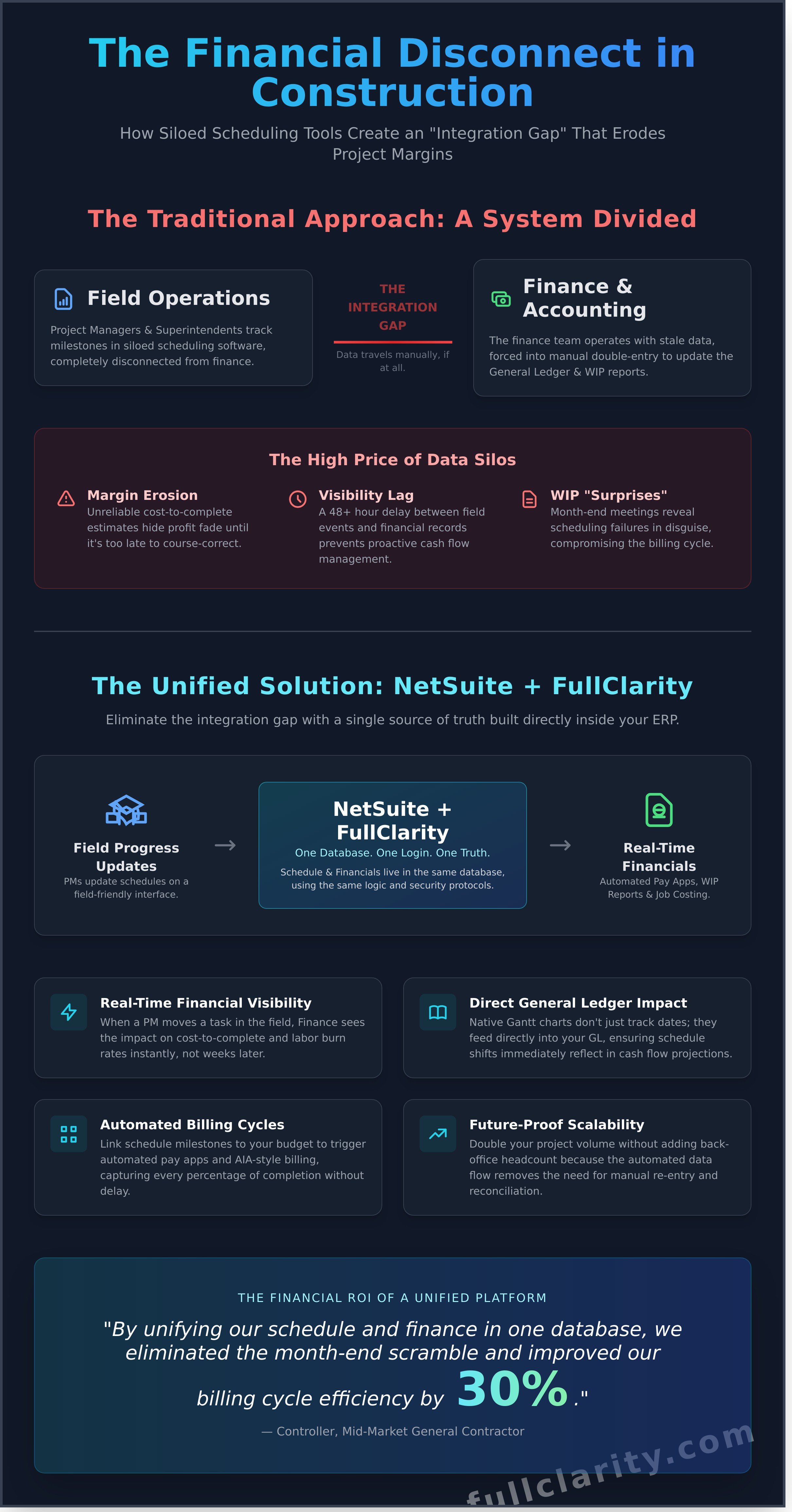
For decades, scheduling was seen as an operational task-something Project Managers handled in a vacuum to keep crews moving. However, in today’s volatile market, construction project scheduling software must be viewed as a financial instrument. When scheduling lives outside your ERP, it creates an "Integration Gap" that hides margin erosion until it is too late to course-correct. CFOs are increasingly moving away from disconnected point solutions in favor of unified platforms like NetSuite + FullClarity to ensure that every timeline shift is immediately reflected in the company’s financial health.
Modern Project management software built inside NetSuite ensures that your schedule drives your financials, not the other way around. Without this connection, your cost-to-complete accuracy is only as good as your last manual update, leaving your balance sheet vulnerable to stale data and unforeseen slippage.
The High Price of Data Silos
- Manual Entry Errors: Relying on staff to bridge the gap between field tools and the office leads to "fat-finger" errors and mismatched committed costs.
- The Visibility Lag: In 2026, a 48-hour delay between a field event and a financial record is too long. This lag prevents Finance from seeing the impact of delays on cash flow in real-time.
- WIP Surprises: Month-end "surprises" during WIP meetings are often just scheduling failures in disguise. If the schedule isn't built in NetSuite, the financial impact of a missed milestone remains invisible until the billing cycle is already compromised.
Moving from Reactive to Proactive Financial Management
The shift to a unified system allows Finance teams to move from tracking what happened to predicting what will happen. Real-time visibility into the schedule acts as an early warning system; if a critical path task slips, the impact on cost-to-complete and retainage aging is instantly projected.
The most common objection from leadership is: "PMs won't use it if it is in the ERP." However, by providing a field-friendly interface that is natively built inside NetSuite, you eliminate the friction of double entry. PMs get the intuitive construction project scheduling software they need, while Finance gains a single source of truth for every pay app and change order.
"By unifying our schedule and finance in one database, we eliminated the month-end scramble and improved our billing cycle efficiency by 30%." - Controller, Mid-Market General Contractor
Download our Construction Financial Health Checklist to see if your current tools are protecting your margins or eroding them.
The 'Built inside NetSuite' Advantage for Project Timelines
Most construction project scheduling software operates as a third-party island, requiring fragile API connectors to communicate with your accounting system. When these bridges fail, data desynchronizes, leading to inaccurate WIP reports and delayed visibility into committed costs. By choosing a solution built inside NetSuite, you eliminate the "integration gap" entirely.
The NetSuite + FullClarity approach ensures that your project schedules and financial records live in the same database. This architecture provides several immediate advantages for mid-market firms:
- One database, one login: No more managing multiple sets of user permissions or troubleshooting sync errors between disparate platforms.
- Direct GL impact: Native Gantt charts don't just track dates; they feed directly into your general ledger, ensuring that schedule shifts are immediately reflected in your cash flow projections.
- Real-time financial visibility: When a project manager moves a task in the field, the finance team sees the impact on labor burn rates and cost-to-complete metrics instantly.
- Scalability: You can double your project volume without adding back-office headcount because the automated data flow removes the need for manual re-entry.
What Native Integration Actually Means
In the software world, "integrated" often means two separate systems trying to speak different languages. A solution built natively inside NetSuite uses the same tables, logic, and security protocols as your ERP. This creates a bulletproof audit trail, which is essential for maintaining compliance and managing retainage aging accurately.
Research published in the Project Management Journal emphasizes that data integrity is the cornerstone of successful project outcomes. With NetSuite + FullClarity, you achieve a single source of truth where field operations and corporate finance are always in sync, reducing the risk of margin erosion during complex builds.
Empowering the Field Without Overcomplicating the ERP
While accountants need the depth of an ERP, project managers need speed. NetSuite + FullClarity provides user-friendly interfaces designed specifically for the jobsite trailer, not just the corporate office. PMs can update schedules and track progress via mobile devices, sending data directly into NetSuite without ever touching a complex journal entry.
This streamlined communication ensures that pay apps are processed faster and change orders are documented the moment they occur. By simplifying the interaction between the field and the office, you improve operational efficiency and ensure your construction project scheduling software actually serves the people using it daily.
Clients frequently report significant improvements, with some experiencing a reduction in billing cycle times by as much as 30% after transitioning to a native NetSuite environment.
Ready to align your operations and finance?
Download our Construction Accounting Integration Checklist to see if your current stack is holding you back, or request a demo of NetSuite + FullClarity today.
Integrating Scheduling with Job Costing and WIP Reporting
For many firms, the schedule is a siloed document used only by project managers. However, for finance leaders, the schedule is the pulse of cash flow. When your construction project scheduling software is built inside NetSuite, every milestone becomes a financial trigger rather than just a date on a calendar. This alignment ensures that committed costs are tied directly to specific timeline phases, providing a clear map of when cash will leave the business.
Effective financial control requires more than just knowing what you are spending; it requires knowing when those costs hit the ledger. Research into construction scheduling methods and software highlights that the most successful projects are those where the timeline and the budget are treated as a single entity. By tracking retainage aging alongside project progress, NetSuite + FullClarity allows VPs of Finance to forecast liquidity with precision. Furthermore, the financial impact of change orders is captured immediately within the master schedule, preventing the margin erosion that occurs when field changes aren't reflected in the budget.
Automating the Billing Cycle
Manual AIA-style billing is a primary cause of slow payment cycles and administrative bottlenecks. By using schedule completion percentages to drive the billing process, you eliminate the friction between field progress and office invoicing. NetSuite + FullClarity allows you to:
- Generate AIA-style billing and pay apps directly from schedule milestones.
- Reduce the time from work performed to cash in the bank by automating data entry.
- Manage complex billing processes without the need for disconnected spreadsheets.
Advanced WIP and Cost-to-Complete Visibility
Accurate Work-in-Progress (WIP) reporting relies on real-time data from the field. In a system built in NetSuite, the schedule drives the cost-to-complete calculation automatically. This provides a real-time "single source of truth" that identifies "red flag" projects through schedule-financial variance. If a critical path task is delayed, the projected cost-to-complete updates instantly, allowing for proactive adjustments.
Practical Workflow Example: Milestone Completion (Field) > Automated Pay App Draft (Accounting) > Controller Review > Customer Submission.
Stop chasing data across multiple platforms. Download our Construction Financial Control Checklist to see how to streamline your operations, or request a demo of NetSuite + FullClarity to see our native solution in action.
A Step-by-Step Workflow for Construction Finance Leaders
For many CFOs, the disconnect between the job site and the back office is a constant source of anxiety. When your construction project scheduling software operates in a silo, financial forecasts are often based on outdated information. By using a solution built in NetSuite, finance leaders can establish a seamless workflow that syncs operational progress with financial reality in a single source of truth.
Setting Up Your Financial Foundation
Financial control begins at the pre-construction phase. To prevent margin erosion, your team must align the project budget with the execution plan from day one. This requires a shift from reactive accounting to proactive financial management.
- Align Cost Codes: Define cost codes that map directly to schedule tasks. This ensures every labor hour and material purchase is tracked against a specific activity, not just a generic bucket.
- Link Committed Costs: Attach subcontracts and purchase orders directly to schedule activities. This provides immediate visibility into your total committed costs versus your remaining cost-to-complete.
- Establish Reconciliation Cadence: Move away from monthly surprises. Because PMs update progress within the construction project scheduling software built inside NetSuite, finance can reconcile the budget weekly to catch variances early.
Executing the Monthly Close with Real-Time Data
The traditional monthly close is often a race against time, plagued by manual data entry and chasing down field reports. NetSuite + FullClarity transforms this process by automating the flow of data from the field to the general ledger.
Because progress updates flow directly into your WIP reports, you can validate pay apps against actual schedule progress instantly. If a subcontractor submits an invoice for 60% completion while the schedule confirms only 40% of the work is done, you have the objective data needed to adjust the billing. This level of visibility ensures that your financial statements, retainage aging, and surety reports are always accurate and ready for stakeholder review.
[Case Study: A mid-market heavy civil firm reduced their monthly close from 10 days to 3 days by leveraging NetSuite + FullClarity for real-time WIP tracking.]
To streamline your financial reporting, download our Month-End Close Checklist for Construction Finance Leaders or request a demo to see how NetSuite + FullClarity can align your teams.
Future-Proofing Your Firm with NetSuite + FullClarity
As we move toward 2026, the construction industry is rapidly consolidating around unified cloud platforms. For growing mid-market firms, the era of disconnected "best-of-breed" silos is ending. Relying on standalone construction project scheduling software that doesn't communicate with your ledger creates dangerous blind spots in your WIP reporting and cash flow forecasts.
The ROI of unification is found in the elimination of margin erosion. When schedules are disconnected from finance, project delays often go unnoticed by the accounting team until they impact the bottom line. NetSuite + FullClarity solves this by providing a scheduling solution built inside NetSuite. This alignment ensures that every shift in the project timeline is immediately reflected in your committed costs and cost-to-complete projections, allowing for proactive adjustments before margins disappear.
Whether you are managing a handful of local projects or scaling into a national enterprise, NetSuite + FullClarity provides the foundation to grow without outgrowing your software. Moving from manual spreadsheets to a single source of truth allows your firm to operate with the financial control of a much larger organization.
The Long-Term Value of Unified Data
Modernizing your tech stack is a strategic advantage for attracting top talent who expect efficient, digital workflows. Beyond recruitment, a unified system builds a historical database of actual performance. By analyzing historical job costs and schedule variances, you can bid more accurately on future work, ensuring your estimates are rooted in reality rather than guesswork. This data-driven approach transforms your finance team from "number crunchers" into strategic advisors.
Getting Started with a Native Solution
To begin, evaluate your current scheduling-finance gap. If your project managers are using one tool for the field and your finance team is manually entering pay apps and tracking retainage in another, your data is already stale. Transitioning to a native environment ensures your construction project scheduling software and your financial records live in the same database.
- Soft CTA: Download our "Construction ERP Transition Checklist" to identify gaps in your current process.
- Hard CTA: Request a demo of NetSuite + FullClarity to see how we bridge the gap between field operations and back-office finance.
Achieving a Single Source of Truth in 2026
In the current landscape, the gap between field progress and financial reporting is a risk no firm can afford. By moving beyond disconnected spreadsheets, your team can achieve a "single source of truth" where every schedule update reflects immediately in your WIP reporting and job costing. Implementing the right construction project scheduling software is no longer just about tracking tasks; it is about ensuring that committed costs and cost-to-complete data remain accurate in real-time.
With NetSuite + FullClarity, you leverage a solution built inside NetSuite that eliminates the friction of external integrations. Our clients have reported a 40% efficiency improvement by automating specialized workflows like AIA-style billing and retainage tracking. This native approach ensures that your finance team has total visibility into margin erosion before it impacts the bottom line, providing the control needed to scale confidently.
Stop chasing data across multiple platforms and start driving profitability with a unified system designed for the high-stakes demands of construction finance. We look forward to helping you future-proof your firm.
Ready to align your field and finance teams?
Request a custom demo of NetSuite + FullClarity
Frequently Asked Questions
Is construction scheduling software better as a standalone tool or part of an ERP?
Standalone construction project scheduling software often creates data silos between the field and the back office. For CFOs, this results in manual data entry and reconciliation errors. Choosing a solution built inside NetSuite ensures that schedule changes immediately reflect in your financial forecasts. This eliminates the gap between project milestones and cash flow reality, providing a single source of truth for the entire firm.
How does scheduling software help with WIP reporting accuracy?
Accuracy in WIP reporting depends on real-time visibility into project progress. When your scheduling tool is built in NetSuite, percent-complete data flows directly into your WIP schedule. This eliminates the "gut-feel" estimates often provided by project managers. Finance teams gain precise cost-to-complete figures, preventing overbilling or underbilling surprises and protecting the company from significant margin erosion during month-end closing.
Can project managers update schedules directly in NetSuite?
Yes. With NetSuite + FullClarity, project managers do not need to toggle between disconnected applications or spreadsheets. They can update Gantt charts and task dependencies directly within the ERP environment. Because the tool is built inside NetSuite, every schedule update automatically updates related project records, ensuring the finance team sees the same operational data as the project team in real-time.
What is the difference between built in NetSuite and an integrated solution?
An integrated solution relies on external APIs to sync data between two different databases, which often leads to sync errors and "broken" data. A solution built in NetSuite lives on the same database as your general ledger. There is no syncing required; a change in the schedule is a change in the system of record, ensuring total data integrity and eliminating the need for manual exports.
How does scheduling software handle change orders and their financial impact?
Scheduling software built in NetSuite links change orders to specific line items and timeline adjustments. When a change order is approved, the system updates the project budget and the schedule simultaneously. This allows finance leaders to track how delays or scope changes impact committed costs and potential margin erosion in real-time, rather than waiting for weekly or monthly status meetings.
Can I manage AIA-style billing through my scheduling software?
While traditional scheduling tools only track dates, NetSuite + FullClarity links schedule progress directly to your billing cycle. You can generate AIA-style pay apps, including G702 and G703 forms, based on verified milestones within the schedule. This ensures that billing is always supported by actual field progress, which accelerates the approval process and significantly improves the firm's cash flow.
What are committed costs and how do they relate to project schedules?
Committed costs represent your financial obligations, such as subcontracts and purchase orders. By linking these to your construction project scheduling software, you can see exactly when these costs will hit your cash flow based on the current project timeline. This visibility helps CFOs manage retainage aging and ensure that funds are available exactly when subcontractors meet their scheduled milestones and submit their pay apps.
How much does it cost to implement construction scheduling software within NetSuite?
The cost of implementing scheduling software within NetSuite depends on your firm’s project volume and specific workflow requirements. However, because the solution is built inside NetSuite, you avoid the high costs associated with building and maintaining custom third-party integrations. Most mid-market firms find that the reduction in margin erosion and faster billing cycles provides a rapid return on their initial investment.