

Construction Accounting Software for Small Business: The 2026 Buyer’s Guide
Profit margins in construction are notoriously thin, and they can vanish completely when your financial data is scattered across disconnected spreadsheets and applications. If you're manually tracking retainage in Excel or struggling with data silos between the field and the office, you're not just losing efficiency-you're actively eroding the profitability of every project.
This challenge is a critical signal that you’ve outgrown basic bookkeeping. The solution is not just another app, but a powerful construction accounting software for small business specifically engineered to handle the unique financial complexities of your industry. It’s time to move from fragmented data to a single source of truth that provides total visibility and control over your financials.
In this comprehensive 2026 Buyer’s Guide, we’ll show you exactly how to make that transition. You will discover the essential features that deliver automated job costing, provide real-time reporting on project profitability, and build a scalable financial foundation to protect your margins and fuel sustainable growth for years to come.
Key Takeaways
- Recognize the critical signs that your generic bookkeeping software is eroding project margins and limiting your company's growth.
- Pinpoint the non-negotiable features, like advanced job costing and automated retainage, that separate basic tools from powerful construction platforms.
- Learn how to evaluate the true Total Cost of Ownership (TCO) when choosing the right construction accounting software for small business to ensure it scales with you.
- Discover how a "single source of truth" provides the real-time financial visibility needed to protect profitability on every single job.
Why Small Construction Businesses Outgrow Generic Accounting Software
Many contractors start their journey with generic, off-the-shelf accounting software. While these tools are adequate for basic bookkeeping, they lack the robust, industry-specific functionality required to manage the financial complexity of construction projects. As your business scales, you inevitably hit a wall where these systems create more risk than value. The fundamental difference is that construction accounting is a highly specialized form of project accounting, not just general ledger management. It demands powerful, integrated tools for:
- Detailed Job Costing: Tracking labor, materials, and equipment costs against budgets in real time for each specific job.
- Retainage Management: Accurately tracking and managing retention withheld on contracts.
- AIA & Progress Billing: Generating complex, percentage-of-completion invoices required by general contractors and clients.
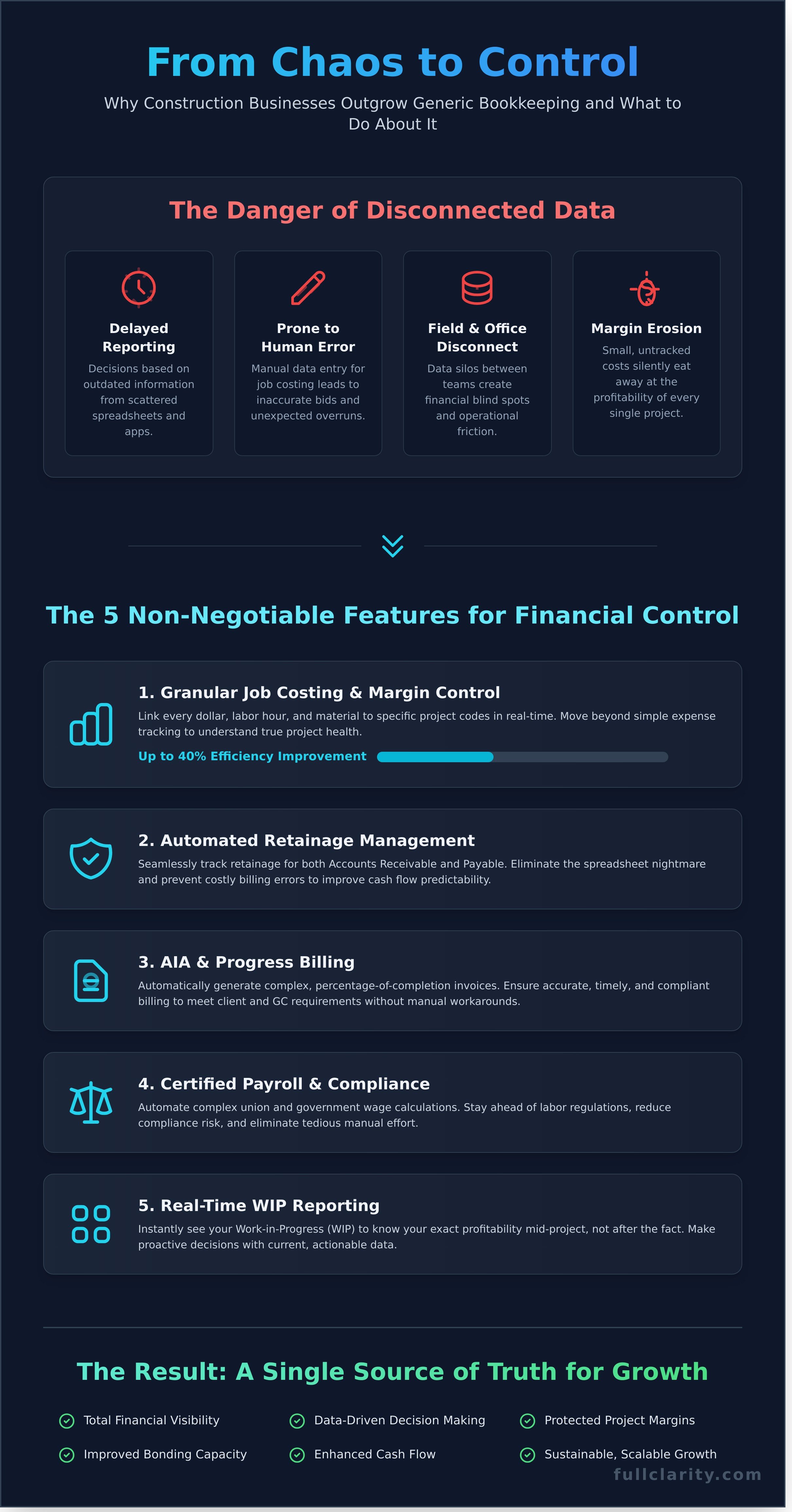
When your team spends more time creating manual workarounds in spreadsheets than executing projects, you've hit the "QuickBooks Wall." This reliance on disconnected data and manual entry is a direct cause of margin erosion, where small, untracked costs silently eat away at profitability. The solution is a unified platform-a single source of truth that connects project management and financial data, providing complete visibility and control.
The Hidden Costs of Manual Spreadsheets
Relying on spreadsheets to bridge the gap between the field and the office creates dangerous financial blind spots. Manual data entry for job costing is not only inefficient but also highly susceptible to human error, leading to inaccurate bids and unexpected cost overruns. This delayed reporting forces project managers to make critical, high-stakes decisions based on outdated information, jeopardizing project timelines and profitability.
Transitioning from "Bookkeeping" to "Financial Management"
Scaling a construction business requires a strategic shift from simple bookkeeping to active financial management. Modern cloud-based ERPs and dedicated construction accounting software for small business are no longer reserved for enterprise-level firms. They provide the real-time visibility needed to protect margins and demonstrate tight financial control, which is essential for securing better bonding capacity and more favorable financing terms for future growth.
5 Essential Features for Construction Accounting Success
Generic accounting software fails to address the unique financial complexities of the construction industry. To protect margins and drive growth, the best construction accounting software for small business must offer more than just a general ledger. It needs a robust, industry-specific feature set built to provide a single source of truth for your entire operation. Look for these five non-negotiable capabilities to gain complete financial control from the job site to the boardroom.
Mastering Job Costing and Margin Control
Job Costing is the heartbeat of construction profitability. While basic software simply tracks expenses, true job costing provides granular visibility by linking every dollar, labor hour, and material unit directly to specific project codes and tasks. This level of detail is fundamental to understanding project health and is a core principle echoed in the official SBA guide to managing business finances. By connecting labor costs to project tasks in real-time, contractors report up to a 40% efficiency improvement, eliminating guesswork and preventing margin erosion before it starts.
Solving the Retainage Accounting Puzzle
Managing retainage-the percentage of payment held back until a project is complete-is a notorious administrative nightmare. Tracking these holdbacks manually in spreadsheets for both Accounts Receivable (money owed to you) and Accounts Payable (money you owe subs) invites costly billing errors. Automated solutions built for the industry, such as Retainage for NetSuite, solve this puzzle by seamlessly managing these balances, ensuring accurate invoicing and dramatically improving cash flow predictability.
Beyond these critical functions, a powerful platform delivers a complete operational toolkit:
- Certified Payroll & Compliance: Automate complex union and government wage calculations to stay ahead of labor regulations without manual effort.
- Real-Time WIP Reporting: Move beyond historical reports. Instantly see your Work-in-Progress (WIP) to know your exact profitability mid-project, not after it's too late.
- Native Cloud Integration: The right construction accounting software for small business provides a unified platform accessible anywhere, ensuring every decision is based on current, accurate data.
QuickBooks vs. Construction ERP: Which is Right for You in 2026?
Many small construction businesses launch with an entry-level tool like QuickBooks. It’s affordable and handles basic bookkeeping well. But as you scale-taking on more complex jobs, hiring more staff, and managing more subcontractors-the limitations of generic software become a significant operational risk. The choice isn't just about today's needs; it's about future-proofing your business for growth and profitability.
The initial low cost of basic accounting software is deceptive. The true Total Cost of Ownership (TCO) quickly escalates as you bolt on separate apps for project management, estimating, and scheduling. This creates "app fatigue" and a web of fragile integrations that can break, leading to data silos and costly errors. A true construction ERP provides these core functions in one robust platform, delivering a lower TCO over five years and a single source of truth for your entire operation.
Scalability: Will You Outgrow Your Software Next Year?
Generic small business software often imposes restrictive user limits and data caps that stifle growth. A truly scalable platform like NetSuite removes these barriers. By adopting a powerful construction accounting software for small business built on a world-class ERP, you invest in a system that grows with you, eliminating the need for disruptive and expensive software migrations in the future.
Integration vs. Native Functionality
Relying on third-party connectors between your project management and accounting systems creates brittle data pathways. When one app updates, the connection can break, leaving your teams working with conflicting information. This is a critical liability, as accurate, real-time data is essential for meeting complex construction accounting industry standards. Solutions "Built on NetSuite" eliminate this risk by providing seamless, native functionality.
When your accounting, job costing, Gantt charts, and document storage all reside in one unified system, you achieve unparalleled visibility and control. Data flows instantly from the field to the back office, empowering you to make decisions with confidence.
Indicators that you're ready to make the switch:
- You manage critical job cost data in disconnected spreadsheets.
- Your project managers and accountants are working from different sets of numbers.
- You cannot get real-time reports on project profitability and cash flow.
- Your team wastes hours manually reconciling data between systems.
Evaluation Checklist: Choosing Your Construction Software
Selecting the right construction accounting software for small business is a strategic decision that directly impacts profitability and scalability. Before you commit, a thorough evaluation is critical. A powerful platform must provide real-time visibility into job costs, streamline field-to-office communication, and simplify complex compliance tasks. Consider the specific demands of your operations, from the volume of change orders you manage to your requirements for certified payroll and union reporting.
Step 1: Audit Your Financial Pain Points
The first step is to look inward. Where is margin erosion happening? Disconnected spreadsheets, delayed field reports, and manual data entry are common culprits. Involve your project managers in this audit-they are on the front lines and can pinpoint where outdated processes are costing you time and money. Based on this feedback, create a clear list of priorities.
- Must-Haves: Real-time job costing, integrated change order management, and robust subcontractor compliance tracking.
- Nice-to-Haves: Advanced mobile capabilities, CRM integration, and detailed equipment management.
Step 2: Vetting the Software Platform
Once your needs are defined, it's time to evaluate vendors. Don’t just look at features; assess the foundation of the technology. Ask vendors about their experience with integrated construction ERP software versus standalone accounting tools. A truly scalable solution is built natively on a robust platform like Oracle NetSuite, creating a "single source of truth" across your entire business. To see how this works in practice, request a NetSuite demo tailored specifically to complex construction workflows.
Finally, confirm the platform can generate the detailed reports your stakeholders-from banks to bonding agents-require. Evaluate the vendor’s implementation support and industry expertise, as this partnership is key to long-term success. Choosing the right construction accounting software for small business is an investment in future growth and operational control. To learn how a unified platform can transform your financial visibility, explore the solutions at fullclarity.com.
FullClarity + NetSuite: The Powerhouse Solution for Growing Contractors
For contractors planning to scale, standard off-the-shelf software eventually hits a ceiling. FullClarity extends the power of Oracle NetSuite, creating a unified, robust platform that grows with you. This combination provides a real-time "single source of truth" across your entire operation-from the job site to the back office-eliminating the data silos and manual entry that lead to costly margin erosion. It’s the ideal construction accounting software for small business owners who have their sights set on mid-market success.
By integrating every financial and project management detail into one system, you gain unparalleled visibility. This allows you to make proactive, data-driven decisions that protect your profitability on every job. FullClarity transforms NetSuite into an end-to-end construction management solution with specialized applications designed for the industry's unique challenges, including:
- Gantt for NetSuite: For intelligent, visual project scheduling and resource management.
- Retainage for NetSuite: To automate and accurately track retainage receivables and payables.
- Certified Documents: To streamline the creation and management of certified payroll and compliance documents.
Construction for NetSuite: A Product Overview
The flagship product, Construction for NetSuite, is an all-in-one solution built natively on the NetSuite platform. Existing clients report up to 40% efficiency improvements by consolidating disparate systems and automating critical workflows. This powerful application simplifies complex processes, from advanced job costing and progress billing to the seamless management of Certified Documents in NetSuite, giving your team the tools to perform at a higher level.
Future-Proofing Your Construction Business
Choosing a solution built on the world’s #1 Cloud ERP means you are investing in a future-proof platform. As your business grows in complexity-taking on larger projects, more employees, and new service lines-your system scales seamlessly with you. FullClarity provides the enterprise-grade power you need to compete and win, without the typical complexity, ensuring your technology is an asset for growth, not a barrier. Ready to build your business on a stronger foundation? Learn more about FullClarity’s construction solutions.
Build Your Future on a Solid Financial Foundation
As this 2026 buyer's guide has demonstrated, selecting the right platform is a critical strategic decision. Generic accounting tools simply cannot handle the complexities of job costing, change orders, and project management, leading to data silos and margin erosion. For ambitious contractors, a true construction accounting software for small business is not a luxury-it is the essential blueprint for scalable growth and profitability.
This is where the FullClarity + NetSuite solution delivers a decisive advantage. Natively built on Oracle NetSuite, it provides the robust, 'single source of truth' that firms like Claremont Homes and Mars Energy Group rely on for complete financial visibility. With clients reporting up to a 40% improvement in operational efficiency, our platform empowers you to protect your profits and manage projects with unparalleled confidence.
Stop letting disparate systems dictate your success. It’s time to build on a foundation of clarity and control. Request a tailored demo of Construction for NetSuite today and discover how to future-proof your business.
Frequently Asked Questions About Construction Accounting Software
Is NetSuite too big for a small construction company?
While NetSuite is a powerful enterprise-level ERP, its scalability makes it a future-proof choice for growing businesses. When tailored with industry-specific solutions built on its platform, NetSuite becomes a perfectly sized, robust system for small construction companies. This approach provides a powerful foundation that you won't outgrow, eliminating the need for costly data migrations down the road as your operations expand and become more complex.
How does construction accounting software help with job costing?
Effective construction accounting software provides a real-time, granular view of project profitability. It allows you to track all costs-including labor, materials, equipment, and subcontractor fees-against specific job codes in your budget. This immediate visibility helps you identify potential cost overruns early, protect your margins, and make more accurate bids on future projects. It transforms job costing from a reactive report into a proactive management tool.
What is the difference between general accounting and construction accounting?
General accounting software focuses on the overall financial health of a business with standard features like accounts payable/receivable and payroll. Construction accounting is project-centric and far more specialized. It includes critical, industry-specific functionalities like detailed job costing, retainage tracking, progress billing (e.g., AIA G702/G703), and management of subcontractor compliance. These tools are essential for managing the unique financial lifecycle of a construction project.
Can I track retainage automatically in my accounting software?
Yes, best-in-class construction accounting platforms feature robust, automated retainage tracking. The software can automatically calculate and withhold the correct retainage percentage on customer invoices and subcontractor bills. It also provides clear visibility into retainage receivables and payables, with alerts for release dates. This automation eliminates manual spreadsheet errors, improves cash flow forecasting, and ensures compliance with contractual obligations without the administrative burden.
How long does it take to implement a construction ERP for a small business?
A typical implementation for a small construction business ranges from 8 to 16 weeks. The exact timeline depends on factors like the complexity of your existing data migration, the number of third-party integrations required, and the level of custom configuration needed for your specific workflows. A well-defined project scope and a dedicated implementation partner are key to ensuring a smooth, efficient transition to your new, powerful system.
Does construction software integrate with project management tools like Gantt charts?
Absolutely. Modern construction accounting software is designed for seamless integration with a wide range of project management tools. Top-tier solutions often have Gantt chart functionality built natively within the platform. This creates a powerful, single source of truth where the project schedule is directly linked to financial data, providing unparalleled visibility into how timeline changes impact the budget and overall project profitability in real-time.
How much does construction accounting software for small businesses cost in 2026?
By 2026, the cost of cloud-based construction accounting software for small businesses will likely follow a subscription model, ranging from $150 to $400 per user, per month. The final investment depends on the required modules (e.g., payroll, inventory), the number of users, and the level of implementation support. While entry-level options may seem cheaper, a truly scalable solution provides a much higher ROI by preventing margin erosion and improving efficiency.