

7 Job Costing Mistakes Eroding Your Construction Profits (and How to Fix Them)
Does winning a major construction bid feel less like a victory and more like a high-stakes gamble on profitability? For many firms, the gap between the initial estimate and the final P&L is a frustrating black box, filled with unexplained cost overruns and shrinking margins. When your accounting and project teams operate from different data sets and unwieldy spreadsheets become the source of truth, it’s the small, undetected errors that cause the most damage. The key to transforming this uncertainty into predictable success lies in avoiding common job costing mistakes that silently sabotage your bottom line.
This article provides the clarity you need to regain financial control. We will expose the seven most critical job costing errors that are eroding your profits and provide proven, actionable strategies to fix them for good. You will discover how to gain real-time visibility into project financials, empower your teams with a single source of truth, and make the data-driven decisions necessary to protect your margins. It's time to build a robust, scalable system that ensures every project is as profitable in reality as it was on paper.
Key Takeaways
- Discover why "experience-based" estimates and manual time tracking are silent profit killers and what data-driven methods you should use instead.
- The key to avoiding common job costing mistakes lies in moving beyond disconnected systems to a single source of truth for real-time financial visibility.
- Learn to accurately identify and allocate the indirect costs-from equipment to supervision-that are often overlooked but significantly impact project profitability.
- Master the process for managing change orders and conducting project post-mortems to stop profit leakage and improve the accuracy of future bids.
Mistake #1: Relying on Inaccurate Estimates and Outdated Data
The financial success of any project is decided long before the first shovel hits the ground. It begins with the initial bid-the foundation upon which profitability is built. Yet, this is precisely where the most damaging errors occur, creating a ripple effect of financial pressure and margin erosion from day one. Relying on outdated data and inaccurate estimates is a critical failure, but a preventable one. Mastering this first step is fundamental to avoiding common job costing mistakes and securing your bottom line.
The 'Guess-timating' Trap
Many seasoned contractors fall into the 'guess-timating' trap, relying on instinct and memory of "similar" past jobs to build a bid. While experience is valuable, it cannot replace granular data. This approach fails to account for today's volatile market realities: rising material costs, fluctuating labor rates, and regional subcontractor availability. The result is a dangerous bidding pattern-underbidding complex jobs that drain resources and overbidding simpler ones that are lost to more precise competitors. Effective Job costing demands precision, not approximation.
The Spreadsheet Illusion
Spreadsheets often provide a false sense of control. In reality, they are static, disconnected, and dangerously prone to hidden formula errors that can derail an entire estimate. This creates data silos where the bid is completely detached from the actual, real-time costs being logged in the field. Worse, a lack of version control means different team members often work from outdated files, leading to decisions based on incorrect numbers. Spreadsheets cannot provide the "single source of truth" required for intelligent, profitable construction management.
An inaccurate bid is more than a simple miscalculation; it's a foundational flaw that guarantees financial strain throughout the project lifecycle. It forces project managers to cut corners, renegotiate with suppliers, and sacrifice quality just to break even. The only way to build winning bids consistently is by leveraging a robust, integrated system that draws on your own historical data and real-time costs. This data-driven approach is the cornerstone of avoiding common job costing mistakes and building a more resilient, profitable business.
Mistake #2: Failing to Track Actual Costs in Real Time
An accurate estimate is a powerful starting point, but it is not a guarantee of profitability. Your project’s financial success is ultimately determined by the variance between your estimate and your actual costs. Relying on month-end accounting reports to understand this variance is one of the most significant yet preventable errors in project management. By the time these reports are generated, it’s too late for proactive course correction. Small budget overruns in labor or materials have already compounded, turning a profitable job into a significant loss.
Without a live view of expenditures, project managers are essentially flying blind. This lack of real-time visibility makes it impossible to control margin erosion as it happens. For any organization serious about avoiding common job costing mistakes, bridging the gap between planned and actual costs with immediate data is a non-negotiable requirement for financial control.
The Lagging Data Problem
The primary culprit behind delayed cost data is manual, fragmented processes. When project managers and accounting teams rely on paper invoices, manual timesheet entry, and disconnected spreadsheets, a significant information lag is created. This delay obscures the true financial health of a project, forcing critical decisions to be made based on data that is weeks, or even a month, out of date. Understanding the fundamentals of cost allocation, as detailed in federal guidelines like the Contract Cost Principles and Procedures, is essential, but that knowledge cannot be applied effectively without timely data.
Symptoms of Poor Actuals Tracking
When you lack a real-time, single source of truth for job costs, the warning signs are often painful and expensive. This operational gap typically manifests in several ways:
- Surprise Invoices: Subcontractor or supplier invoices appear at the end of a project, revealing costs you never accounted for and instantly vaporizing your profit margin.
- Profitability Blindness: When asked, "Are we profitable on this job today?" the only honest answer is, "I don't know." You cannot measure daily progress against the budget.
- Persistent Cash Flow Crunches: The business is busy and projects are underway, yet cash flow remains tight because you are consistently overspending without realizing it until it’s too late.
Mistake #3: Operating with Disconnected Systems and Data Silos
Many growing construction firms operate with a patchwork of disconnected software-one system for estimating, another for accounting, and separate spreadsheets or apps for project management. While this approach may work for a time, it creates dangerous data silos that prevent a unified view of project health. This fragmentation is a primary source of inefficiency and a critical flaw in your financial controls, forcing teams to make high-stakes decisions with incomplete, outdated, or conflicting information.
The most immediate result is a reliance on manual, double-data entry. When a project manager has to re-key progress reports, change orders, or material costs from their system into the accounting software, the process is not just slow-it’s dangerously prone to human error. The core principles of effective construction job costing depend on accurate, real-time data, but this manual workflow guarantees delays and inaccuracies, making it impossible to trust your numbers when you need them most.
The Cost of Disconnected Workflows
This communication breakdown between departments directly erodes your profit margins. When systems don't talk to each other, critical information gets lost in translation, leading to costly overruns and disputes. Key challenges include:
- Lack of Financial Visibility: Project managers in the field can't see the real-time financial impact of their decisions. They're flying blind on labor overages, material cost spikes, and subcontractor billing until it's too late to course-correct.
- Delayed Field Data: The accounting team works with outdated information, unable to see on-the-ground progress, pending change orders, or unexpected expenses. This lag means financial reports reflect history, not the current reality of the project.
Why a 'Single Source of Truth' Matters
Successfully avoiding common job costing mistakes requires a strategic shift to an integrated platform. A unified system creates a robust 'single source of truth,' ensuring every stakeholder-from the CFO to the site supervisor-works from the same up-to-the-minute data. This powerful, seamless connection between field operations and financial outcomes eliminates guesswork and the 'blame game' between departments. It provides the absolute clarity needed to protect your margins and deliver every project profitably.
See how an integrated system creates clarity.
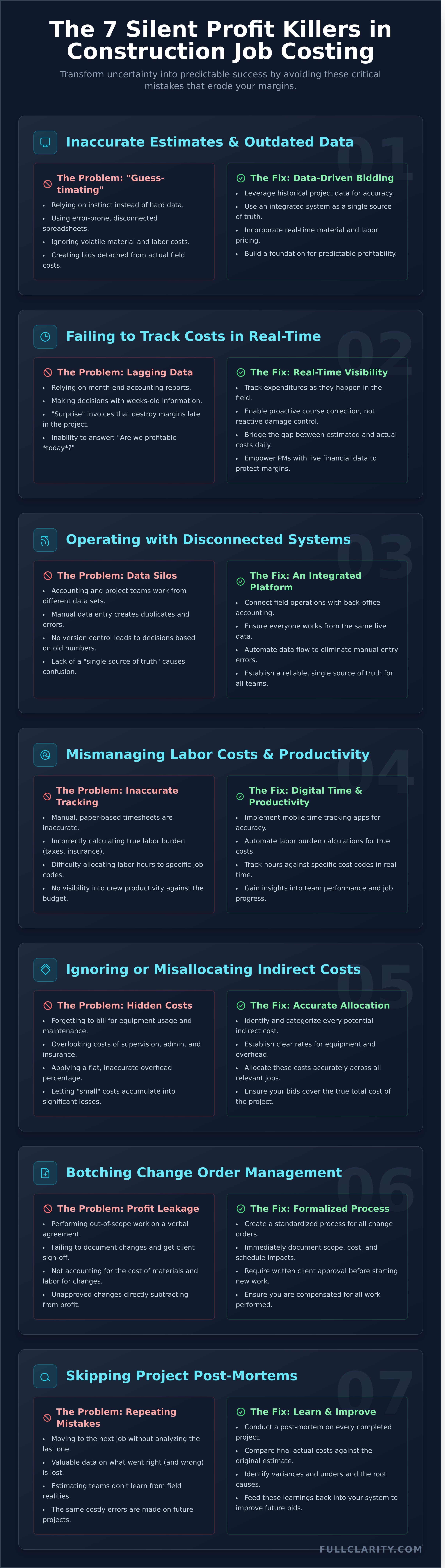
Mistake #4: Mismanaging Labor Costs and Productivity
For most construction and service-based projects, labor is not just a significant expense-it is often the largest and most volatile variable impacting your bottom line. When time tracking is inaccurate or lacks detail, your job cost data is fundamentally flawed. This directly leads to margin erosion and prevents you from understanding true project performance. Effective job costing demands granular labor data, not just a summary of total hours worked.
Simply knowing a crew worked 40 hours is useless for analysis. You need to know they spent 15 hours on framing, 10 on sheathing, and 15 on interior finishing-and how those figures compare to your budget. Failing to capture this level of detail makes productivity analysis impossible, preventing you from identifying and correcting inefficient processes or underperforming crews. A critical step in avoiding common job costing mistakes is to treat labor data with the precision it deserves.
Beyond Simple Time Clocks
Relying on paper timesheets is a direct path to inaccuracy. They are prone to errors, manual entry delays, and are nearly impossible to analyze efficiently. To gain control, you need a system that enables mobile time entry from the field. This ensures hours are logged in real-time and, most importantly, allows employees to link every minute of their work directly to specific project cost codes. This transforms time tracking from a simple payroll function into a powerful job costing tool.
Connecting Productivity to Profit
When you capture detailed, code-specific labor data, you can finally connect field activity to financial outcomes. This allows you to perform powerful budget vs. actual analysis on a task-by-task basis. You can immediately identify which phases of a project consistently go over their labor budget. This data-driven insight is essential for creating more accurate future estimates and is a core strategy for avoiding common job costing mistakes that silently drain profitability over time.
Mistake #5: Ignoring or Improperly Allocating Indirect Costs
True project profitability isn't calculated on materials and direct labor alone. Indirect costs-often called overhead-can significantly erode your margins if they aren't tracked and allocated with precision. Many contractors rely on a generic, flat-percentage markup to cover these expenses, a practice that is notoriously inaccurate.
This guesswork can make you uncompetitive on simpler jobs (where your bid is too high) and dangerously unprofitable on more complex ones (where your bid is too low). A critical step in avoiding common job costing mistakes is gaining granular control over these indirect expenses. A proper job costing system provides the visibility needed to move from estimation to accurate financial data.
Identifying Hidden Project Costs
Failure to track indirect costs understates the true cost of completing a project, turning expected profits into unexpected losses. These costs can be job-specific (direct overhead) or part of general company operations (indirect overhead), but both impact your bottom line. Common examples include:
- Project management and supervision salaries
- Equipment rental, depreciation, and maintenance
- Vehicle usage, fuel, and insurance
- Permits, licenses, and job-specific bonds
- Small tools, safety equipment, and consumables
Methods for Accurate Allocation
Moving beyond a simple percentage markup is essential for financial control. A powerful job costing system allows you to allocate overhead based on specific cost drivers that accurately reflect resource consumption. Instead of applying a blanket 20% overhead, you can assign costs based on direct labor hours, machine usage hours, or material costs. This intelligent approach ensures each project carries its fair share of the burden, giving you a "single source of truth" for job profitability.
Mastering this process is fundamental to avoiding common job costing mistakes and protecting your margins. With a robust, integrated platform from FullClarity, you gain the real-time visibility needed to allocate every dollar accurately and price every job for maximum profitability.
Mistake #6 & #7: Botching Change Order Management and Skipping Post-Mortems
The final hurdles in smart job costing occur during a project's most dynamic phases and after the work is complete. How you manage scope creep and how you learn from performance are what separates truly profitable contractors from those constantly chasing their margins. Mastering these final two areas is mission-critical for avoiding common job costing mistakes and building a resilient, scalable business.
Turning Change Orders into Profit Centers
Unapproved or poorly documented change orders are pure profit killers. A casual "go-ahead" on-site without a formal process can instantly erode your project's profitability. Elite contractors treat every change order not as a hassle, but as a mini-project with its own budget. This requires a robust system to:
- Implement a formal process for every change, no matter the size, ensuring all stakeholders sign off.
- Track all associated costs-labor, materials, and overhead-specifically against that change order for true visibility.
- Generate clear documentation that justifies client billing and protects your bottom line from disputes.
When managed with disciplined processes and the right software, change orders become opportunities for revenue, not sources of unrecoverable loss.
The Power of the Post-Project Review
A project isn’t truly over when the final invoice is paid. Failing to perform a post-mortem, or project review, guarantees that costly errors will be repeated. This is the essential feedback loop that makes your entire operation smarter over time. A powerful post-project review involves a detailed comparison of final actual costs against the original budget, line by line, to analyze what went right and what went wrong. This intelligence is invaluable, allowing you to feed real-world data back into your estimating database. This is the ultimate strategy for avoiding common job costing mistakes on future projects. It transforms your job costing from a simple accounting task into a powerful business intelligence engine. Build a system that learns from every job.
From Margin Erosion to Profit Protection: Your Next Step
The profitability of every construction project hinges on accurate, real-time data. As we've explored, reliance on outdated estimates, operating with disconnected data silos, and failing to track actuals against budget are direct threats to your bottom line. Ultimately, avoiding common job costing mistakes is less about working harder and more about working smarter with a powerful, foundational system.
This is where a truly integrated solution becomes essential. Construction for NetSuite provides the real-time 'single source of truth' needed to eliminate these errors. Natively built on the world's #1 Cloud ERP, Oracle NetSuite, our robust platform is trusted by leading construction firms to eliminate margin erosion and drive predictable growth. Stop letting preventable errors dictate your success.
Ready to take control of your project financials? Request a demo of Construction for NetSuite to eliminate these mistakes for good. Gain the complete visibility you need to build a more profitable future.
Frequently Asked Questions
What's the difference between job costing and process costing?
Job costing tracks all expenses-labor, materials, and overhead-for a single, unique project, such as a commercial building or custom home. This method provides granular financial detail for each job. In contrast, process costing averages expenses over large quantities of identical products, which is common in manufacturing. For construction firms, where every project is different, robust job costing is the only way to accurately measure profitability and maintain control over project financials.
How exactly does construction job costing software improve profit margins?
Intelligent job costing software improves margins by providing real-time visibility into every project's financial health. It allows you to identify budget overruns the moment they occur, not weeks later, enabling proactive decisions that eliminate margin erosion. By analyzing accurate historical data from past jobs, you can create more competitive and profitable bids for future projects. This is a critical strategy for avoiding common job costing mistakes and securing your bottom line.
Can't I just use QuickBooks for my construction job costing?
While QuickBooks is a capable general accounting tool, it lacks the specialized features required for complex construction projects. It cannot natively handle industry-specific needs like retainage, lien waivers, or detailed cost-code tracking without cumbersome and error-prone workarounds. This creates data silos and an inaccurate view of project health. For true financial control and scalability, a dedicated construction accounting solution is essential to manage the industry's unique demands.
What are the first steps to implementing a formal job costing system?
The first step is to establish a standardized list of cost codes that aligns with how you estimate and execute projects. Next, train your entire team, from the field to the office, on how to apply these codes consistently for all labor, material, and equipment costs. Finally, select a powerful, integrated software platform to centralize this data. A solid foundation in process and technology is the key to successfully avoiding common job costing mistakes and gaining financial clarity.
How does an integrated ERP like NetSuite provide a 'single source of truth'?
An integrated ERP like NetSuite creates a 'single source of truth' by unifying all business functions-accounting, project management, and field operations-on one cloud platform. When enhanced with a solution like FullClarity, all data from change orders to labor hours is entered once and is instantly available across the organization. This powerful integration eliminates data silos and ensures every stakeholder is making decisions based on the same complete, accurate, and real-time information.
What is the typical ROI on implementing a construction management solution?
While specific ROI varies, businesses often see significant returns within the first 12-18 months. The value is driven by eliminating redundant data entry, reducing costly budget overruns through real-time tracking, and improving bid accuracy. For instance, a 5-10% reduction in project cost slippage directly translates to a substantial increase in net profit. Many firms report operational efficiency gains of 40% or more, freeing up key personnel to focus on high-value activities.
How does real-time data from the field get into the accounting system?
Real-time data capture is achieved through mobile applications that are seamlessly integrated with your central ERP system. Field personnel can use tablets or smartphones to submit daily reports, log labor hours against specific cost codes, and upload receipts for purchases directly from the job site. Because these apps sync instantly with the accounting platform, project managers and the finance team gain immediate, accurate visibility into field progress and actual costs as they are incurred.