
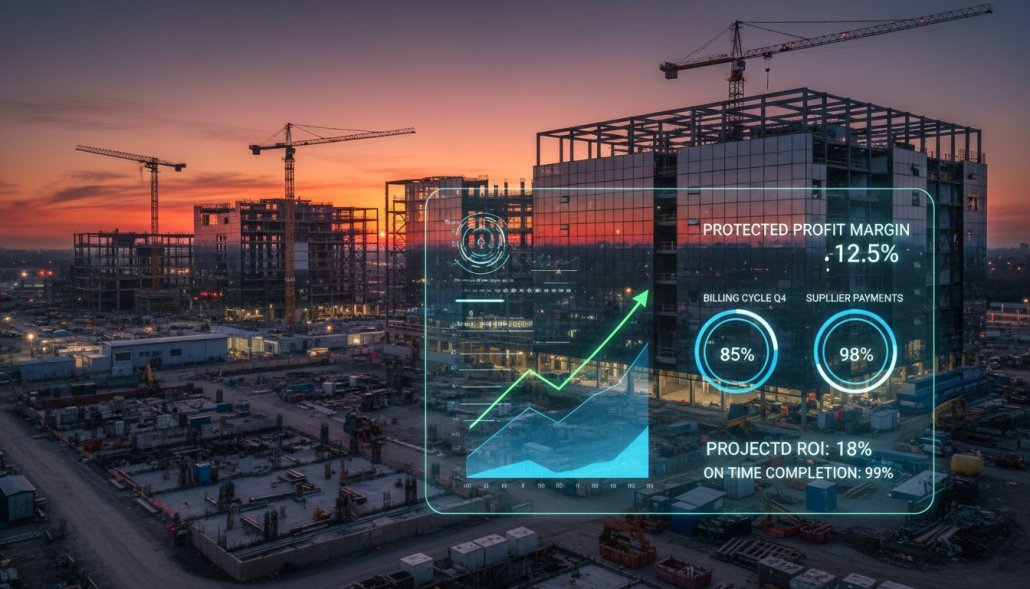
How to Streamline Construction Billing to Protect Project Margins
In the construction industry, profit isn't just made in the field-it's protected in the back office. Yet for many firms, margin erosion is a constant threat, driven by an inefficient billing process that drains cash flow and fuels disputes. When disconnected data between the field and finance leads to manual, error-prone invoicing and compliance headaches, project profitability is put at serious risk. The key to not just surviving but thriving is learning how to streamline construction billing into a powerful, predictable, and scalable operation.
This is about more than just sending invoices faster; it's about re-engineering your financial workflow for maximum efficiency and real-time visibility. In this guide, you will discover actionable strategies and the robust technology framework required to transform your construction billing from a chaotic cost center into a streamlined, profit-driving process. Get ready to accelerate payment cycles, improve invoice accuracy, automate compliance, and gain the financial control needed to protect your margins on every job.
Key Takeaways
- Reframe your billing process as a core financial function, not an administrative task, to directly protect project profitability and improve cash flow.
- Discover why establishing a standardized, repeatable workflow is the non-negotiable first step before implementing any technology solution.
- Learn how to streamline construction billing by moving from disconnected spreadsheets to an integrated platform that provides a single source of truth for all project data.
- Master complex scenarios like retainage, change orders, and AIA billing with a framework that connects field operations directly to your financial system.
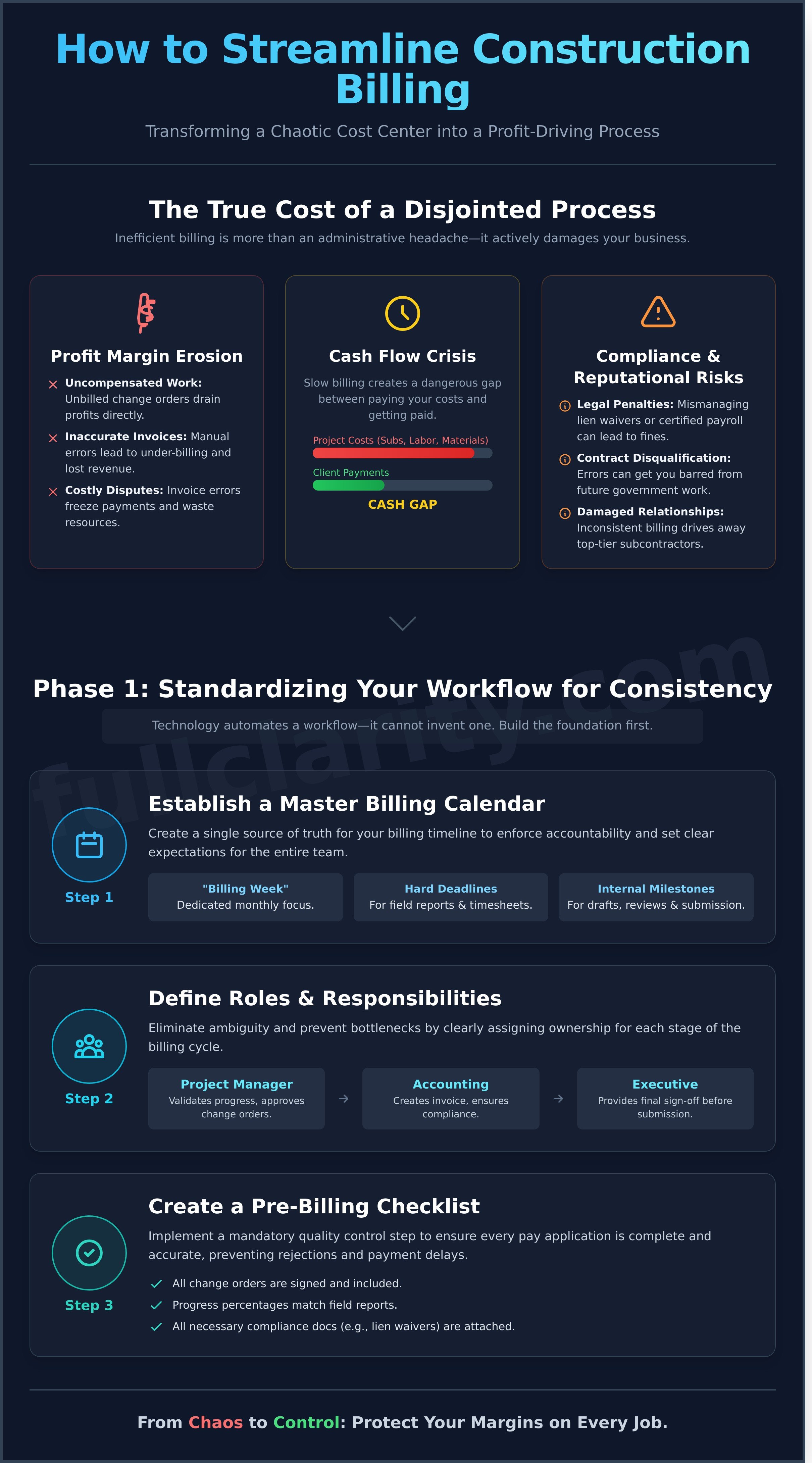
The True Cost of a Disjointed Construction Billing Process
In construction, billing is not just an administrative task-it is the engine that drives your cash flow and a critical financial function. It’s a core component of disciplined Construction accounting, directly governing project viability and profitability. When this process is manual, fragmented, or slow, the consequences extend far beyond delayed payments. The real challenge is understanding how to streamline construction billing to prevent the hidden costs of inefficiency from crippling your business through margin erosion, cash flow crises, and significant compliance risks.
How Inaccurate Billing Erodes Profit Margins
Profit margins are under constant pressure. A disjointed billing process actively erodes them in several key ways:
- Uncompensated Work: Unbilled or improperly documented change orders mean you are funding project changes directly out of your own pocket, performing work for which you are never paid.
- Inaccurate Invoices: Miscalculations in labor hours, material usage, or equipment rates captured on spreadsheets or paper forms inevitably lead to under-billing and permanently lost revenue.
- Costly Disputes: Invoices with errors or insufficient backup documentation invite client disputes, which freeze payments and consume valuable administrative time and resources to resolve.
The Cash Flow Crisis: When Payments Can't Keep Up with Costs
The most immediate impact of a slow billing cycle is a severe cash flow crisis. Contractors often pay subcontractors, labor, and suppliers weeks or even months before receiving payment from the client. A manual, multi-step billing process widens this cash flow gap significantly, forcing you to finance project operations on expensive lines of credit. This dependency on debt not only eats into profits but also limits your capacity to take on new, larger projects, stalling business growth.
Compliance and Reputational Risks
Beyond the balance sheet, billing failures introduce significant compliance and reputational liabilities. Mismanaging lien waivers can lead to legal penalties and jeopardize your right to payment. For public projects, errors in certified payroll reporting can result in hefty fines and disqualification from future government contracts. Furthermore, a reputation for slow or difficult billing processes strains relationships with your best subcontractors, making it harder to secure top talent for future jobs.
Phase 1: Standardizing Your Billing Workflow for Consistency
Before any software can deliver powerful efficiency gains, you must first build a robust, repeatable process. Technology automates a workflow; it cannot invent one. The foundational step in learning how to streamline construction billing is to eliminate inconsistency and create a predictable, scalable system that your entire team understands and follows. This standardization is the bedrock of financial control and improved cash flow, transforming chaotic monthly scrambles into a smooth, results-oriented cycle.
Establishing a Master Billing Calendar
Create a single source of truth for your billing timeline. A master calendar enforces accountability and sets clear expectations. Designate a specific "billing week" each month where all key personnel are focused on the task. This calendar should include non-negotiable deadlines for submitting critical data like field reports, timesheets, and expense receipts, as well as internal milestones for first drafts, project manager reviews, and final invoice submission to the client.
Defining Roles: Who Owns Each Step of the Process?
Ambiguity is the enemy of efficiency. Clearly define who is responsible for each component of the billing cycle to prevent bottlenecks. The Project Manager typically owns the validation of progress, approving percent-complete figures, and signing off on all change orders. The Accounting or Project Controls team then takes this validated data to create the formal invoice, ensure compliance, and manage supporting documentation. A formal approval workflow-from PM to executive sign-off-ensures every invoice is accurate before it reaches the client.
Creating a Pre-Billing Checklist
A pre-billing checklist ensures no critical component is missed, preventing rejections and payment delays. This quality control step is essential for any contractor seeking to master how to streamline construction billing. Your checklist should mandate that every pay application includes all necessary documentation. This mirrors the rigorous standards seen in federal projects, where guidelines for Progress payments under construction contracts are strictly defined. Your list must include:
- Essential Documents: All fully executed change orders, subcontractor invoices for the period, and required lien waivers.
- Cost Verification: A step to cross-check all submitted costs against the project budget and Schedule of Values to protect your margins.
- Compliance Forms: Correctly prepared and updated forms, such as the AIA G702/G703, ready for submission.
Phase 2: Leveraging Technology for a Single Source of Truth
While refining internal processes is a critical first step, true efficiency gains are unlocked by technology. Many construction firms still operate with a patchwork of disconnected tools-spreadsheets for job costing, generic accounting software for payables, and email for change order approvals. This fragmented approach creates data silos, invites manual errors, and slows the entire billing cycle. The ultimate goal for any firm wondering how to streamline construction billing is to establish a real-time, single source of truth for all project information.
The Limits of Spreadsheets and Standalone Invoicing Tools
Relying on spreadsheets for critical financial data is a high-stakes gamble. A single formula error or outdated version can lead to inaccurate bids and invoices, directly causing margin erosion. Generic invoicing tools fail to manage construction-specific complexities like retainage, AIA billing, and change orders, forcing teams into time-consuming manual workarounds and double-entry between disconnected systems.
The Power of an ERP Built for Construction
A construction-specific Enterprise Resource Planning (ERP) system acts as the central nervous system for your entire operation. It breaks down data silos by seamlessly integrating job costing, accounting, and project management into one robust platform. As detailed in Construction Executive's Definitive Guide on Accounting for Construction Companies, managing project-based financials requires a specialized approach. An ERP provides this by ensuring data entered once-like a signed change order or a subcontractor invoice-automatically flows to every relevant area, from the project budget to the next pay application. This visibility is fundamental to accelerating payment cycles.
Moving Billing into the Cloud
Modernizing your technology stack means moving to the cloud. A cloud-based ERP provides secure, real-time access to project data from any device, anywhere. This empowers field teams to submit daily reports and change orders that are instantly visible to the office, eliminating information lag. Platforms natively built on best-in-class systems like NetSuite offer unparalleled scalability and security, ensuring your technology can grow with your business. By connecting every stakeholder, you eliminate delays and gain complete control over your cash flow. See how an integrated system provides a single source of truth.
Advanced Strategies for Complex Construction Billing Scenarios
Standard invoicing is challenging enough, but the true test of a firm’s financial process lies in managing complex, high-friction scenarios. Progress billings, change orders, and retainage are notorious for causing delays, disputes, and margin erosion. The most effective way how to streamline construction billing in these situations is to move beyond disconnected spreadsheets and implement a unified platform where project operations and financial data live in a single source of truth.
Automating Progress Billings and Schedules of Values (SOV)
Manually updating a Schedule of Values is a tedious, error-prone process that slows down your entire payment cycle. A robust, integrated system eliminates this bottleneck by allowing project completion percentages to flow directly from the field to the financial backend. This enables the automatic generation of accurate, AIA-style invoices (G702/G703) that reflect real-time project status, dramatically reducing calculation errors and accelerating client approval.
Seamlessly Integrating Change Order Management
Unbilled change orders are a primary source of revenue leakage in construction. When a change order is approved in a separate system-or worse, via email-it often fails to make it onto the next invoice. A seamless workflow ensures that once a change order is approved, it automatically becomes a billable line item in your system. This guarantees that all approved work is invoiced promptly, protecting project margins and ensuring you get paid for every bit of value you deliver.
Simplifying Retainage and Lien Waiver Management
Tracking retainage and managing lien waivers manually is an administrative nightmare that introduces significant compliance risk. Modern construction software transforms this process by automating retainage tracking and linking lien waiver collection directly to subcontractor payments. This intelligent automation provides powerful advantages:
- Error-Free Calculations: Retainage is calculated automatically based on contract terms, eliminating costly manual mistakes.
- Enhanced Compliance: The system can prevent payment release until a valid lien waiver has been received and verified.
- Complete Visibility: Gain a real-time, portfolio-wide view of all retainage held and owed, improving financial forecasting.
Ultimately, knowing how to streamline construction billing for these complex tasks comes down to creating a powerful, unified environment for your data. By connecting the field to the office, you gain the visibility and control needed to protect your cash flow and drive profitability. Discover how a solution built natively on a robust ERP can deliver this level of efficiency.
The FullClarity Advantage: Streamlined Billing Natively in NetSuite
The strategies for improving your billing cycle aren't just theoretical-they are the built-in reality of a truly unified platform. FullClarity's Construction for NetSuite provides the definitive answer to the question of how to streamline construction billing by eliminating the root causes of delay and inaccuracy: data silos and manual processes. Instead of patching together disparate systems, you can manage your entire project lifecycle within the world's #1 Cloud ERP.
Eliminate Double-Entry with a Unified Platform
Unlike standalone project management tools that require clumsy, breakable integrations, our solution is built on the NetSuite platform. This means your project accounting, job costing, commitments, and billing all operate from the same robust database. There is no duplicate data entry, no reconciliation headaches, and no version control issues. It establishes a powerful, real-time 'single source of truth' across your entire organization, from the field to the back office.
Achieve Real-Time Job Costing for Pinpoint Accurate Invoices
This unified data model is the key to protecting your profitability. When job costs-from labor hours to subcontractor invoices-are captured in real-time within your ERP, they are immediately visible and ready for billing. You can generate progress billings or AIA-style invoices with absolute confidence, knowing every single billable item is accounted for. This proactive visibility eliminates margin erosion caused by missed costs and empowers you to manage project financials with pinpoint accuracy.
From Invoice to Insight: Gaining Full Financial Visibility
True financial control extends beyond just sending an invoice. Because FullClarity + NetSuite operates as one seamless system, your billing data instantly updates your company's core financial statements. CFOs and project executives gain unprecedented, up-to-the-minute visibility into cash flow, profitability, and Work-in-Progress (WIP) reports. This is how you move from reactive problem-solving to proactive, data-driven strategy. It’s time to take complete control of your project financials. Request a demo to see streamlined billing in action.
Gain Control and Protect Margins with Streamlined Billing
In today's competitive landscape, a disjointed billing process is more than an inconvenience-it's a direct threat to your project margins. The path to profitability involves standardizing your workflows and adopting technology for a single source of truth. This strategic approach is the definitive answer to how to streamline construction billing, replacing manual errors and data silos with efficiency and financial control.
This is precisely the advantage offered by FullClarity. Natively built on the Oracle NetSuite platform, our robust solution eliminates margin erosion by providing real-time job costing and total financial visibility. Trusted by leading construction firms, FullClarity transforms your billing process from a liability into a strategic asset, ensuring you get paid faster and protect your hard-earned profits on every project.
Discover the power of a single source of truth for your projects. Learn more about FullClarity.
Take the final step toward securing your financial future and driving predictable growth.
Frequently Asked Questions
What is the difference between construction accounting software and generic software like QuickBooks?
Generic software like QuickBooks handles basic bookkeeping but lacks the robust, industry-specific functionality required for construction. It cannot manage complex job costing, retainage, or specialized compliance documents like AIA forms and lien waivers. Purpose-built construction accounting software provides a single source of truth, integrating project management and financial data for complete visibility. This prevents data silos and costly manual workarounds that erode project margins and hinder accurate financial forecasting.
How does billing software help manage AIA G702 and G703 forms?
Intelligent construction billing software automates the creation of AIA G702 and G703 forms, eliminating manual data entry and calculation errors. The system seamlessly pulls data directly from your project's schedule of values, approved change orders, and stored retainage to populate the forms accurately. This powerful automation not only accelerates the payment application process but also ensures compliance and professionalism, helping you get paid faster and maintain positive client relationships.
What is the best way to ensure all change orders are included in the next invoice?
The most effective method is using an integrated construction management platform where change orders are managed within the same system as your accounting. When a change order is approved, it automatically becomes available for inclusion in the next billing cycle. This creates a real-time, single source of truth that eliminates the risk of forgotten work and revenue leakage. Centralizing this process ensures every billable item is captured, protecting your project margins and financial health.
How can I automate the process of collecting lien waivers from subcontractors before paying them?
A robust construction ERP system can fully automate lien waiver collection. You can establish workflows that make payment releases conditional upon the receipt of a signed lien waiver. The system can automatically send waiver requests to subcontractors, track their status in real-time, and prevent payments from being issued until the required documentation is uploaded and approved. This powerful feature significantly reduces administrative burden and mitigates the financial risk associated with non-compliance.
Can a streamlined billing process really improve my company's cash flow?
Absolutely. Learning how to streamline construction billing directly accelerates your payment cycle, which is the key to improving cash flow. By automating invoice creation, eliminating errors, and simplifying the submission of progress billings and change orders, you reduce client disputes and approval delays. This efficiency means invoices go out faster and get paid sooner. A streamlined process transforms billing from a bottleneck into a powerful engine for financial stability and growth.
What does it mean for a construction application to be 'natively built' on NetSuite?
When an application is 'natively built' on NetSuite, it means it was developed within the NetSuite platform itself, sharing the same database, user interface, and security protocols. It is not a separate piece of software connected by a fragile integration. This native architecture provides a true single source of truth with real-time data flow between your financials and operations. This results in a more robust, scalable, and future-proof solution that eliminates data sync errors and provides unparalleled visibility.