

The Real Cost of Chaos: 7 Challenges of Disconnected Construction Software
In construction, chaos is expensive. It's the cost of rework from miscommunication, the budget overruns from outdated job cost reports, and the countless hours your team wastes on manual data entry. These aren't isolated incidents; they are the direct result of the fundamental challenges with disconnected construction software. When your accounting, project management, and field operations platforms don't communicate seamlessly, you're left making high-stakes decisions with incomplete data, creating blind spots that erode margins and derail timelines.
This article uncovers the real cost of that chaos. We will break down the seven most significant financial and operational risks of a fragmented tech stack. You will discover how these issues directly impact your bottom line and learn how a truly integrated platform can eliminate them. By achieving a 'single source of truth' for all project information, you can gain real-time visibility, restore control, and drive powerful, predictable profitability from the field to the back office.
Key Takeaways
- Learn to identify the hidden financial leaks, like margin erosion and inaccurate job costing, that quietly drain your project profitability.
- Understand how the core challenges with disconnected construction software create costly communication breakdowns between the field and the office.
- Discover why poor data integrity from separate systems weakens strategic decision-making and puts your company’s long-term scalability at risk.
- Explore the framework for creating a "single source of truth" to eliminate data chaos, restore operational control, and drive predictable project outcomes.
The Financial Black Hole: How Disconnected Systems Destroy Profitability
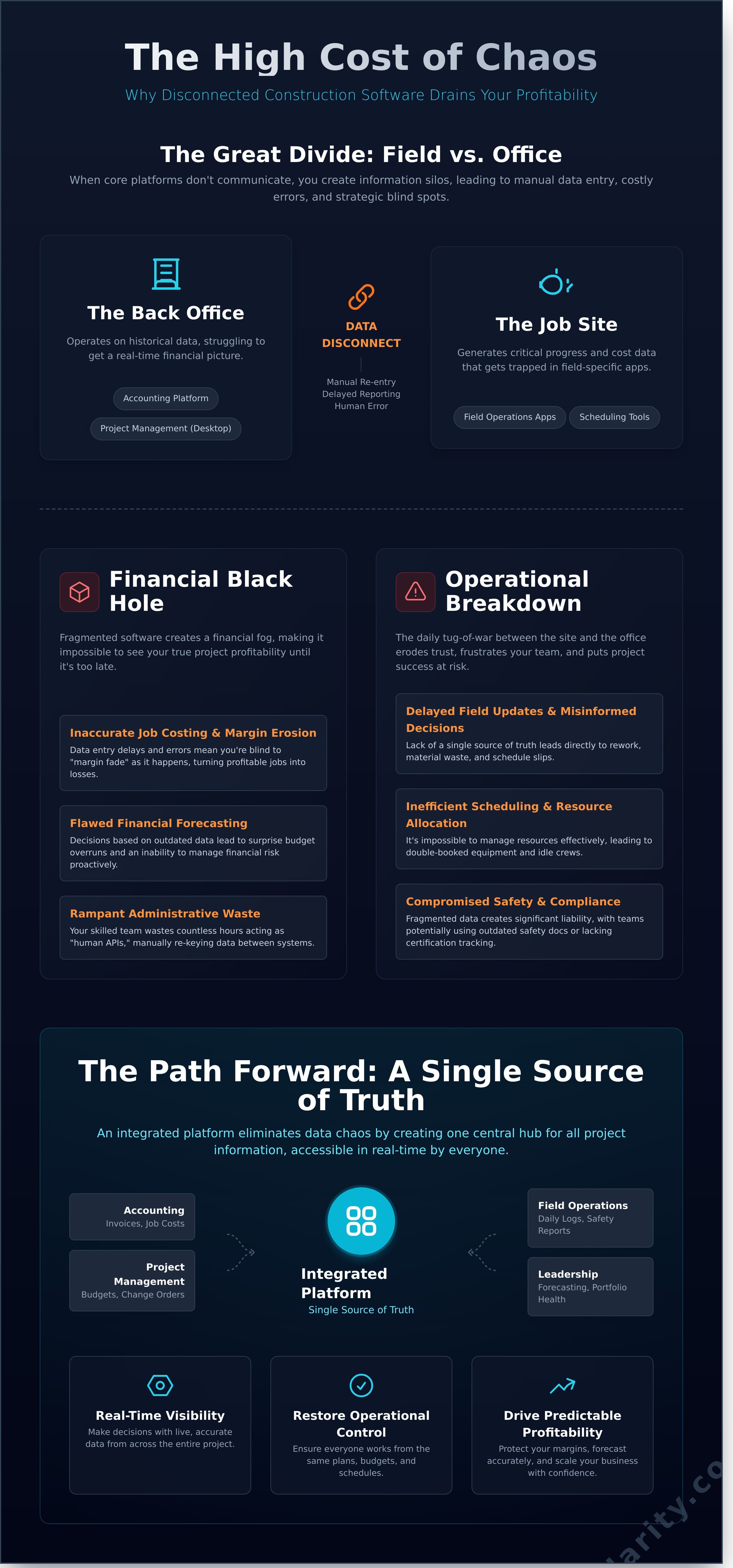
For construction CFOs and owners, profitability isn't just a goal-it's the measure of survival. Yet, many firms operate with a significant, often invisible, drain on their bottom line. The source? A fragmented collection of software that fails to communicate. Managing project financials with separate tools for accounting, field operations, and project management is like trying to balance a checkbook using three different, unsynchronized ledgers. This creates a constant state of financial uncertainty, where critical decisions are based on delayed, incomplete, or inaccurate data. These are the core challenges with disconnected construction software: they create a financial black hole that silently erodes your margins.
Inaccurate Job Costing and Real-Time Margin Erosion
When field data from a mobile app must be manually re-entered into your accounting system, the door opens wide for costly errors. A single typo or a week-long delay in reporting labor and material costs can completely distort a project's financial reality. This lag means you are blind to margin fade as it happens. By the time the true costs are reflected in a profitability report, it is far too late to make corrective decisions, turning what looked like a profitable job into a loss.
Flawed Financial Forecasting and Budget Overruns
Effective financial management requires foresight, but disconnected systems force you to manage by looking in the rearview mirror. When your leadership team makes strategic decisions based on last week's-or last month's-data, you are perpetually reacting instead of planning. This chronic delay in visibility makes it nearly impossible to project cost-to-complete figures accurately, leading directly to surprise budget overruns, unexpected cash flow crises, and an inability to proactively manage financial risk across your portfolio.
Rampant Administrative Waste and Duplicate Data Entry
Your skilled team members are forced to act as "human APIs," wasting valuable hours manually bridging the gap between systems. Every piece of data that is entered more than once represents a direct, measurable hit to your overhead. This operational drag stems from each department working within its own information silo, a structure that inherently breeds inefficiency. Consider the real costs of this waste:
- Time Theft: Staff hours lost re-keying payroll, purchase orders, invoices, and change orders.
- License Bloat: Paying for multiple software licenses with redundant, overlapping features.
- Opportunity Cost: Project managers bogged down in administrative tasks instead of managing job sites and clients.
On-Site vs. Office: The Operational Communication Breakdown
Beyond the balance sheet, the most immediate damage from disconnected software occurs in the daily tug-of-war between the job site and the back office. When a Project Manager’s reality on the ground doesn’t match the Accountant’s data in the financial system, trust erodes, and costly mistakes become inevitable. These operational challenges with disconnected construction software create a constant state of internal friction, frustrating your best people and putting project success at risk by undermining the very collaboration required to build effectively.
Delayed Field Updates and Misinformed Decisions
Imagine a superintendent approves a crucial change order in a field app. Thirty minutes later, the Project Manager, working from a separate accounting system, denies a material purchase because it exceeds the now-outdated budget. This lack of a single source of truth leads directly to:
- Costly Rework: Crews building from old plans because updates haven't synced.
- Material Waste: Ordering incorrect quantities based on incomplete data.
- Schedule Slips: Delays caused by waiting for information to be manually reconciled.
Inefficient Scheduling and Resource Allocation
Operational chaos intensifies when scheduling tools don't sync with real-time progress reports and equipment logs. This gap in visibility makes it impossible to manage resources effectively, leading to double-booked excavators or idle crews waiting for materials that were never confirmed. A single delay has a ripple effect, pushing back every subsequent trade and putting your team in jeopardy of missing deadlines and incurring liquidated damages.
Compromised Safety and Compliance Reporting
Perhaps the most severe risks stem from fragmented safety and compliance data. Field teams may unknowingly access outdated safety documents from a local tablet, while the back office struggles to track worker certifications stored in a separate HR system. This data fragmentation isn't just inefficient; it's a significant liability. In fact, annual reports on construction technology trends consistently show that a lack of application integration is a primary source of risk, making it nearly impossible to compile accurate compliance reports without tedious, error-prone manual effort.
The Domino Effect: How Poor Data Integrity Weakens Your Business
The daily frustrations of manual data entry and inaccurate reports are just the beginning. The most severe challenges with disconnected construction software are not isolated project issues; they are foundational business problems that create a domino effect, weakening your company from the inside out. A single incorrect cost code or a delayed change order doesn't just impact one job-it erodes trust, damages client relationships, and puts a hard ceiling on your company's growth potential.
The Absence of a 'Single Source of Truth'
A ‘single source of truth’ is a powerful business concept where all data, from finance to field operations, is housed in one unified system. Without it, you get meetings where teams argue over whose spreadsheet is correct. This constant conflict wastes countless hours on reconciliation instead of strategy. More critically, it destroys confidence. When leadership cannot trust the data, every decision becomes a gamble, and when teams cannot trust leadership's numbers, the entire operational structure begins to fray.
Impaired Client Relationships and Billing Disputes
Internal data chaos inevitably spills over into client interactions. When job costing data is fragmented, invoices become suspect. A lack of transparent, real-time reporting on budgets, change orders, and progress payments leads directly to billing disputes and delayed payments. This not only strains cash flow but also damages your reputation for professionalism and integrity. In an industry built on trust, these preventable errors can be fatal to securing repeat business and valuable referrals.
Stifled Scalability and Future Growth
Your patchwork of disconnected systems may be holding you together now, but it will break under the strain of expansion. You cannot scale a business on manual processes and data reconciliation. Without a robust, integrated platform, your teams lack the historical performance data needed to confidently bid on larger, more complex jobs. Your growth goals remain out of reach, not because of a lack of ambition, but because your technology infrastructure is a direct barrier to achieving them.
Overcoming these strategic challenges requires moving from fragmented applications to a powerful, unified platform. See how an integrated solution built on NetSuite can provide the visibility and control needed to future-proof your business.
The Path Forward: From Data Chaos to a Single Source of Truth
Understanding the costs of a fragmented tech stack is the first step. The next is architecting a solution that eliminates them permanently. The answer isn’t more apps or fragile connectors; it’s a fundamental shift to a unified construction platform that provides a real-time, single source of truth for your entire operation. This approach moves beyond simply linking software and instead builds your entire workflow on a single, powerful data core, resolving the core challenges with disconnected construction software from the foundation up.
What is a Natively Integrated Platform?
Many vendors claim integration, but they rely on brittle API connections that can break, lag, or require constant maintenance. A natively integrated platform is different. Think of it like a custom-built house, where the electrical, plumbing, and structure are designed to work together seamlessly from day one. In contrast, API-based systems are like a modular home-separate pieces bolted together, where the seams always present a point of failure. A native system provides a consistent user interface and ensures data flows instantly and accurately across all functions.
Core Benefits of Unifying Your Tech Stack
By moving to a single, robust platform, construction firms unlock transformative business outcomes. The primary benefit is the elimination of data silos, which directly leads to:
- Real-Time Visibility: Instantly see how field progress impacts project financials, with job costing data that is always current.
- Improved Data Accuracy: Eradicate errors from manual data entry and redundant work, ensuring every decision is based on reliable information.
- Reduced Administrative Overhead: Automate workflows between accounting, project management, and field teams, freeing up resources for high-value tasks.
- Enhanced Collaboration: When everyone from the CFO to the site supervisor works from the same data, accountability is clear and collaboration becomes effortless.
The Power of a Foundation: NetSuite + FullClarity
The most powerful solutions are built on a world-class foundation. FullClarity is built natively on NetSuite, the world’s #1 Cloud ERP. This unique combination provides the best of both worlds: the robust, scalable financial power of a best-in-class ERP and the project management functionality tailored specifically for the construction industry. This is how you solve the deep-rooted challenges with disconnected construction software-not with a temporary patch, but with a future-proof platform designed for growth and profitability.
Ready to end the data chaos? See how an integrated solution works.
Eliminate Chaos, Build with Confidence
The real cost of running your business on a patchwork of systems is clear: crippling margin erosion, critical communication breakdowns between the office and the field, and compromised data integrity. These are not just minor inconveniences; they are the fundamental challenges with disconnected construction software that directly threaten your profitability and project success.
The path forward is to consolidate these fragments into a single source of truth. FullClarity provides this clarity. Built natively on the Oracle NetSuite platform, our robust solution is trusted by construction firms to eliminate margin erosion with powerful, real-time job costing. Gain complete visibility and control over every project, from bid to closeout, and turn data chaos into a competitive advantage.
Stop letting fragmented systems dictate your success. It's time to build with confidence and control. Tired of managing chaos? Schedule a demo to see a single source of truth in action.
Frequently Asked Questions
What is the difference between 'integrated software' and an 'all-in-one' system?
An 'all-in-one' system is a single software package attempting to do everything, often resulting in weaker functionality in key areas. An integrated platform, like FullClarity for NetSuite, connects powerful, specialized applications to a central ERP. This approach creates a seamless, robust 'single source of truth' without compromising on best-in-class features for finance, project management, and operations. It offers greater flexibility and scalability than a rigid, closed system.
Our teams use specialized software they love. Do we have to give that up?
Not always. A powerful, integrated platform built on NetSuite is designed for flexibility. While our native solutions offer deep, seamless functionality, the core goal is to create a central data hub. We can often integrate with existing applications your teams already master, ensuring they remain efficient. This connects their valuable work back to your financial core, providing complete project visibility without disrupting proven workflows or forcing unnecessary change.
How can we justify the cost of switching to a new construction ERP system?
The justification lies in calculating the total cost of your current disconnected systems. Consider the hours lost to manual data entry, the financial impact of decisions made on outdated information, and the direct cost of margin erosion from project delays. An integrated ERP like FullClarity for NetSuite provides a clear ROI by automating processes, providing real-time job costing visibility, and empowering your team to protect profitability. It's an investment in future-proof efficiency.
What does the implementation process for an integrated platform look like?
Our implementation is a structured, collaborative process designed to minimize disruption and maximize value. It begins with a deep discovery phase to understand your unique workflows. We then configure the platform, migrate your critical data, and conduct comprehensive team training. Our expert team provides dedicated support through the go-live phase and beyond, ensuring a smooth transition to a powerful, unified system that delivers immediate results and scales with your business growth.
How does a system like FullClarity for NetSuite handle construction-specific needs like retainage?
FullClarity for NetSuite is purpose-built for construction, so complex requirements like retainage are handled natively. Our system automates retainage calculations on both payables and receivables, tracks release schedules, and provides clear visibility in financial reports. This eliminates risky manual tracking in spreadsheets and ensures compliance. It’s not an add-on or a workaround; it's a core, robust feature designed to manage construction financials with precision and control.
Isn't it safer to use 'best-of-breed' software for each function?
While 'best-of-breed' tools offer deep functionality, using them in isolation creates the very data silos that lead to costly errors. The primary challenges with disconnected construction software stem from this lack of a 'single source of truth.' A truly integrated platform like FullClarity, built on NetSuite, combines a best-in-class ERP core with powerful, construction-specific functionality. This gives you a superior, connected solution that eliminates risk and provides unparalleled business visibility.