

Moving from QuickBooks to NetSuite for Construction: A Strategic Guide
Are you wrestling with inaccurate job costing, relying on a patchwork of spreadsheets to track profitability? If the manual management of retainage and lien waivers is causing costly errors and your financial and project data live in disconnected silos, you're not just facing inefficiency-you're facing significant risk to your margins. These operational cracks are the critical signs that your firm has outgrown its current system. For growing companies, making the decision of moving from QuickBooks to NetSuite for construction is the definitive step toward gaining powerful financial control and real-time visibility.
This strategic guide is designed to provide clarity on that crucial transition. We will explore the tell-tale signs that QuickBooks is limiting your potential and demonstrate how a robust ERP platform-NetSuite, enhanced by FullClarity-creates a single source of truth for your entire operation. Prepare to learn how you can automate complex construction accounting, gain instant insight into project health, and implement a truly scalable system that is built to support your future growth, not hinder it.
Key Takeaways
- Learn to identify the critical warning signs-like margin erosion and a lack of project visibility-that signal your construction firm has outgrown QuickBooks' capabilities.
- Understand how NetSuite provides a scalable ERP foundation, while FullClarity's 'Built on NetSuite' solution adds the essential, industry-specific functions you require.
- Successful moving from QuickBooks to NetSuite for construction is a business transformation project; discover a phased roadmap to ensure a smooth transition and maximize value.
- Reframe the investment by calculating the true ROI, focusing on gains in operational efficiency and improved project profitability, not just software license fees.
Why Construction Firms Hit a Wall with QuickBooks: The Warning Signs
Your construction firm is growing-that's the goal. But the accounting software that got you here is now holding you back. QuickBooks is an excellent tool for basic bookkeeping, but it was never designed to manage the immense complexity of the construction industry. As you take on larger projects and expand your operations, you begin patching the gaps with manual spreadsheets, creating dangerous data silos and increasing the risk of costly errors.
Recognizing these operational bottlenecks is the first critical step toward protecting your margins. For many firms, these challenges are the primary drivers for moving from QuickBooks to NetSuite for construction, a platform built to handle industry-specific demands from the ground up.
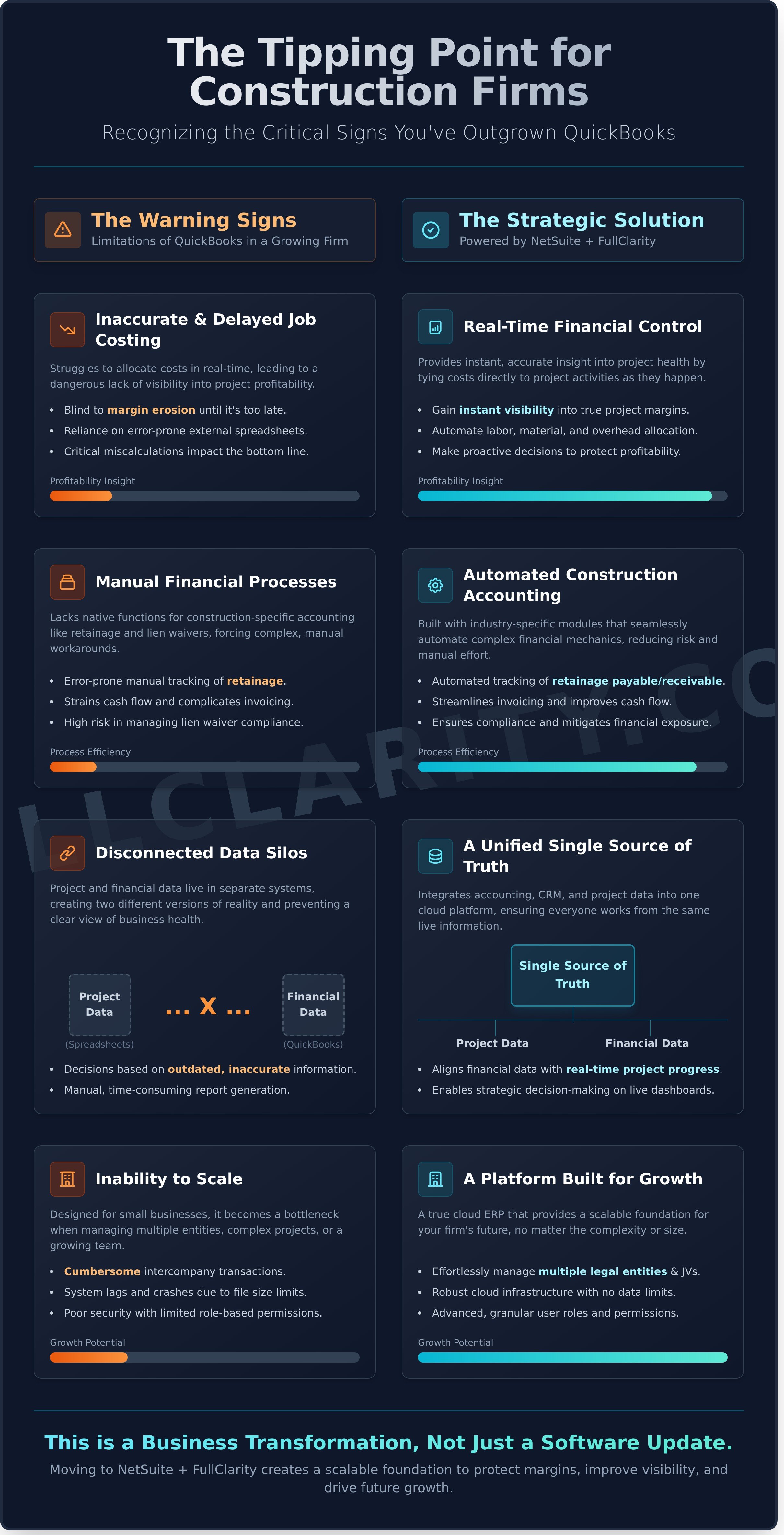
Inaccurate and Delayed Job Costing
Effective job costing is the lifeblood of a profitable construction business. QuickBooks struggles to allocate labor, materials, and overhead costs accurately across multiple complex jobs in real-time. This lack of immediate visibility means you are effectively blind to margin erosion until it's too late. Relying on external spreadsheets to track costs-to-complete is not just inefficient; it’s a recipe for critical miscalculations that directly impact your bottom line.
Manual Management of Retainage and Lien Waivers
The unique financial mechanics of the construction industry, such as retainage, are completely foreign to generic accounting software. QuickBooks has no native functionality for tracking retainage payable or receivable, forcing your team into manual, error-prone workarounds. This complicates invoicing, strains cash flow, and makes compliance a constant challenge. The complexities of construction accounting demand a system that manages these processes seamlessly, including the high-risk task of tracking lien waivers to ensure compliance and mitigate financial exposure.
Disconnected Project and Financial Data
When project managers work in spreadsheets and the accounting team works in QuickBooks, you have two different versions of reality. Generating a consolidated report on project financial health becomes a weekly, manual chore of stitching together disparate data. This fundamental disconnect prevents you from achieving a real-time, single source of truth. As a result, strategic decisions are based on outdated, incomplete, and often inaccurate information.
Inability to Scale with Multiple Entities or Complex Projects
As your firm grows, so do your structural needs. Managing intercompany transactions, multiple legal entities, or complex joint ventures is extraordinarily cumbersome in QuickBooks. The software's inherent limitations on data file size can severely hinder performance, causing system lags and crashes. Furthermore, its lack of robust, role-based user permissions creates significant security and internal control issues as more employees need access to financial data.
NetSuite's Core Platform Advantages for Construction
While QuickBooks is an effective tool for basic bookkeeping, growing construction firms eventually hit a hard ceiling. The leap to a true cloud ERP is about shifting from simply tracking transactions to strategically managing your entire business operation. Before layering on industry-specific modules, it's crucial to understand the foundational power NetSuite provides. The core platform itself is the primary reason why moving from QuickBooks to NetSuite for construction delivers such a transformative impact on visibility, control, and future growth potential.
A Unified 'Single Source of Truth'
NetSuite dismantles the dangerous information silos that plague firms running on disconnected software. It seamlessly integrates accounting, CRM, and critical project data into one robust cloud platform, creating the real-time ‘single source of truth’ your leadership team needs. This unified view eliminates the disconnect between the back office and the field, ensuring financial data aligns perfectly with project progress. Decisions are no longer based on outdated spreadsheets, but on accurate, live dashboards accessible to every stakeholder.
Robust Financial Controls and Audit Trails
As your projects grow in complexity, so does your financial risk. NetSuite provides the sophisticated command required to protect your margins and ensure compliance. Unlike the limited controls in basic accounting software, NetSuite offers powerful, granular governance over your data. This includes:
- Advanced user roles and permissions to ensure team members only access the specific data relevant to their job, from project managers to estimators.
- Detailed, un-editable audit trails that track every single transaction and system change, providing complete accountability for audits.
- Sophisticated revenue recognition capabilities to accurately manage complex, long-term contracts and maintain ASC 606 compliance.
Unmatched Scalability for Growth
A key driver for successful construction firms is planning for the future, and your software should never be a limiting factor. The decision for moving from QuickBooks to NetSuite for construction is often cemented by this need for limitless scalability. NetSuite is architected for expansion, natively handling complexities like multi-entity management for different business units and multi-currency operations for new regions. As your data and transaction volumes multiply, this powerful cloud platform scales seamlessly, ensuring your system is a future-proof asset, not a growth bottleneck.
Bridging the Gap: How FullClarity Tailors NetSuite for Construction
Oracle NetSuite provides a powerful, scalable cloud ERP platform, but it isn't designed as a construction-specific solution out of the box. This is a critical distinction for firms evaluating their options. The process of moving from QuickBooks to NetSuite for construction requires a solution that speaks the language of the industry-from job costing and progress billing to retainage and lien management. Attempting to force a generic ERP to fit these needs often leads to costly, time-consuming custom development that is difficult to maintain.
FullClarity eliminates this risk. Our suite of applications is ‘Built on NetSuite,’ meaning it seamlessly extends NetSuite’s robust financial core with the critical functionality construction firms need. This powerful combination of NetSuite + FullClarity creates a true, end-to-end construction ERP, transforming a powerful accounting engine into a comprehensive operational command center.
Achieve Real-Time, Accurate Job Costing
Stop managing projects by looking in the rearview mirror. FullClarity extends NetSuite to provide a live, detailed view of project financial health. Our solution empowers you to:
- Track actual costs for labor, materials, and subcontractors against your budget in real time.
- Automate complex cost allocations to ensure every dollar is assigned to the correct job and cost code.
- Gain immediate visibility into margin erosion and potential cost overruns before they impact profitability.
Automate Complex Construction Billing
Construction billing is notoriously complex, and generic accounting systems simply can't keep up. Our tools are purpose-built to handle these challenges directly within NetSuite’s native workflows. We simplify everything from progress billings and AIA-style invoices to change order management. Our best-in-class Retainage for NetSuite application solves one of the industry's biggest financial headaches, giving you complete control and visibility over withheld funds.
Integrate Project and Document Management
A successful project depends on seamless communication between the field and the back office. FullClarity creates a single source of truth by linking critical documents like contracts, insurance certificates, and lien waivers directly to their corresponding financial records in NetSuite. With tools like Gantt for NetSuite, you can visualize project timelines and dependencies within your ERP, ensuring project managers and accounting teams are always operating from the same unified data.
See the Difference a True Construction ERP Can Make
Don't just migrate your data; transform your operations. Request a demo to see how FullClarity’s ‘Built on NetSuite’ solutions provide the visibility and control needed to drive growth and protect your margins. Let us show you how we solve construction's biggest financial challenges.
The Migration Roadmap: A Phased Approach from QuickBooks
The journey of moving from QuickBooks to NetSuite for construction is more than an IT project; it's a fundamental business transformation. A successful migration hinges on a strategic, phased plan that prioritizes clean data, refined processes, and user adoption-not just technology. Following a structured roadmap minimizes disruption, reduces risk, and ensures you achieve the powerful results you expect from a best-in-class ERP.
This disciplined approach ensures your new system delivers a true single source of truth from day one.
Phase 1: Strategic Planning and Data Preparation
This foundational phase is about defining your "why." Before any software is configured, you must establish clear goals and identify the key performance indicators (KPIs) you aim to improve. Your most critical task here is preparing your data, as a "garbage in, garbage out" approach will undermine your investment. Key actions include:
- Define Objectives: Pinpoint specific processes to enhance, such as job costing accuracy, change order management, or financial consolidation.
- Assemble Your Team: Designate internal project champions and engage an expert implementation partner who understands the complexities of construction finance.
- Cleanse Your Data: Audit your QuickBooks files to archive obsolete records, standardize data formats, and finalize a chart of accounts built for robust, scalable reporting.
Phase 2: Configuration and Data Migration
With a clean foundation, the technical build begins. Your implementation partner will configure the robust NetSuite + FullClarity platform to mirror your optimized future-state workflows-not just copy old habits from QuickBooks. The migration itself is methodical and designed to ensure data integrity. We start by moving static master data (customers, vendors, items) before conducting a series of test migrations with transactional data to validate accuracy and de-risk the entire project.
Phase 3: Testing, Training, and Go-Live
The final stage focuses on your team. During User Acceptance Testing (UAT), your project managers and accountants test the system using real-world scenarios to confirm it meets business requirements. Comprehensive training is non-negotiable; it drives user adoption and unlocks the platform's full potential. Finally, your go-live is strategically planned for a low-activity period, backed by dedicated post-launch support to ensure a seamless transition. A successful migration starts with the right partner. Learn how FullClarity can guide your transition.
Calculating the ROI: Justifying the Move Beyond License Fees
A true cost-benefit analysis of moving from QuickBooks to NetSuite for construction goes far beyond comparing license fees. The most significant expense for a growing firm is often the cost of inaction-the hidden price of operating on a disconnected, inefficient system that stifles growth. The investment in a robust platform like NetSuite, enhanced by FullClarity's construction-specific solutions, pays for itself through powerful, measurable business outcomes.
Instead of viewing it as a software expense, consider it a strategic investment in profitability and control. The return on investment is realized across three critical areas of your business:
Eliminating Margin Erosion on Projects
In construction, protecting your margin is everything. NetSuite + FullClarity provides the real-time job costing and budget visibility needed to spot overruns before they decimate your profits. By centralizing historical project data into a single source of truth, you can create more accurate bids and estimates, winning the right work at the right price. Saving even 1-2% on every project through superior control directly translates to tens or hundreds of thousands of dollars added to your bottom line.
Improving Cash Flow and Reducing Administrative Overhead
Manual processes are a drag on your cash flow and your team's productivity. Our solution automates complex billing, including AIA-style progress billing and retainage management, ensuring invoices are sent out faster and more accurately. This accelerates payments and improves your financial stability. Consider the benefits:
- Faster Payments: Reduce DSO (Days Sales Outstanding) by eliminating invoicing errors and delays.
- Reclaimed Hours: Free your team from hours spent on manual reporting and wrestling with spreadsheets.
- Reduced Errors: Automate data entry to minimize costly human errors in accounting and project management.
Future-Proofing Your Business for Scalable Growth
QuickBooks hits a ceiling; NetSuite is a foundation. A scalable, cloud-based ERP removes technology as a barrier to your growth, allowing you to seamlessly add new divisions, services, or geographic locations. The superior data and analytics empower you to make smarter, more confident strategic decisions. This move is about equipping your company with the intelligent, future-proof platform it needs to compete and win in an increasingly complex industry.
The ROI isn't just a number on a spreadsheet; it's the newfound efficiency in your operations, the confidence in your financial data, and the capability to scale without limits. To understand the specific return your business can expect, explore our solutions and see how we empower construction leaders.
Your Blueprint for Scalable Growth with NetSuite + FullClarity
Outgrowing QuickBooks isn't a sign of failure; it's a milestone of success. The limitations of disconnected data and inadequate job costing eventually give way to the need for a robust, unified platform. NetSuite provides that single source of truth, delivering the real-time visibility and powerful project controls necessary to protect your margins and scale your operations confidently.
The journey of moving from QuickBooks to NetSuite for construction is more than a software upgrade-it's a fundamental business transformation. With a solution designed by construction and accounting experts and built on Oracle NetSuite, the world's #1 Cloud ERP, you gain a future-proof foundation. We are trusted by growing construction firms to eliminate margin erosion and drive predictable profitability.
Ready to turn your growth challenges into strategic advantages? Schedule a free consultation to map your move from QuickBooks. Let's build your next stage of success, together.
Frequently Asked Questions
How long does a typical migration from QuickBooks to NetSuite for a construction company take?
A typical implementation timeline ranges from 90 to 120 days. This timeframe depends on factors like the complexity of your historical data, the number of legal entities, and the specific customizations your business requires. Our process is designed to be methodical, often starting with core financials and then layering in project management and job costing to ensure a smooth, predictable transition with minimal disruption to your operations.
Can I import my historical project data and job costs from QuickBooks into NetSuite?
Yes, migrating historical data is a critical step in the process. We facilitate the import of your essential project data, including detailed job cost histories, vendor and subcontractor lists, change orders, and customer records. This ensures you maintain a complete operational and financial history within NetSuite from day one, providing a seamless transition for reporting and analysis without losing valuable business intelligence or starting from scratch.
What is the main difference between using native NetSuite for construction versus a solution like FullClarity?
While NetSuite provides a world-class ERP foundation, it isn't purpose-built for the construction industry's unique workflows. FullClarity is a "Built on NetSuite" solution that enhances the platform with critical, industry-specific functionality. This includes robust job costing, progress billing (AIA), retainage management, and change order tracking-all seamlessly integrated to create a powerful, single source of truth for your entire construction operation.
Is NetSuite too complex for my project managers and accounting staff who are used to QuickBooks?
This is a common concern, but NetSuite's intuitive, role-based dashboards simplify the user experience. Each team member, from a project manager in the field to a controller in the office, sees only the data and tools relevant to their specific job. The process of moving from QuickBooks to NetSuite for construction includes comprehensive training to ensure your team feels confident and empowered, quickly leveraging the system's powerful capabilities for greater efficiency.
How is the pricing for NetSuite and FullClarity structured for a construction business?
Pricing is structured as an annual subscription tailored to your specific needs. The NetSuite license is typically based on your required modules and user count. FullClarity’s construction-specific modules are then added to provide the advanced functionality your team requires. This scalable, subscription-based model eliminates large upfront capital expenditures and ensures you only pay for the powerful tools you need to drive profitability and growth in your construction business.
What kind of support can we expect during and after the implementation process?
We provide comprehensive, end-to-end support to guarantee your success. During implementation, a dedicated project team guides you through every step, from data migration to user training. Post-launch, you gain access to our expert, US-based support team for ongoing assistance and system optimization. We view our relationship as a long-term partnership focused on helping you maximize the value and ROI of your investment.