
Construction Project Timeline Software: The Guide to On-Budget, On-Time Delivery
Constant project delays, disconnected teams, and outdated spreadsheets aren't just frustrating-they actively erode your profit margins. This operational chaos stems from a lack of real-time visibility, a problem that legacy tools and manual tracking simply cannot solve. For firms aiming to protect their bottom line, relying on static plans is no longer a viable strategy. The solution lies in adopting powerful construction project timeline software that provides a single, reliable source of truth for every project phase, from groundbreaking to final handover.
In this guide, we move beyond the limitations of chaotic spreadsheets. We will explore how the right timeline platform provides the robust financial control and complete visibility necessary to deliver every project profitably. You will learn how to replace data silos with a seamlessly integrated system, empower your teams to proactively identify risks, and improve accountability across the board. It's time to transform project management from a source of anxiety into your greatest competitive advantage.
Key Takeaways
- Understand why static spreadsheets expose your projects to risk and how dynamic software provides the real-time visibility needed to protect margins.
- Discover the strategic advantage of linking your schedule directly to job costing data for a complete, real-time picture of project profitability.
- Identify the core capabilities that best-in-class construction project timeline software must have to enable proactive, data-driven decision-making.
- Evaluate the critical differences between standalone scheduling apps and fully integrated ERP solutions to determine the most scalable path for your business.
Beyond Spreadsheets: Why Your Old Methods Are Costing You Money
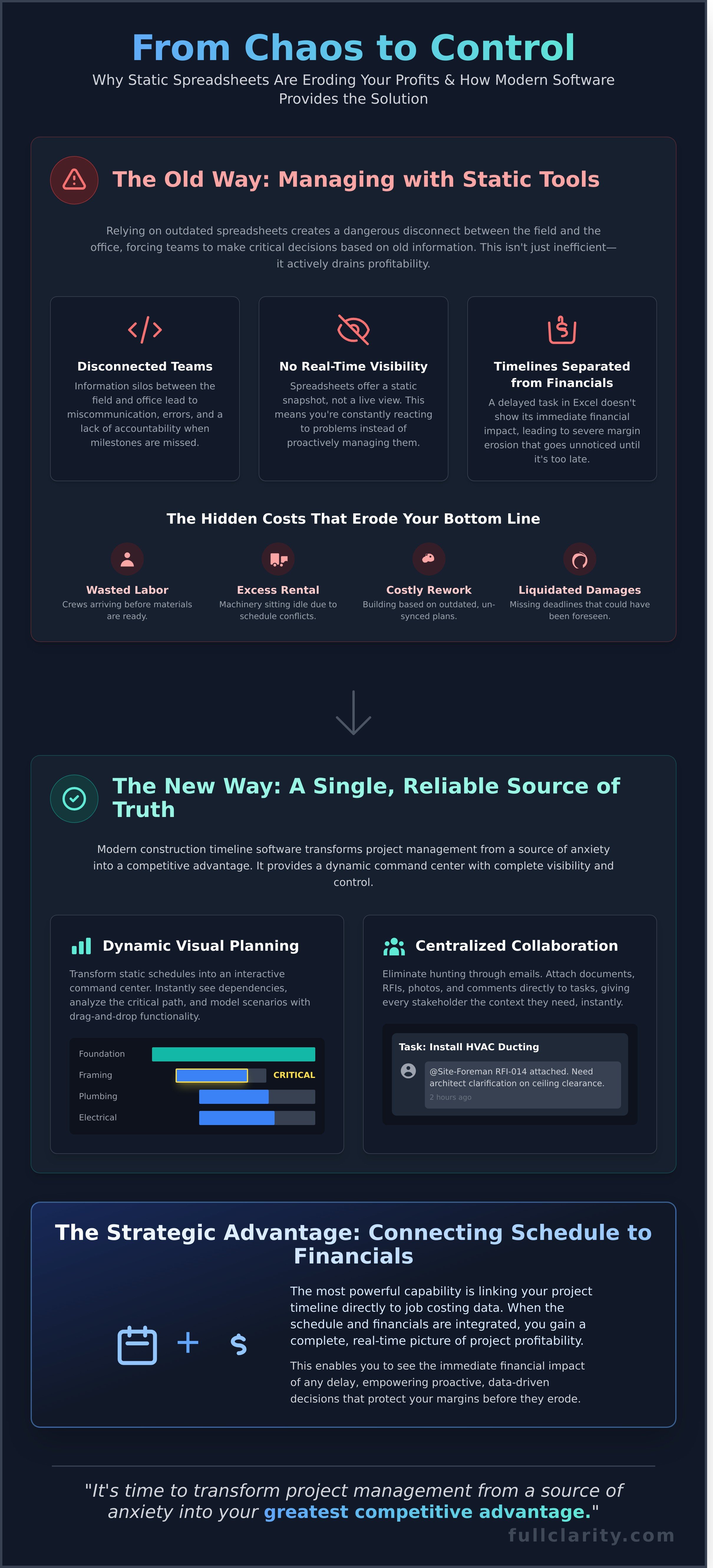
For years, spreadsheets have been the default tool for managing construction schedules. They are familiar, accessible, and seemingly simple. However, this familiarity masks a critical weakness: you are managing a dynamic, fast-moving project with a completely static tool. The core function of modern Project management software is to overcome this disconnect by providing a live, interactive view of your project. Relying on manual updates in a spreadsheet isn't just inefficient-it actively drains your profitability through errors, miscommunication, and preventable delays.
The hidden costs of this inefficiency are substantial and directly impact your bottom line. These aren't line items you'll find in a budget, but they represent real financial losses from:
- Wasted Labor: Crews arriving on-site before materials or prerequisite tasks are complete.
- Excess Equipment Rental: Paying for machinery that sits idle due to scheduling conflicts.
- Costly Rework: Building based on outdated plans that didn't reflect a recent change order.
- Liquidated Damages: Incurring penalties for missing contractual deadlines that could have been foreseen.
The Disconnect Between the Field and the Office
When your master schedule lives in a spreadsheet on a project manager's desktop, a dangerous information gap is created. Progress made in the field isn't reflected in the plan until someone manually enters it, which can be hours or even days later. This forces office teams to make critical procurement and scheduling decisions based on outdated information. Without a real-time, single source of truth, accountability blurs, and the blame game begins when milestones are inevitably missed.
No Real-Time Visibility into Project Health
A spreadsheet offers a snapshot in time, not a live view of project health. You cannot see at a glance where bottlenecks are forming or which tasks are falling behind. A one-day delay in pouring concrete might seem minor, but if it pushes back three other dependent trades, it has a compounding effect on the critical path. This lack of visibility means you are constantly reacting to problems instead of proactively managing them. In contrast, a centralized dashboard in robust construction project timeline software provides instant clarity, turning potential disasters into manageable adjustments.
The Critical Failure: Separating Timelines from Financials
Perhaps the most significant failure of spreadsheet-based management is its inability to connect the schedule directly to your financials. A Gantt chart in Excel can show you that a task is delayed, but it cannot show you the immediate financial impact of that delay on your budget. This disconnect makes accurate job costing impossible and leads to severe margin erosion. Every unforeseen delay burns cash, but without an integrated system, you won't know the true cost until it's too late to fix.
Core Capabilities of Modern Construction Timeline Software
Leaving behind the limitations of static spreadsheets and fragmented communication is no longer an option-it’s a competitive necessity. The operational drag and margin erosion caused by outdated methods only compound the construction industry's long-standing productivity issues. A robust construction project timeline software directly confronts these challenges by providing a powerful, integrated platform built on core capabilities that deliver visibility and control.
Dynamic Visual Planning: Gantt Charts and Beyond
Modern software transforms the project schedule from a static document into a dynamic command center. Interactive Gantt charts provide a clear visual map of your entire project, instantly clarifying task dependencies and sequences. With intuitive drag-and-drop functionality, project managers can adjust timelines in seconds to model different scenarios and react to changes with agility. This is further enhanced by critical path analysis, which automatically highlights the sequence of tasks that directly determines the project's completion date, ensuring your team focuses its resources on what truly matters.
Centralized Collaboration and Communication
Eliminate the costly delays caused by miscommunication and siloed information. Best-in-class software creates a single source of truth by allowing teams to attach documents, RFIs, photos, and comments directly to specific tasks on the timeline. Instead of hunting through email chains, every stakeholder has instant access to the context they need. Real-time notifications for schedule changes, task completions, and comments ensure the office, the field, and subcontractors are always aligned, fostering accountability and proactive problem-solving.
Resource and Equipment Management
Gain powerful control over your most valuable-and expensive-assets. A key capability of enterprise-grade construction project timeline software is the ability to schedule and track labor, subcontractors, and heavy equipment with precision. This prevents the costly scenarios of overbooking crews or having million-dollar machinery sitting idle. By providing a clear view of resource allocation across one or multiple projects, you can optimize utilization, prevent bottlenecks, and make data-driven decisions that directly protect your project margins.
The Strategic Advantage: Integrating Timelines with Project Financials
Most articles on construction project timeline software focus exclusively on scheduling features like Gantt charts and dependency mapping. While essential, these tools only present half the picture. A schedule without financial context is a plan without a pulse. The critical differentiator between basic scheduling and true project control is the seamless integration of your project timeline with real-time financial data. This transforms your schedule from a simple calendar into a dynamic, intelligent model of project health, creating a powerful single source of truth for your entire operation.
True visibility isn't just knowing when a task is done; it's knowing precisely what it cost. By connecting your schedule directly to your ERP, you gain unparalleled control over the two most critical elements of any project: time and money.
Real-Time Job Costing Against Milestones
Imagine seeing labor, material, and subcontractor costs populate against your budget the moment they are incurred-all tied directly to a specific milestone on your Gantt chart. This direct link provides immediate visibility into budget variances. Instead of discovering a cost overrun weeks later, you can identify margin erosion as it happens, allowing for proactive budget management, not reactive damage control.
Managing Change Orders and Their Financial Impact
Change orders are a major source of disputes and profit loss. An integrated system removes the ambiguity. When a change order is created, its impact on both the project timeline and the budget is calculated and displayed automatically. Once approved, the schedule and financials adjust in real-time, providing absolute clarity for your team, subcontractors, and the client. This is how you maintain control and protect your margins.
Forecasting Profitability with Accurate Data
This level of integration elevates a tool from simple construction project timeline software to a strategic financial asset. With real-time cost data tied to schedule progress, you can generate accurate 'percent complete' calculations and reliably forecast final project costs and margins. This data-driven foresight is an indispensable tool for executive-level decision-making, ensuring every project contributes positively to the bottom line. See how FullClarity connects your project schedule to NetSuite financials.
Standalone Scheduling Apps vs. Integrated ERP Solutions
When selecting software to manage project timelines, construction firms face a critical decision: adopt a simple, standalone scheduling app or invest in a solution that is fully integrated with a core Enterprise Resource Planning (ERP) system. While standalone tools offer initial simplicity, they often create long-term barriers to growth and efficiency. The strategic choice lies in unifying your data for complete operational visibility.
The Limits of Standalone Point Solutions
Standalone scheduling tools can seem appealing for a single, straightforward project. However, their limitations quickly become apparent. These applications create dangerous data silos, completely disconnecting your project schedule from your financial and operational data. This forces teams into inefficient, error-prone workflows.
- Manual Double Entry: Project managers update timelines in one system, while accounting manually re-enters cost and labor data into another, wasting valuable hours and increasing the risk of costly mistakes.
- Version Control Chaos: To share information, teams often export data to spreadsheets, leading to multiple conflicting versions of the schedule and budget.
- Security Vulnerabilities: Disconnected systems and reliance on spreadsheets expose sensitive project and financial data to unnecessary security risks.
The Power of a 'Single Source of Truth' in an ERP
An integrated system establishes a powerful ‘single source of truth’ for your entire construction business. When your construction project timeline software lives inside your ERP, every piece of data-from the Gantt chart to job costing, procurement, and payroll-is stored in one secure, centralized database. A change in the project schedule instantly and automatically updates resource allocation, cash flow projections, and material purchasing needs. This seamless data flow eliminates guesswork and empowers every department with real-time, accurate information.
Why 'Built on NetSuite' Offers Unmatched Scalability
The ultimate form of integration is a solution built natively on your ERP platform. Unlike a simple integration that "syncs" data between two separate systems, a native application is part of the ERP's core architecture. Solutions like FullClarity's Gantt for NetSuite are not just connected to NetSuite-they are built on it. This provides unmatched benefits: perfect data consistency with zero lag, the robust security of the world’s #1 cloud ERP, and the unlimited scalability to grow with your business, ensuring your technology is a future-proof asset, not a liability.
How to Choose the Right Timeline Software for Your Business
Selecting the right construction project timeline software is a critical business decision that directly impacts profitability and efficiency. To move beyond slick sales presentations and truly vet a potential partner, you must be prepared with targeted, results-oriented questions. This evaluation framework will empower you to identify a robust solution that provides a genuine, single source of truth for your entire operation.
Key Questions to Ask During a Demo
A live demonstration is your opportunity to see past marketing claims. Insist on seeing how the platform handles the real-world complexities of a construction project. Ask pointed questions that reveal the software’s true capabilities:
- Change Orders & Financial Impact: "Show me precisely how your system processes a change order, and how that change is instantly reflected in both the project timeline and the master budget. How do you prevent margin erosion at this critical stage?"
- Real-Time Field Updates: "Demonstrate how a progress update or daily log entered by a superintendent on a mobile device in the field appears in the master schedule for the project manager in the office. Is this update instantaneous?"
- System Integration: "How does your software seamlessly integrate with our existing accounting or ERP system, such as NetSuite? We need to see how data flows from operations to finance without manual data entry."
Evaluating Implementation and Team Adoption
The most powerful software is useless if your team won’t adopt it. A smooth implementation and intuitive user experience are non-negotiable. Discuss the practical aspects of rolling out the new system to ensure it becomes an asset, not a burden.
- Inquire about the typical implementation timeline and what resources are required from your team.
- Ask about the training and ongoing support structure for both office staff and, crucially, your field teams.
- Discuss the mobile interface. Is it user-friendly and designed for quick data entry on a job site, or is it a stripped-down version of the desktop app?
Assessing Scalability for Future Growth
Your chosen solution must not only solve today’s challenges but also support your company's future growth. A platform that can't scale becomes a liability. Probe its capacity to handle increased complexity and a growing project portfolio.
- Question how the software’s performance is affected as you add a significant number of projects and users.
- Ask about its ability to manage multi-phase, complex jobs with intricate dependencies.
- Discuss the reporting capabilities. Can you easily generate a portfolio-level view to assess the health of all projects at once?
Asking these questions will give you the clarity needed to select a future-proof platform. Solutions natively built on a powerful cloud ERP are designed to provide positive answers to every point. To see how a fully integrated system can transform your business, explore the powerful solutions at fullclarity.com.
Gain Full Control Over Your Construction Timelines
Moving beyond outdated spreadsheets is no longer an option-it’s a necessity for survival and growth. The right construction project timeline software does more than just schedule tasks; it provides real-time visibility and connects your entire operation. The most powerful solutions integrate project schedules directly with financials, creating a single, dynamic command center that protects your profitability on every job.
Stop letting disconnected data lead to margin erosion and costly project delays. FullClarity provides that crucial single source of truth from field to finance. Because our solutions are built natively on the Oracle NetSuite platform, you gain a robust, scalable tool designed to drive efficiency and secure your margins. It's time to transform your project management from a reactive process into a proactive strategy for success.
Take control of your projects. See FullClarity's Gantt for NetSuite in action.
Frequently Asked Questions About Construction Project Timeline Software
What is the difference between construction scheduling and project management software?
Construction scheduling software focuses specifically on creating and tracking project timelines, often using Gantt charts to visualize dependencies. In contrast, comprehensive project management software is a robust, integrated platform. It includes scheduling but also adds powerful capabilities for job costing, resource allocation, document management, and financial reporting. A full suite provides a single source of truth for every project aspect, from initial bid to final closeout, giving you complete operational and financial visibility.
How much does construction project timeline software typically cost?
Costs vary based on complexity, the number of users, and the level of integration with other systems like your ERP. Simpler tools may start at $25-$50 per user per month. However, a fully scalable, enterprise-grade construction project timeline software solution will have a custom pricing structure based on your specific operational needs. This investment ensures robust functionality that grows with your business, preventing costly data silos and eliminating margin erosion down the line.
Is Gantt chart software enough to manage a complex construction project?
While Gantt charts are an essential tool for visualizing timelines, they are not sufficient for managing the full complexity of a modern construction project. They lack critical, integrated capabilities for real-time financial tracking, subcontractor compliance, and change order management. Relying solely on a Gantt chart creates data silos and limits visibility, leading to potential budget overruns. An effective solution must integrate scheduling with job costing and resource management for complete control.
How does this type of software improve subcontractor management and coordination?
This software centralizes all project information, creating a single source of truth accessible to everyone. It improves subcontractor coordination by providing real-time access to the latest schedules, plans, and change orders, eliminating confusion from outdated information. Automated notifications for task assignments and deadlines ensure accountability. This seamless data flow reduces delays, prevents rework, and gives you complete visibility into subcontractor progress, strengthening partnerships and protecting project margins.
Can this software be accessed on mobile devices from the job site?
Absolutely. Best-in-class platforms are cloud-based and offer robust mobile applications for both iOS and Android devices. This empowers your field teams-from project managers to superintendents-to access and update project timelines, view blueprints, and submit daily reports directly from the job site. This real-time data flow is critical for making informed, on-the-ground decisions that keep the project on schedule and within budget without communication delays.
What kind of training is required for my team to adopt a new timeline software?
The level of training depends on the software's complexity and your team's current technical skill. Leading providers offer comprehensive onboarding programs, including live training sessions, on-demand video tutorials, and detailed documentation. The goal is a smooth transition that empowers your team, not overwhelms them. A well-designed, intuitive user interface significantly reduces the learning curve, allowing your team to quickly leverage the platform’s powerful features to drive efficiency and project success.