

The Best ERP for Construction in 2026: A Complete Review
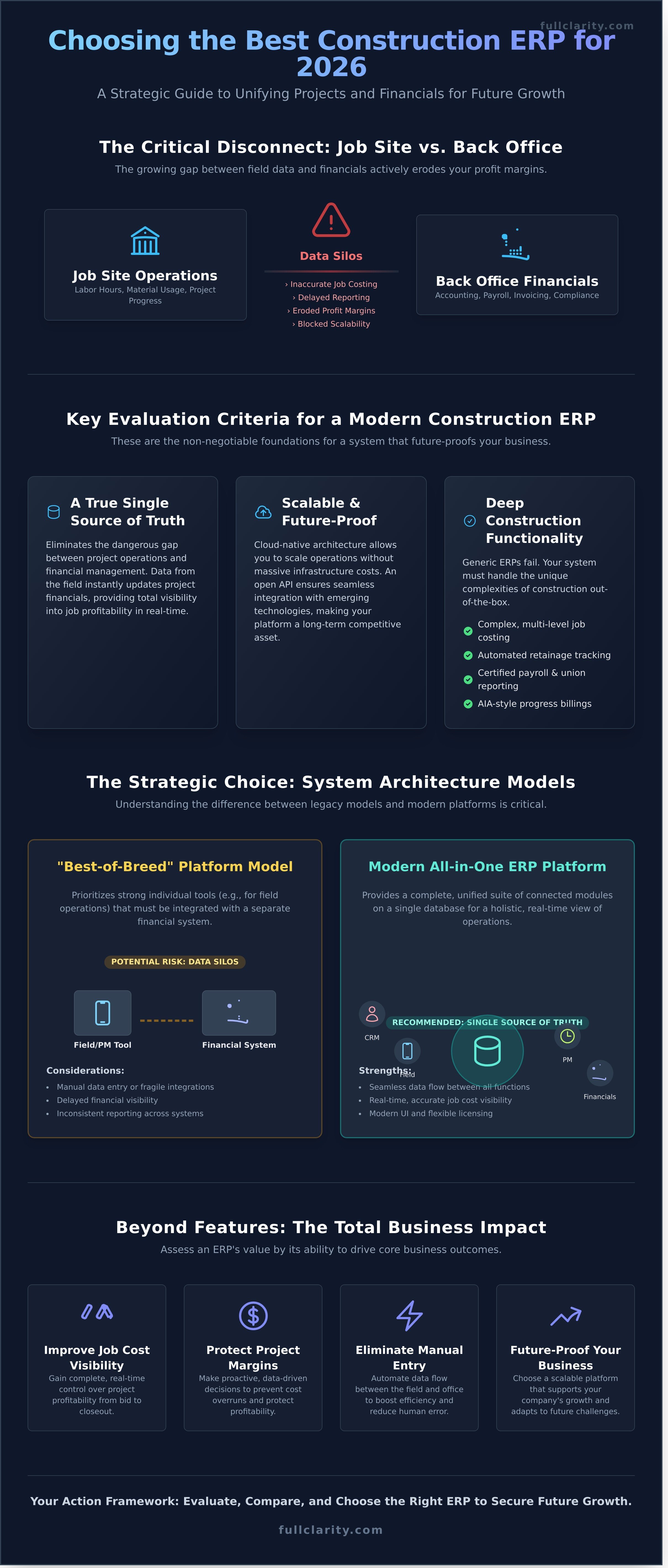
Is the growing gap between your job site and your back office costing you more than just time? When field data is siloed from financials, inaccurate job costing and delayed reporting don't just cause headaches-they actively erode your profit margins. As the industry advances, relying on disconnected systems is a direct threat to your scalability and profitability. Finding the best ERP for construction 2026 is no longer just an operational upgrade; it's a strategic imperative for gaining complete control over your projects and securing future growth.
This definitive review provides the clarity you need. We will evaluate the top construction ERP solutions, highlighting the critical differences between legacy all-in-one suites and powerful, platform-based systems. You will learn how to identify a truly robust and scalable solution that delivers a real-time 'single source of truth' for all project and financial data. Prepare to eliminate manual data entry, gain powerful visibility into project profitability, and choose a system that future-proofs your business for the challenges ahead.
Key Takeaways
- Understand the non-negotiable features a modern construction ERP must have to provide a single source of truth and eliminate data silos across your projects.
- Discover the critical difference between legacy all-in-one suites and scalable platform-based ERPs to determine which model truly future-proofs your business.
- Get a clear, actionable framework to evaluate leading vendors and select the best ERP for construction 2026 based on your company's specific financial and operational needs.
- Move beyond feature comparisons and learn to assess an ERP's total business impact, from improving job cost visibility to protecting project margins.
What Defines the Best Construction ERP in 2026? Key Evaluation Criteria
The era of juggling disconnected spreadsheets, accounting software, and project management tools is over. Survival and growth in today's competitive landscape demand a unified command center. The search for the best erp for construction 2026 is not about finding more software; it's about adopting a foundational business system. A modern Enterprise Resource Planning (ERP) platform serves as the central nervous system for your entire operation, connecting every function from bid to closeout. The right choice, however, is not one-size-fits-all. It depends entirely on your business model, scale, and strategic growth plans. This guide outlines the non-negotiable criteria for evaluating the top solutions on the market.
A True Single Source of Truth
A best-in-class construction ERP must eliminate the dangerous gap between project operations and financial management. When your teams work in separate systems, you create data silos that lead directly to margin erosion and reactive, poor decision-making. The core promise of a modern ERP is delivering a real-time 'single source of truth,' where data from the field-like labor hours and material usage-instantly updates project financials, providing total visibility into job profitability.
Scalability and Future-Proof Architecture
Your ERP is a long-term investment; it must be built to grow with you. A cloud-native architecture is essential, providing the flexibility to scale your operations up or down without massive infrastructure costs. This ensures your teams can access critical data from anywhere, on any device. Furthermore, a truly future-proof system features an open API, allowing for seamless integration with emerging technologies and ensuring your platform remains a competitive asset for years to come.
Deep Construction-Specific Functionality
Generic ERPs simply cannot handle the unique complexities of the construction industry. The best erp for construction 2026 must offer robust, out-of-the-box functionality tailored to how you build. This goes far beyond standard accounting. Look for a platform that intelligently manages:
- Complex, multi-level job costing
- Automated retainage tracking and billing
- Certified payroll and union reporting
- AIA-style progress billings and lien waiver management
These are not optional add-ons; they are foundational requirements for maintaining compliance, controlling costs, and protecting your margins on every project.
Top Construction ERP Systems for 2026: A Market Review
Choosing the best erp for construction 2026 requires understanding that different platforms are engineered with different priorities. The optimal choice aligns with your company's core operational drivers, whether they are in the field, the back office, or across the entire enterprise. As the Construction Management Profession Outlook highlights the growing complexity of the industry, selecting a system that empowers your team is critical for maintaining profitability and control. Below is our market review of leading solutions, grouped by their primary strength.
Solutions Focused on Field Operations & Project Management
Some leading platforms prioritize an exceptional project and field management experience. These systems offer intuitive mobile applications and powerful collaboration tools, designed to connect job site and office teams in real-time, streamlining on-site activities and communication.
- Strengths: Strong user experience for field staff, robust project management modules (RFIs, Submittals, Drawings), and often a wide range of integrations.
- Considerations: Financial functionality may not be a native strength. While some offer accounting features, many firms find they need to integrate with a separate, more robust financial system, which can sometimes lead to data silos.
Modern Cloud-Native All-in-One Platforms
A category of modern, born-in-the-cloud ERPs offers comprehensive, all-in-one solutions. These platforms typically provide a complete suite of connected modules, encompassing financials, job costing, project management, and CRM, all unified within a single database for a holistic view of operations.
- Strengths: Often feature flexible licensing models, a modern user interface, and strong, unified functionality across various business areas.
- Considerations: While highly comprehensive, these systems might not always offer the same specialized depth in highly niche areas (such as complex union payroll) compared to some legacy, highly specialized systems.
Sage 300 Construction and Real Estate (CRE): Best for Deep Financial Control
For decades, Sage 300 CRE has been the gold standard for construction accounting. Companies where granular job costing, complex payroll, and rigorous financial controls are paramount continue to rely on its powerful back-office capabilities.
- Strengths: Exceptionally robust and detailed job cost accounting, payroll, and financial reporting modules that are trusted by generations of contractors.
- Considerations: Its legacy is in on-premise software, and the user interface can feel dated compared to cloud-native solutions. Cloud hosting is often managed through third-party providers.
The Platform Model: NetSuite + FullClarity Construction for NetSuite
A more flexible and scalable strategy is emerging as the definitive model for growth-oriented firms: building on a world-class platform. This approach combines the power of Oracle NetSuite, the #1 Cloud ERP, with a native suite application like FullClarity that adds deep construction functionality. This creates a true best-of-both-worlds solution, delivering elite financial and platform capabilities with purpose-built project tools. This is arguably the most future-proof path for finding the best ERP for construction in 2026, creating a single source of truth that eliminates compromises between back-office power and field efficiency.
Strategic Choice: All-in-One Suites vs. The Platform ERP Model
When selecting the best erp for construction 2026, you face a critical strategic choice, much like deciding between a vehicle off the lot or a custom-built one. An off-the-lot model works well if your needs are standard, but a custom build offers unparalleled performance and adaptability for unique demands. In construction software, this choice is between a legacy All-in-One Suite and a modern Platform ERP.
The All-in-One Suite Approach
Traditional all-in-one suites are the "off-the-lot" option. They come from a single vendor with pre-integrated modules designed specifically for construction. While this offers simplicity upfront, it often comes at the cost of flexibility. These systems can be rigid, making customizations difficult and expensive, and their core financial modules often lack the robust power of a true enterprise-grade system.
- Pros: Single vendor relationship, unified user interface, and construction-specific workflows out of the box.
- Cons: Inflexible architecture, limited scalability, and often a weaker, less sophisticated financial core.
This model is best for companies whose operations fit perfectly into the vendor's predefined box and who do not anticipate significant process changes or growth.
The Platform ERP Approach (NetSuite + FullClarity)
The Platform ERP model is the "custom-built" vehicle, engineered for peak performance and future growth. It starts with a best-in-class, industry-agnostic foundation-like Oracle NetSuite, the world's #1 Cloud ERP-and layers on powerful, native applications built specifically for construction. This approach directly counters the myth that a platform is "too generic." Instead of a "bolted-on" integration that creates data silos, a native application like FullClarity is built on NetSuite, sharing the same data model for seamless operations. As broader ERP Software Market Trends show, this move toward flexible, platform-based solutions is accelerating.
- Pros: A world-class financial core, unmatched scalability for growth, and extreme customizability to fit your unique processes.
- Cons: Requires a strategic decision to select both the right platform and the right native construction application.
For ambitious firms seeking a future-proof system, this model is the clear winner. The ability to combine a robust financial engine with specialized construction functionality makes it the foundation for the best ERP for construction in 2026 and beyond. See how a platform solution provides a single source of truth.
Critical Features to Demand from Your ERP in 2026
While strategic alignment is crucial, the true power of an ERP lies in its daily functionality. The features you choose will determine your team's efficiency, your project's profitability, and your company's ability to scale. The best erp for construction 2026 will not just manage your business-it will provide the intelligent insights needed to future-proof it. Below are the non-negotiable capabilities you must demand.
Intelligent Job Costing and Forecasting
Yesterday’s ERPs tracked costs after the fact, providing a historical record of where money was spent. A modern system must offer predictive, real-time financial intelligence. This means instantly comparing budgets to actuals-including committed costs-as they are incurred, not weeks later. This powerful visibility allows project managers and CFOs to identify potential overruns and eliminate margin erosion before it happens. A true "single source of truth" for project financials is no longer a luxury; it's a requirement for survival.
Automated Retainage and Lien Management
Retainage is a unique and significant financial challenge in construction, tying up critical cash flow and creating immense administrative burdens. Manually tracking percentages, release dates, and compliance across dozens of projects is a recipe for error. Your ERP must automate this entire workflow. A robust system, like FullClarity’s solutions built on NetSuite, seamlessly handles complex retainage calculations and lien waiver tracking, ensuring you never miss a deadline and can accelerate your cash conversion cycle.
Integrated Project & Resource Management
Data silos between project management and accounting are a primary source of inefficiency and costly errors. The capabilities that separate a standard system from the best erp for construction 2026 are found in its native integration. When your operational and financial data live in one platform, you gain unparalleled control. Look for a solution that provides:
- Visual Project Timelines: Interactive Gantt charts that are directly linked to project tasks and financial milestones.
- Unified Resource Scheduling: The ability to allocate labor and equipment, with costs flowing directly into the project budget in real-time.
- Centralized Document Control: A single repository for all plans, change orders, and RFIs, accessible to everyone from the field to the back office.
These integrated features transform an ERP from a simple accounting tool into the central nervous system of your entire operation. See how FullClarity's construction solutions deliver this powerful, unified control.
How to Choose the Right Construction ERP for Your Business
Selecting the right enterprise resource planning system is one of the most critical strategic decisions your firm will make. The goal is not just to find a software solution; it is to implement a central nervous system that provides a single source of truth for your entire operation. To find the best erp for construction 2026, you must move beyond feature lists and adopt a results-oriented evaluation framework. This three-step process will empower you to make a confident, future-proof decision.
Step 1: Assess Your Current Processes & Pain Points
Before you can evaluate solutions, you must have complete clarity on your current challenges. A robust ERP addresses specific operational weaknesses to eliminate margin erosion and boost efficiency. Ask your team these critical questions:
- Where are our biggest data bottlenecks between the field and the office?
- Which manual processes, like change order management or invoicing, are costing us the most time and money?
- What critical financial or project information do we wish we had in real-time to make better decisions?
Step 2: Define Your 5-Year Business Goals
The right ERP must be a partner for growth, not a limitation. Your selection needs to be a scalable platform that supports your future ambitions, not just your present-day needs. Consider your long-term strategic plan: Do you plan to expand into new service lines or geographic markets? How much revenue growth are you projecting, and can your systems handle that increased complexity? Your ERP should be a powerful engine for that growth.
Step 3: Schedule Demonstrations with a Focus on Your Use Cases
Once you have a shortlist, insist on personalized demonstrations. A generic product tour is not enough. You need to see how the software handles your specific workflows and solves your unique problems. Challenge vendors to walk you through your most complex job costing scenario or a difficult retainage calculation. This is the only way to truly validate a system’s capabilities. See how a best-in-class solution built on NetSuite handles these challenges firsthand. Request a personalized demo of Construction for NetSuite.
Future-Proof Your Operations: Securing the Right Construction ERP
Choosing your next ERP is a foundational business decision. As we've explored, the future of construction management hinges on integrated, scalable platforms that provide complete visibility from the field to the back office. The search for the best erp for construction 2026 is not about finding a single tool, but a unified ecosystem that eliminates data silos and empowers strategic decision-making.
While many systems claim to be comprehensive, the most powerful solutions are built on a world-class foundation. FullClarity transforms the world's #1 Cloud ERP, Oracle NetSuite, into a robust construction management platform. Trusted by construction firms to eliminate margin erosion and boost efficiency, our solution delivers the single source of truth needed to protect your profits and drive growth.
Ready to build your business on a future-proof platform? Discover how FullClarity transforms NetSuite into the ultimate construction ERP. Request a Demo Today.
Frequently Asked Questions
What is the average cost of a construction ERP system in 2026?
In 2026, construction ERP costs are highly dependent on your company's scale and specific module requirements. Pricing is typically determined by user licenses, selected features like advanced job costing or project management, and implementation complexity. A mid-sized contractor might see an initial investment in the tens of thousands, while large enterprises can easily exceed six figures. The key is to evaluate the total cost of ownership against the powerful ROI from eliminating margin erosion and boosting operational efficiency.
How long does it take to implement a new construction ERP?
A typical construction ERP implementation timeline ranges from three to nine months, contingent on system complexity and your team’s readiness. A phased rollout focusing on core financial and job costing modules can be completed faster. A comprehensive, enterprise-wide deployment involving extensive data migration and custom workflows will naturally take longer. A successful implementation hinges on a clear project plan and a dedicated partner to ensure a smooth transition and rapid time-to-value for your business.
Is Procore a true ERP system?
Procore is a best-in-class project management platform, excelling at field operations and collaboration. However, it is not a true ERP because it lacks a native, integrated accounting and financial core. A true ERP, like NetSuite, manages all financial data-from general ledger to job costing-in one unified database. While Procore integrates with accounting software, it often creates data silos rather than providing the real-time, single source of truth that a unified ERP delivers.
Can a construction ERP integrate with other software like ProEst or Autodesk?
Absolutely. The best ERP for construction 2026 will feature a robust API framework, enabling it to seamlessly integrate with specialized point solutions. Modern cloud ERPs are designed to connect with essential tools like ProEst for estimating, Autodesk for BIM and design, and various payroll or CRM platforms. This creates a powerful, interconnected ecosystem, ensuring data flows automatically from pre-construction to project closeout, enhancing visibility and eliminating redundant data entry across all critical business functions.
What's the difference between a native NetSuite application and a simple integration?
A native application is built directly on the NetSuite platform, sharing its database, user interface, and security model for a truly unified, real-time experience. In contrast, a simple integration is a connector that syncs data between two separate systems, often leading to delays, potential data discrepancies, and a disjointed workflow. A native solution provides a genuine single source of truth without the fragility and maintenance headaches of third-party connectors, making it a more robust and future-proof choice.
How does an ERP help with construction industry compliance and reporting?
A powerful ERP is fundamental for managing construction compliance. It automates the generation of complex documents like AIA billings, certified payroll reports, and lien waivers, ensuring accuracy and timeliness. By centralizing all financial and project data, the best ERP for construction 2026 provides a clear audit trail and robust, configurable reporting capabilities. This drastically reduces administrative burden, minimizes the risk of non-compliance penalties, and provides stakeholders with the real-time visibility needed for confident decision-making.