

Your Bulletproof Construction Software Implementation Plan: A 5-Phase Guide
Investing in best-in-class construction software is a strategic move to gain a competitive edge. Yet, the fear of a botched rollout is real and justified-a poorly managed transition can lead to massive operational disruption, cripple team morale, and turn a significant investment into a costly mistake. The difference between a seamless launch and a catastrophic failure isn't the software itself. It's having a meticulously crafted construction software implementation plan to navigate complexity and mitigate risk from day one.
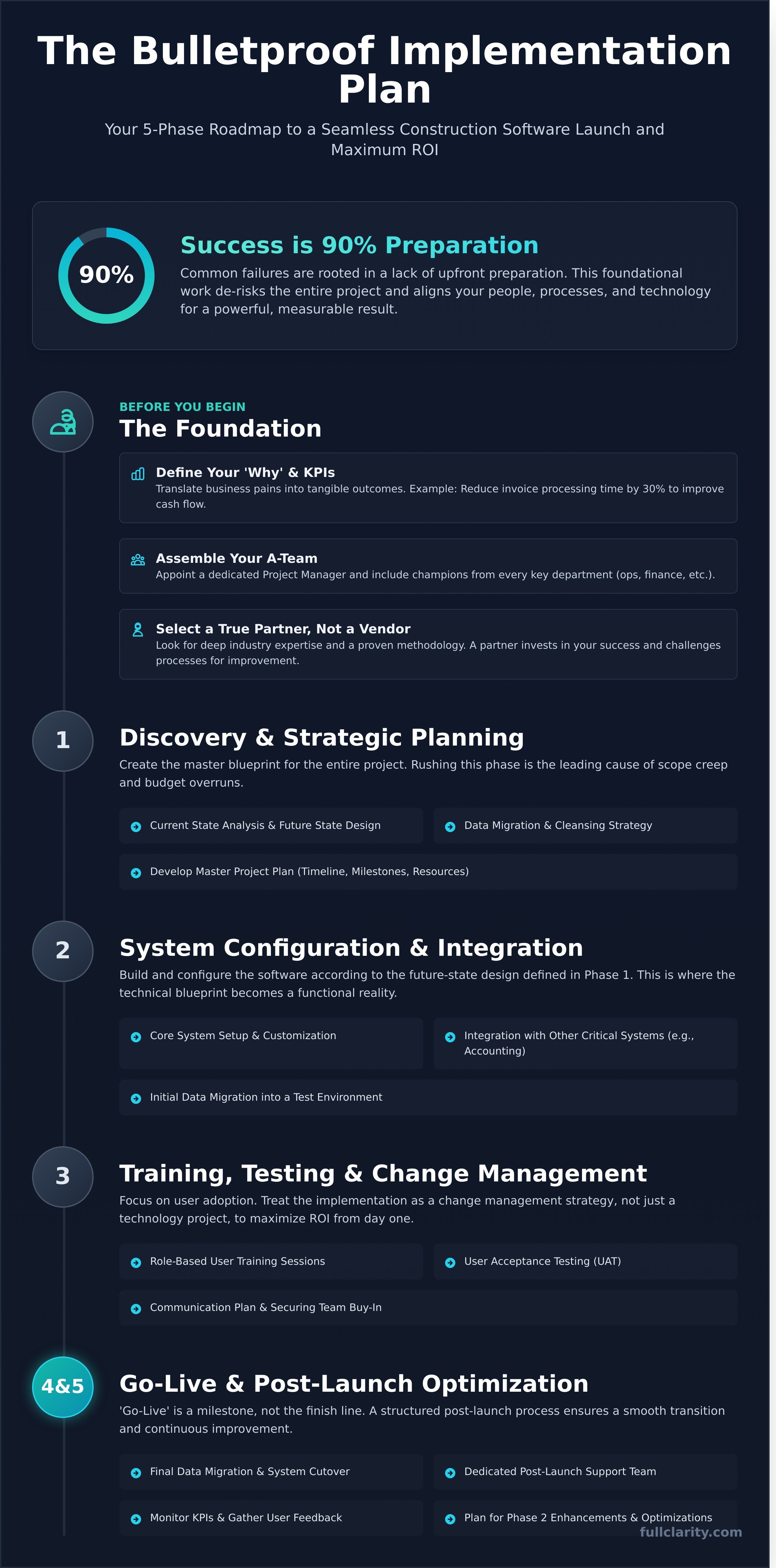
This guide eliminates the guesswork. We've distilled the process into a powerful, 5-phase framework designed to secure complete team buy-in, ensure flawless data migration, and drive rapid user adoption from the field to the back office. Follow our bulletproof plan to transform your software purchase into a tangible asset that delivers a clear and immediate return on investment, giving you the confidence to lead your company forward.
Key Takeaways
- A successful implementation is 90% preparation. Learn the critical groundwork to lay before you begin Phase 1 to de-risk your entire project.
- Transform your strategic goals into a functional solution by deeply analyzing current workflows and defining a clear, future-state design during the Discovery phase.
- Maximize your ROI by treating your construction software implementation plan as a change management strategy, focusing on user training and testing to drive adoption from day one.
- Understand that 'Go-Live' is a milestone, not the finish line. A structured post-launch optimization process is essential for ensuring a smooth transition and continuous improvement.
Before You Begin: The Foundation for a Successful Implementation
A successful software rollout is far more than a timeline; it’s a comprehensive change management strategy. While the technical definition of what is a software implementation focuses on executing a plan, our experience shows that 90% of common failures are rooted in a lack of upfront preparation. Before configuring a single setting, the most critical work involves aligning your people, processes, and technology. This foundational phase of your construction software implementation plan is about defining what success looks like and assembling the A-team to achieve it, ensuring your investment delivers powerful, measurable results.
Define Your 'Why': Setting Clear, Measurable Objectives
True transformation begins with clarity. Instead of focusing on software features, pinpoint the specific business pains driving this change. Are you battling margin erosion from inaccurate job costing? Is project visibility fragmented across multiple systems? Translate these challenges into tangible business outcomes with clear KPIs. This creates a powerful roadmap for success and secures the executive sponsorship needed to champion the project from the top down.
- KPI Example: Reduce invoice processing and approval time by 30% within six months.
- Business Outcome: Improve cash flow and subcontractor relationships.
- Financial Impact: Capture early payment discounts and reduce administrative overhead.
Assemble Your Internal Implementation Team & Governance Structure
Technology alone does not solve problems-people do. A robust governance structure is essential for navigating decisions and maintaining momentum. Appoint a dedicated internal Project Manager to serve as the single point of contact between your team and your implementation partner. This core team must include champions from every key department, including operations, finance, and project management, to ensure all workflows and requirements are represented. Establish a steering committee for key approvals and define roles, responsibilities, and communication cadences from day one.
Select the Right Implementation Partner (Not Just a Vendor)
Your implementation provider is the most critical variable in your project's success. Look beyond technical skills and seek a true partner with deep construction industry expertise. A vendor sells software; a partner invests in your success. Evaluate their implementation methodology, request references from companies similar to yours, and ask how they manage project scope and risk. A best-in-class partner won’t just replicate your existing workflows in a new system-they will challenge your processes to unlock new levels of efficiency and build a scalable foundation for future growth.
Phase 1: Discovery and Strategic Planning
This initial phase is the most critical foundation of your entire project. Rushing through discovery is the leading cause of scope creep, budget overruns, and ultimately, a failed implementation. The goal here is to create the master blueprint that will guide every subsequent step. A robust construction software implementation plan begins with a deep, honest assessment of your current state to design a powerful, efficient future.
Current State Analysis & Future State Design
Before you can build a better future, you must thoroughly understand the present. This involves mapping every key business process-from job costing and billing to change orders and retainage. By analyzing these workflows, you can pinpoint process gaps and inefficiencies that are eroding your margins. This analysis aligns with best practices for project lifecycle management, as outlined in guides like The Construction Playbook, and allows you to design ideal future-state workflows within the new software, securing stakeholder sign-off on a clear vision for operational excellence.
Data Migration Planning
Your data is one of your most valuable assets, but only if it's accurate and accessible. This step involves identifying all legacy data sources and defining a rigorous strategy for data cleansing and validation before any migration begins. You must determine what historical data is essential for day-to-day operations versus what can be archived. The outcome is a detailed data mapping document that provides the technical team with a clear roadmap, ensuring a seamless transition and preventing a "garbage in, garbage out" scenario.
Develop the Master Project Plan
With a clear understanding of your processes and data, you can build the master project plan. This is the formal document that turns strategy into an actionable schedule. It provides total visibility into the project's scope and resources, detailing:
- A realistic timeline with key milestones, dependencies, and deliverables.
- A detailed project budget that accounts for software, implementation partners, and internal resource allocation.
- A comprehensive risk management plan to proactively identify and mitigate potential roadblocks.
This plan is your single source of truth for a successful rollout. Let our experts help you build a project plan that guarantees success.
Phase 2: System Configuration and Integration
This phase is where your strategic vision transforms into a tangible, functional software solution. The meticulous planning from Phase 1 now guides your implementation partner in configuring a system tailored precisely to your future-state design. Understanding the core strategic factors in technology adoption is critical here, as every configuration choice should directly support your primary business objectives. The central goal is to build a powerful, real-time ‘single source of truth’ for all project data. Throughout this stage, regular check-ins and prototype demonstrations are essential for ensuring the final product aligns perfectly with your operational needs.
Core System Configuration
Your implementation partner will now build the foundational architecture of your new system. This is a critical step in any successful construction software implementation plan, involving the precise setup of your core financial and operational frameworks. Key configuration tasks include:
- Establishing the chart of accounts and robust job cost structures.
- Defining user roles, permissions, and automated approval workflows.
- Building custom reports and dashboards to track your defined KPIs for real-time visibility.
Every element is meticulously configured to mirror the signed-off design documents, ensuring a perfect fit for your business.
Building Integrations
To achieve maximum efficiency, your new construction software must communicate flawlessly with other business-critical systems. This step focuses on developing and testing robust API connections to your existing payroll, estimating, or CRM platforms. The objective is to create a seamlessly integrated ecosystem that eliminates information silos and eradicates the costly, error-prone process of manual data entry between departments, empowering your teams with consistent and accurate information.
Initial Data Migration & Testing
With the core system configured, the next step is to populate it with your historical data. We perform an initial migration of cleansed, validated data into a secure test environment. This allows for rigorous, end-to-end testing to confirm data accuracy and system integrity before going live. Any discrepancies or errors identified during this process are documented and resolved immediately, guaranteeing a reliable and trustworthy data foundation from day one.
Phase 3: Training, Testing, and Change Management
Even the most powerful construction software is only effective if your team uses it correctly and consistently. With the technical configuration complete, your construction software implementation plan must now shift focus from the system to the people. This phase is dedicated to empowering your team, validating workflows, and managing the transition to ensure the new platform is not just installed, but fully adopted.</ Strong user adoption is the ultimate measure of a successful implementation and the key to unlocking a true return on your investment.
This critical stage bridges the gap between technical setup and operational reality, building the confidence and competence needed for a seamless launch.
Develop a Comprehensive Training Program
A one-size-fits-all training session won't deliver the results you need. A strategic, role-based approach ensures every team member understands how the new software enhances their specific daily tasks, driving efficiency from the start. A robust training program should include:
- Role-Based Materials: Create custom training guides and sessions for different user groups, such as project managers, estimators, and accounting personnel, focusing on the workflows most relevant to them.
- Departmental 'Super Users': Identify and intensively train key individuals from each department. These internal champions become the first line of support for their peers, drastically improving adoption and reducing reliance on the IT team.
- Hands-On Sandbox Training: Conduct training in a safe, separate "sandbox" environment. This allows users to practice with real-world scenarios, like creating a change order or processing an invoice, without any risk to your live company data.
- Ongoing Support Resources: Provide a library of quick reference guides, video tutorials, and FAQs to support continuous learning long after the initial training is complete.
Execute Robust User Acceptance Testing (UAT)
User Acceptance Testing is your final, critical checkpoint before going live. This is not a test for the implementation partner; it is a test for your business, led by your team. During UAT, key users follow detailed test scripts to run the configured system through real-world business processes, from project setup to final job costing. This is the last opportunity to catch configuration gaps or workflow issues before they can impact your operations. Securing formal, written sign-off from each department head after UAT is complete confirms that the system meets their requirements and instills shared ownership of the project's success. This step is a non-negotiable part of a well-managed construction software implementation plan.
Phase 4 & 5: Go-Live and Post-Launch Optimization
Many firms view the 'Go-Live' date as the finish line. In reality, it is the starting point for realizing the true value of your investment. A successful construction software implementation plan extends far beyond the initial launch, focusing on seamless adoption, rigorous performance monitoring, and continuous optimization to drive long-term ROI and operational excellence.
The Go-Live Cutover Plan
A meticulously planned cutover minimizes business disruption and ensures a smooth transition from legacy systems. The goal is to make the switch as seamless as possible for every user. Key actions for a successful cutover include:
- Strategic Scheduling: Schedule the go-live event during a period of lower business activity, such as a weekend, to reduce operational impact.
- Final Validation: Perform the final data migration and conduct a thorough system validation to ensure data integrity and functionality are robust from day one.
- Hypercare Support: Have a dedicated 'hypercare' support team-a mix of your internal power users and implementation partners-on standby to provide immediate, hands-on assistance.
- Clear Communication: Announce the transition schedule and expectations clearly across the entire company to manage expectations and ensure everyone is prepared.
Post-Launch Support and KPI Monitoring
The first 90 days post-launch are critical for solidifying user adoption and demonstrating value. Establish a clear, accessible process for users to report issues or ask questions, such as a dedicated help desk or ticketing system. This is the moment to begin rigorously tracking the KPIs defined in your foundational phase-measuring improvements in job costing accuracy, project visibility, and financial reporting speed. Hold regular check-in meetings with the project team to review progress against these metrics, address challenges, and celebrate early wins to build positive momentum.
Continuous Improvement and Optimization
Your new construction software is not a static tool; it's a dynamic platform for growth. A robust construction software implementation plan accounts for this evolution. Actively gather user feedback to identify pain points and opportunities for future enhancements. This real-world insight is invaluable for planning 'Phase 2' projects, such as adding new modules or integrating with other business systems. Conducting periodic health checks ensures the system remains aligned with your business processes and continues to scale effectively as your company grows. Our solutions are built to grow with you. Discover the power of FullClarity.
Build Your Future on a Solid Implementation Foundation
A successful software rollout is never an accident. As we've detailed, it's the result of a meticulous, phased approach that prioritizes strategic planning and dedicated change management. Executing a robust construction software implementation plan is less about flipping a switch and more about building a powerful new foundation for your entire operation. This strategic process ensures you achieve a true single source of truth, drive user adoption, and maximize your return on investment from day one.
The right partner makes all the difference. At FullClarity, we combine deep expertise in the construction industry with a proven implementation methodology focused on tangible business outcomes. Because our solutions are natively built on the Oracle NetSuite platform, we provide a seamless, powerful, and future-proof system to manage every aspect of your projects with unparalleled visibility and control.
Ready to transform your operations with a partner who understands your industry? Request a demo to see how FullClarity's expert implementation process delivers results.
Take the next step with confidence and build a more profitable, efficient future for your business.
Frequently Asked Questions
How long does a typical construction software implementation take?
The timeline for a construction software implementation varies based on project complexity, data migration needs, and team readiness. A streamlined implementation can take 3-6 months. For a comprehensive, multi-departmental rollout of a robust ERP like FullClarity + NetSuite, the process typically ranges from 6-12 months. A well-defined plan is crucial to ensuring this process drives efficiency without disrupting core operations and delivers a rapid return on investment.
What are the biggest risks in a software implementation project and how can we avoid them?
The primary risks are poor user adoption, inaccurate data migration, and scope creep, all of which erode ROI. To mitigate these, you must secure executive sponsorship and prioritize change management from day one. A robust implementation partner will help you cleanse historical data before migration to ensure your new system starts as a 'single source of truth'. Finally, a detailed project scope prevents costly delays and ensures the project delivers on its core financial and operational objectives.
What is the difference between software 'installation' and 'implementation'?
Installation is a simple technical event: loading the software or accessing a cloud environment. Implementation, however, is a strategic business process. It involves configuring the system to your specific workflows, migrating clean data, training your team, and integrating the software into your daily operations. A successful implementation transforms the software from a tool into a foundational business solution that provides total visibility and drives powerful efficiency gains across your entire organization.
How much should we budget for implementation services on top of the software cost?
As a general rule, businesses should budget for implementation services to be between 1 to 2 times the annual software subscription cost. For example, if your software license is $50,000 annually, a budget of $50,000 to $100,000 for implementation is a pragmatic starting point. This investment is not a cost; it's what ensures the software is configured to your exact needs, your team is fully trained, and you achieve the maximum possible ROI from day one.
What is 'change management' and why is it so critical for software adoption?
Change management is the strategic process of preparing and supporting your team to successfully adopt new technology and workflows. It's critical because even the most powerful software is ineffective if your team resists the change. An effective change management component, built into your construction software implementation plan, ensures high user adoption, minimizes operational disruption, and accelerates the time it takes to see tangible benefits like improved job costing and reduced margin erosion.
Can we migrate all of our historical data from our old system?
Yes, migrating historical data is a standard part of any robust implementation. However, this process presents a critical opportunity to cleanse and organize your data, not just transfer it. We work with clients to identify which data is essential for ongoing operations and historical reporting. This ensures your new platform, like FullClarity built on NetSuite, launches as a powerful and accurate 'single source of truth' from the start, free from the clutter of legacy data.