

Construction WIP Reporting: The Ultimate Guide to Protecting Project Margins
In the high-stakes world of construction, is the profitability of your projects a constant source of anxiety? Too often, finance and project teams are left navigating with an outdated financial map, manually wrestling with spreadsheets and hoping the final numbers don’t deliver a costly surprise. This lack of real-time visibility isn’t just inefficient-it’s a direct threat to your bottom line, leading to preventable margin erosion and creating uncertainty for the banks and sureties you depend on.
Mastering robust construction wip reporting is the key to trading that uncertainty for powerful, proactive control. A Work-in-Progress (WIP) report is far more than a monthly compliance document; it is the single most critical tool for understanding the true financial health of your projects and your business as a whole.
This definitive guide breaks down everything you need to transform your WIP process from a reactive chore into a strategic advantage. We’ll move beyond the basic formulas to provide actionable insights that empower you to accurately forecast profitability, make decisive moves to protect your margins, and automate reporting to drive powerful new efficiencies. It's time to build with confidence.
Key Takeaways
- Understand how a WIP report provides a real-time financial snapshot of every project, moving beyond historical accounting to proactive margin protection.
- Master the key calculations, including earned value and percent complete, to accurately assess project profitability and identify potential over/under billings.
- Transform your construction wip reporting from a simple accounting exercise into a strategic tool for forecasting cash flow, managing risk, and driving decisive action.
- Discover why manual spreadsheets introduce critical risks and how an integrated ERP creates a "single source of truth" for reliable, automated reporting.
What is a Construction WIP Report? (And Why It's Your Most Critical Financial Tool)
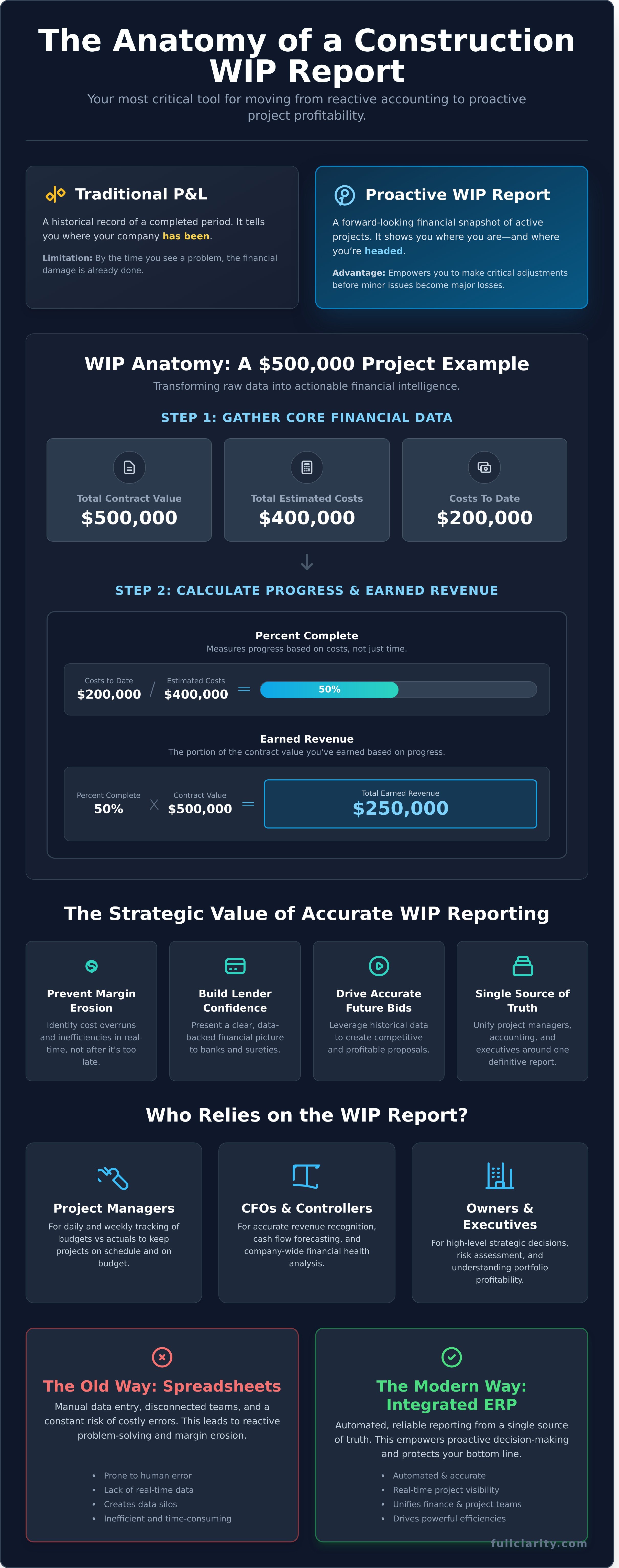
In the high-stakes world of construction, looking backward isn't enough. A Work-in-Process (WIP) report is a real-time financial snapshot of your active projects, providing a clear view of profitability from mobilization to closeout. Far more than a simple accounting exercise, effective construction wip reporting is a powerful management tool that measures progress, costs incurred, and revenue earned to date against the total budget and contract value. It transforms the foundational accounting concept of Work-in-Process (WIP) into actionable business intelligence.
While a standard Profit & Loss (P&L) statement tells you where your company has been, a WIP report shows you precisely where you are-and where you’re headed. The P&L is a historical record of a completed period. The WIP, by contrast, is a forward-looking instrument that calculates projected profitability on ongoing jobs, empowering you to make critical adjustments before minor issues become major losses.
The Strategic Value of Accurate WIP Reporting
Beyond a simple status update, an accurate WIP report delivers powerful, tangible business outcomes. It is the engine that drives financial control and strategic growth, allowing your firm to:
- Prevent Margin Erosion: Identify cost overruns, billing discrepancies, and labor inefficiencies in real-time, not weeks later when it’s too late to take corrective action.
- Drive More Accurate Future Bids: Leverage historical performance data from WIP reports to create future proposals that are both highly competitive and consistently profitable.
- Build Confidence with Lenders and Sureties: Present a clear, data-backed financial picture to banks and bonding agents, demonstrating robust internal controls and project visibility.
- Establish a 'Single Source of Truth': Unify project managers, accounting, and executives around one definitive report on project financial health, eliminating data silos and disputes.
Who Relies on the WIP Report?
The WIP report is not a siloed document; it’s a central hub of financial intelligence for key decision-makers across your entire organization:
- Project Managers: For daily and weekly tracking of budgets versus actuals, ensuring projects stay on schedule and under budget.
- CFOs & Controllers: For accurate revenue recognition, overall company financial health analysis, and robust cash flow forecasting.
- Owners & Executives: For high-level strategic decisions, risk assessment, and understanding the true profitability of the entire project portfolio.
The Anatomy of a WIP Report: Key Metrics and Calculations Explained
A Work-in-Progress (WIP) report transforms raw project data into a powerful financial snapshot. To unlock its value, you must understand its core components. Far from being a static document, it’s a dynamic tool that provides critical visibility into project health. Let’s break down the anatomy of a WIP schedule using a simplified example: a $500,000 office fit-out project.
Core Financial Data
Every WIP report is built on a foundation of three crucial financial inputs. Accuracy here is non-negotiable, as these figures drive all subsequent calculations. Maintaining this data integrity is one of the core financial best practices for WIPs, ensuring your report is a true single source of truth.
- Total Contract Value: The total agreed-upon price with the client, including any approved change orders. (Example: $500,000)
- Estimated Costs: The total forecasted cost to complete the entire project, also known as the budget. (Example: $400,000)
- Costs to Date: The actual, incurred costs recorded against the job up to the reporting date. (Example: $200,000)
Calculated Progress & Revenue
This is where the magic of construction wip reporting happens-translating costs into recognized revenue and profit. The engine driving this is the Percent Complete calculation, which measures progress based on costs, not just time or physical completion.
- Percent Complete: This is calculated as (Costs to Date / Estimated Costs). It represents the portion of the project budget that has been spent. (Example: $200,000 / $400,000 = 50%)
- Earned Revenue: This is the revenue you have financially earned, regardless of what you’ve billed. It's calculated as (Percent Complete * Total Contract Value). (Example: 50% * $500,000 = $250,000)
- Gross Profit: The profit earned to date, calculated as (Earned Revenue - Costs to Date). (Example: $250,000 - $200,000 = $50,000)
Billing and Cash Flow Analysis
Finally, the WIP report provides powerful insights into your cash flow by comparing what you've earned versus what you've billed. This analysis reveals whether you are ahead or behind on cash relative to project progress.
- Billings to Date: The total amount you have invoiced the client. (Example: $300,000)
- Over/Under Billings: The critical difference between your billings and your earned revenue, calculated as (Billings to Date - Earned Revenue). (Example: $300,000 - $250,000 = $50,000 Overbilled)
A positive number signifies overbilling (a liability), meaning you have billed for more work than you have completed. This is generally good for cash flow but must be managed carefully. A negative number indicates underbilling (an asset), meaning you are financing the project for your client and putting your own cash flow at risk.
From Data to Decisions: How to Use Your WIP Report Strategically
A Work-in-Progress report is more than a monthly accounting exercise; it's a powerful strategic tool. The real value isn't in generating the numbers, but in translating them into decisive action. When used correctly, your WIP report provides critical visibility that empowers every leader in your organization, from the job site to the C-suite. It's the key to protecting margins, managing risk, and driving sustainable growth.
For Project Managers: An Early Warning System
For a Project Manager, the WIP report is a real-time health check for their job. It flags issues before they become catastrophic, allowing for proactive course correction. If you see...
- Profit Fade: Immediately investigate the root cause. Are material costs spiking? Is labor productivity lagging? Early intervention can prevent further margin erosion.
- Cost Overruns: Drill down into the specific cost codes. This pinpoints whether you have an isolated issue (e.g., a single bad estimate) or a systemic problem (e.g., an inefficient crew).
- Unbilled Scope Creep: If costs are rising but the contract value isn't, ensure all approved change orders are formally documented and billed to protect your revenue.
For CFOs: Managing Financial Health & Bonding Capacity
CFOs use consolidated WIP data to assess the financial stability of the entire enterprise. This high-level view is essential for managing cash flow, satisfying stakeholders, and securing the bonding needed for future projects. Key actions include:
- Assessing Portfolio Health: Aggregate all project WIPs to get a true, up-to-date picture of company-wide profitability, identifying which jobs are supporting or draining the bottom line.
- Managing Cash Flow: Analyze over/under billing trends across all projects to accurately forecast cash position and manage working capital effectively.
- Maximizing Bonding Capacity: Presenting accurate, detailed financial statements backed by robust construction wip reporting gives sureties and lenders confidence, strengthening your access to credit.
For Owners: Fueling Smart Growth
For company owners, the WIP report is a strategic compass. By analyzing historical performance data, you can make smarter, more profitable decisions about the future direction of your business. Use it to:
- Identify Profitable Niches: Determine which project types, contract sizes, or clients consistently yield the highest margins-and which ones don't.
- Improve Bidding Strategy: Leverage historical cost-to-complete data to create more accurate, competitive, and profitable bids for new work.
- Evaluate Team Performance: Objectively measure the success of your project management teams by their ability to meet or exceed the gross profit projected at the start of a job.
By transforming this data into intelligence, you turn a standard report into a strategic advantage. Systems that deliver a real-time single source of truth make this level of analysis seamless, connecting project performance directly to business growth.
Beyond Spreadsheets: Automating WIP Reporting with an Integrated ERP
For growing construction firms, relying on manual spreadsheets for WIP reporting is no longer a viable strategy-it's a significant business risk. The time spent wrestling with disconnected data and correcting manual errors directly erodes project margins. To achieve scalable growth and protect profitability, contractors must move beyond outdated processes and embrace the power of a single, integrated system.
An Enterprise Resource Planning (ERP) system eliminates the dangerous data silos between accounting, project management, and operations. By centralizing all financial and project data, an ERP creates a real-time, single source of truth that makes accurate construction wip reporting an automated, reliable process.
The Dangers of Manual WIP Spreadsheets
Manual WIP spreadsheets are a breeding ground for costly mistakes and inefficiencies. They introduce unnecessary risk into your most critical financial reporting process, creating problems that include:
- High Risk of Errors: A single broken formula or typo can cascade across the entire report, leading to flawed financial statements and poor decision-making.
- Constantly Outdated Data: Spreadsheets are a snapshot in time, not a live view. By the time data is consolidated, it's already old, preventing proactive project management.
- Lack of Control and Security: With no audit trail, version control, or security protocols, it’s impossible to track changes or ensure data integrity.
- Wasted Administrative Hours: Your team spends valuable time on low-value data entry and reconciliation instead of high-impact analysis and strategy.
The Power of WIP Reporting within NetSuite
Transitioning to a cloud ERP like NetSuite fundamentally transforms your reporting capabilities. When job costs, change orders, contracts, and financials all live in one unified database, the WIP report becomes a dynamic, trustworthy tool. NetSuite generates WIP reports automatically using real-time data, giving you an always-accurate view of project financial health. Its powerful drill-down capabilities allow you to click from a summary line on the report directly to the individual transactions, providing complete transparency. This is how you establish a true single source of truth on NetSuite for your entire organization.
How FullClarity's Construction for NetSuite Elevates WIP Reporting
FullClarity enhances the power of the NetSuite platform with a solution built specifically for the complexities of the construction industry. Because our solution is built natively on NetSuite, it provides a seamless and robust experience. We elevate your construction wip reporting by automating complex calculations like percent complete and earned revenue, directly within the ERP. Customizable dashboards provide at-a-glance visibility into project health, ensuring that everyone from the Project Manager to the CFO is working from the same, accurate data. With NetSuite + FullClarity, you can finally move from reactive reporting to proactive financial control.
Transform Your WIP Report from a Task into a Strategic Asset
As we've explored, the Work-in-Progress report is far more than a monthly accounting task-it is the single most powerful tool for safeguarding project profitability. By understanding its core metrics and using them to make proactive decisions, you shift from simply tracking costs to strategically managing them. However, relying on manual spreadsheets creates data silos and delays that put your margins at risk. Effective construction wip reporting demands accuracy, speed, and integration to truly protect your bottom line.
Trusted by leading construction firms, FullClarity delivers this advantage by providing a robust solution natively built on the NetSuite platform. Achieve a real-time 'single source of truth' for all your project data and move beyond the limitations of manual processes. Eliminate margin erosion and gain real-time financial control. Request a Demo of FullClarity for NetSuite and take the final step toward mastering your project financials.
Construction WIP Reporting: Frequently Asked Questions
How often should a construction company run a WIP report?
For optimal financial control and to meet external requirements, a construction WIP report should be generated at least monthly. This cadence aligns with standard accounting periods and is typically required by sureties and banks. However, for proactive project management, best-in-class companies leverage systems that provide real-time WIP data. This allows project managers to identify and address issues like cost overruns or profit fade instantly, rather than waiting until the end of the month.
What is the difference between overbilling and underbilling, and is one better than the other?
Overbilling means you have invoiced a client for more work than has been completed, creating a positive cash flow situation. Underbilling is the opposite-you have completed more work than you have invoiced, which can strain cash flow but represents future revenue. While precise billing is the goal, slight overbilling is often strategically preferred as it acts as a form of project financing. Significant variances in either direction, however, can signal underlying project management or estimation issues.
How does a WIP report impact my company's ability to get bonding?
A WIP report is one of the most critical documents a surety agent reviews. It provides a real-time snapshot of your company's financial health, operational efficiency, and project management capabilities. An accurate and detailed WIP report demonstrates that you have robust control over your projects and can reliably predict outcomes. This builds immense confidence with the surety, directly leading to an increased bonding capacity and more favorable terms, which is essential for taking on larger, more profitable jobs.
What are the most common mistakes to avoid in construction WIP reporting?
The most damaging mistakes often stem from inaccurate data. This includes using outdated cost information, poor "percent complete" estimations, and failing to promptly account for change orders and their cost implications. Another common error is inconsistent reporting, which makes it impossible to track trends over time. These mistakes obscure the true financial status of your projects, leading to poor decision-making, unexpected losses, and reduced confidence from lenders and sureties.
Can small construction companies benefit from a formal WIP process?
Absolutely. A formal WIP process is not just for large enterprises; it is a fundamental tool for profitability and growth at any scale. For small companies, disciplined construction WIP reporting provides crucial visibility into job-level profitability and cash flow, helping to prevent costly overruns on tight-margin projects. It establishes a foundation of financial discipline that is essential for securing loans, obtaining bonding, and building a scalable, future-proof business operation.
How does software like FullClarity for NetSuite simplify the WIP reporting process compared to spreadsheets?
Software like FullClarity, built on NetSuite, automates the entire WIP process by creating a real-time, single source of truth. It seamlessly integrates job costing, accounting, and project management data, eliminating the manual entry, formula errors, and data silos inherent in spreadsheets. This provides instant, accurate reports with a single click. The result is a dramatic increase in efficiency and the ability to make confident, data-driven decisions without wrestling with cumbersome, error-prone manual processes.
What is 'profit fade' and how can a WIP report help me prevent it?
Profit fade is the gradual, often unnoticed, erosion of a project’s profit margin over its lifecycle. It's typically caused by unforeseen costs, scope creep, or productivity issues. A detailed WIP report is your primary defense against profit fade. By continuously tracking estimated costs to complete against the budget and actuals, it provides an early warning system. This powerful visibility allows project managers to identify negative trends and take immediate corrective action to protect their margins.