

Integrated Construction Software: The Ultimate Guide to Profitability and Control
Are your project managers and accounting teams operating in different worlds? When critical job cost data is trapped in disconnected spreadsheets and financial systems, every decision becomes a gamble. This disconnect leads to manual data entry errors, delayed change order approvals, and the slow, silent erosion of your profit margins. The key to regaining control is integrated construction software, a robust platform that creates a single source of truth by bridging the gap between the field, the project team, and the back office.
In this ultimate guide, we will show you exactly how connecting your project, financial, and field data into one seamless system eliminates these dangerous data silos. You will discover how to gain the real-time visibility needed to make confident, data-driven decisions, streamline workflows from pre-construction to closeout, and ultimately, take command of your financial outcomes. It's time to stop guessing and start growing your construction business with certainty.
The Core Problem: Why Disconnected Construction Software Drains Your Profits
The day starts with a frantic call from accounting about job costs that don’t match their records. A site superintendent then texts, needing approval for an urgent material purchase that wasn't in the original budget. By noon, you're buried in spreadsheets, manually cross-referencing field reports with financial data, trying to give the executive team an accurate progress update. This chaotic, reactive cycle is the direct result of disconnected software systems and a lack of real-time visibility.
This fragmentation creates dangerous information gaps, or 'data silos,' where each department operates from its own set of numbers. The finance team has one version of the truth, project managers have another, and the field has a third. Without a single, reliable data source, you aren't just inefficient-you are actively eroding your profit margins on every project.
The Domino Effect of Data Silos
When your critical business functions don't communicate, the negative impact cascades across the entire organization. This lack of a central data hub means every decision is based on incomplete or outdated information, creating systemic risk and inefficiency.
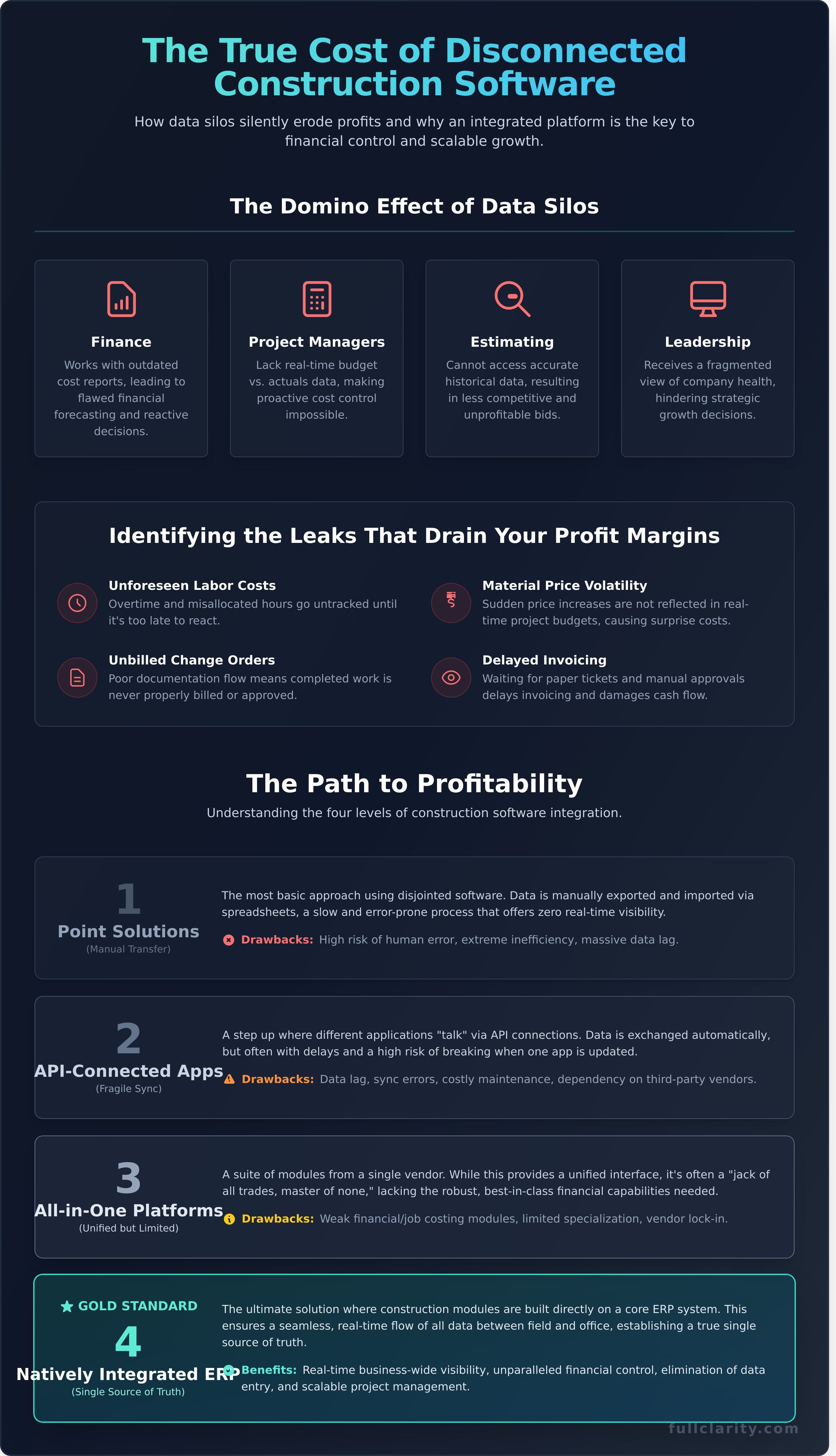
- Finance works with cost reports that are days or weeks old, leading to flawed financial forecasting.
- Project Managers lack real-time budget vs. actuals data, making it impossible to proactively control costs.
- Estimating cannot pull accurate historical data, resulting in less competitive and potentially unprofitable bids.
- Executive Leadership gets a fragmented view of company health, hindering strategic growth decisions.
Margin Erosion: Identifying the Leaks in Your Projects
Margin erosion isn't a single catastrophic event; it's a slow leak caused by countless small discrepancies that disconnected systems fail to catch. Effective construction management hinges on controlling these variables, but data silos make it nearly impossible. These leaks directly drain profitability from your bottom line.
- Unforeseen Labor Costs: Overtime and misallocated hours go untracked until payroll processing, long after the budget is blown.
- Material Price Volatility: Sudden price increases aren't reflected in project budgets in real-time, leading to surprise costs.
- Unbilled Change Orders: Work is completed, but poor documentation flow means change orders are never properly billed or approved.
- Delayed Invoicing: Waiting for paper field tickets and manual approvals to flow to accounting delays invoicing and damages cash flow.
Ultimately, the hidden costs of manual data entry, correcting human errors, and chasing down information are symptoms of a foundational flaw. To protect your profits and scale effectively, you need a powerful, integrated construction software solution designed to provide a single source of truth.
What Is Truly Integrated Construction Software? A Breakdown
In the high-stakes construction industry, the term "integration" is often used but rarely understood. True integrated construction software is not just a collection of apps; it is a single, central platform that connects every facet of your operation-from project management and scheduling in the field to job costing and accounting in the back office. The primary goal is to eliminate data silos and establish a single source of truth accessible to every project stakeholder in real time.
This stands in stark contrast to relying on multiple, disparate "point solutions" that force manual data entry and create operational friction. Academic research even highlights the quantifiable benefits of integration for improving project outcomes and profitability. However, not all integrations are created equal. Understanding the different levels is key to unlocking genuine efficiency.
Level 1: Point Solutions with Manual Export/Import
This is the most basic and inefficient approach, characterized by disjointed software for estimating, scheduling, and accounting. Teams are forced to manually transfer data using spreadsheets and CSV files-a process that is painfully slow, prone to human error, and a direct cause of margin erosion. This method offers zero real-time visibility and is the opposite of true integration.
Level 2: API-Connected Applications
A step up from manual methods, API connections allow different software applications to "talk" to each other and exchange data automatically. While this is an improvement, it often comes with significant drawbacks. Data can lag, creating discrepancies between systems, and connections can break when one vendor updates their software, leading to costly downtime and maintenance headaches.
Level 3: All-in-One Platforms
These platforms offer a suite of modules from a single vendor, providing a unified user interface. While this simplifies the user experience, these systems are often a "jack of all trades, master of none." They may excel at project management but typically lack the robust, best-in-class financial and job costing capabilities that construction businesses need to maintain tight control over profitability.
Level 4: Natively Integrated ERP Solutions
This is the gold standard for modern construction management. With this model, powerful construction modules are built directly on a core Enterprise Resource Planning (ERP) system. This native architecture ensures a seamless, real-time flow of data between field operations and corporate finance. Every change order, labor hour, and material cost is reflected instantly, providing unparalleled financial control and business-wide visibility.
The Must-Have Modules of an Integrated Platform
A truly powerful integrated construction software solution is more than a bundle of disconnected tools. It is a unified ecosystem where every component communicates seamlessly, creating a real-time "single source of truth" for your entire operation. Evaluating a platform requires understanding its core modules and, more importantly, how they work together to eliminate data silos and drive profitability. A complete solution connects the field to the back office, ensuring every action has a visible and immediate financial impact.
Financial Management and Job Costing
This is the financial backbone of the entire system, where every project activity is tied to a financial outcome. Robust integration means that when a purchase order is created or labor hours are logged in the field, the budget is updated instantly. This provides unparalleled visibility and control, eliminating guesswork and margin erosion.
- Real-Time Tracking: Monitor budgets, commitments, and actual costs as they happen, not weeks later.
- Automated Workflows: Streamline invoicing, progress billings, retainage, and lien waiver management to improve cash flow.
- Accurate Reporting: Generate precise Work-in-Progress (WIP) reports automatically, providing a true financial picture of project health.
Project Management and Scheduling
This module translates financial plans into operational execution. It connects the office, field teams, and subcontractors on a single platform, ensuring everyone is aligned. When integrated, a change order approved in project management instantly creates a budget commitment in the financial module. This direct link between field operations and financial oversight is a key driver of efficiency; one academic case study on software benefits found significant productivity gains from such specialized systems. Field teams gain mobile access to the latest plans, schedules, and documents, ensuring decisions are based on current data.
Document Control and Cloud Storage
Disorganized files and version control issues are a major source of risk and costly rework. An integrated document control module acts as a central, secure repository for all project files, from drawings and submittals to photos and contracts. The true power emerges when these files are linked directly to their context-an invoice PDF attached to its transaction, a change order document linked to the budget line item, or a site photo tied to a daily log. This ensures everyone is working from the latest version and that critical information is always just a click away.
See how FullClarity connects financials and project management natively in NetSuite.
The Business Case: Quantifiable Benefits of Integration
Moving beyond a list of features, the true business case for integrated construction software is measured in tangible ROI, risk mitigation, and operational scalability. When data flows seamlessly from the field to finance, every stakeholder gains a powerful advantage. This transforms disconnected processes into a strategic, unified operation and creates a single source of truth that drives profitability and protects margins.
The value is not abstract-it is a quantifiable improvement felt across every level of your business.
For the CFO: Financial Certainty and Control
An integrated platform provides the real-time financial visibility essential for strategic decision-making. By connecting accounting with project operations, you eliminate data silos and manual report consolidation, giving you direct control over the company's financial health.
- Achieve Real-Time Profitability Insights: Instantly view job costing, budget vs. actuals, and portfolio performance without waiting for month-end reports.
- Improve Cash Flow: Studies show integrated systems can accelerate billing cycles by 25-50% through automated progress billings and streamlined approvals.
- Reduce Financial Risk: Enhance compliance with robust audit trails and improve forecasting accuracy with reliable, centralized data.
For the Project Manager: Proactive Problem Solving
Empower your Project Managers to shift from reactive fire-fighting to proactive management. With instant access to budget data, RFIs, and change orders in one place, they can make informed decisions on the spot. This powerful visibility allows them to spend less time chasing information and more time driving project success, identifying and mitigating potential delays before they escalate and impact the critical path.
For the Field Team: Efficiency and Accuracy
Equip your field supervisors and crew with the tools they need to execute flawlessly. A unified system ensures everyone is working from the most current plans and documents, accessible from any tablet or mobile device. This dramatically reduces the risk of costly rework. Daily reporting, time tracking, and photo documentation become simple, digital tasks, strengthening the critical link between the job site and the office and ensuring accurate data capture from day one.
Discover how FullClarity, built on NetSuite, delivers these powerful, integrated benefits. Learn more at fullclarity.com.
How to Choose the Right Integrated Construction Software
Selecting the right platform is a foundational business decision, not just an IT purchase. A methodical approach ensures you invest in a solution that drives profitability and eliminates operational friction. This step-by-step framework will empower you to cut through the noise and choose the best integrated construction software for your company's future.
Step 1: Assess Your Current Processes and Pain Points
Before you can find the right solution, you must deeply understand your current problems. Map your entire workflow, from the initial bid to the final payment. Involve key stakeholders from finance, project management, and the field to identify the most significant bottlenecks. Where does data get lost? What manual processes are causing delays and errors? Pinpointing sources of margin erosion and data silos is the critical first step in defining what you need to fix.
Step 2: Define Your Core Requirements
Translate your pain points into a clear set of requirements. Create a checklist that separates your absolute 'must-haves' from 'nice-to-have' features. Prioritize functionalities that directly impact your bottom line and create a single source of truth across your organization.
- Must-Haves: Robust, real-time job costing; deep, native accounting integration; scalable architecture to support growth.
- Nice-to-Haves: Specific mobile app features, advanced CRM modules, or custom reporting dashboards.
A clear list prevents you from being distracted by flashy features that don't solve your core business challenges.
Step 3: Evaluate the Depth of Integration
This is where many companies make a critical mistake. Not all integrations are created equal. Many vendors offer fragile, third-party API links that require constant maintenance and can break, creating new data silos. Challenge potential vendors to demonstrate the real-time data flow between project management and financial modules. Ask them to prove whether their platform is a collection of acquired products or a truly unified system. Understanding how the software handles complex job costing and accounting is non-negotiable. Request a demo to see true native NetSuite integration in action. Choosing a powerful, genuinely integrated construction software ensures you gain the control and visibility needed to protect your margins and scale your business with confidence.
Build Your Future on a Foundation of Integrated Data
The journey from operational chaos to financial control begins with a single, decisive step: leaving disconnected software behind. As we've detailed, data silos and manual processes are the root cause of margin erosion, creating blind spots where profits disappear. A truly unified platform demolishes these silos, providing a real-time, 360-degree view of project health. Adopting a powerful integrated construction software is the most critical investment you can make in your company's future profitability and resilience.
This is the future-proof foundation that FullClarity provides. Our Construction for NetSuite solution is built natively on the world's #1 cloud ERP, delivering the 'single source of truth' that leading firms trust to eliminate guesswork and protect their bottom line. It’s time to command your data, control your costs, and build with absolute confidence. Discover FullClarity's Construction for NetSuite solution.
Frequently Asked Questions
What is the difference between construction management software and a construction ERP?
Construction management software typically focuses on project-level operations like scheduling, RFIs, and daily reports. A construction ERP (Enterprise Resource Planning) is a more comprehensive solution that seamlessly integrates those project functions with core business financials, accounting, and HR. The key difference is scope: an ERP connects every department, creating a single source of truth that provides complete visibility into financial health and operational efficiency across your entire business, not just the job site.
How much does integrated construction software typically cost?
The cost is a scalable investment tailored to your company’s specific needs. Pricing depends on factors like the number of users, the required modules (e.g., job costing, project management, accounting), and implementation complexity. A best-in-class solution delivers significant ROI by eliminating margin erosion and boosting efficiency. The focus should be on the long-term value gained from real-time data visibility, which far outweighs the initial expense and provides a powerful competitive advantage.
How long does it take to implement an integrated software solution?
Implementation timelines vary based on a company's size, data complexity, and the level of customization required. A typical deployment can range from three to six months, but a structured process with a dedicated partner ensures an efficient transition. This strategic approach guarantees your data is migrated correctly, your team is trained effectively, and the system is configured for maximum impact. The goal is to deliver immediate value and a future-proof platform for growth.
Can integrated software work for small to mid-sized construction companies?
Absolutely. Modern cloud-based solutions are designed to be fully scalable, making them ideal for growing SMBs. You can start with the core functionalities essential for your current operations and seamlessly add more advanced modules as your business expands. This modular approach ensures that powerful integrated construction software is not just for large enterprises. It provides a robust foundation that supports growth, prevents you from outgrowing your system, and delivers enterprise-level efficiency at a manageable scale.
How does integrated software handle mobile access for field teams?
Best-in-class integrated platforms provide robust mobile capabilities through dedicated applications or responsive web portals. This empowers field teams with real-time access to project plans, documents, and communication tools directly from the job site. Field staff can instantly submit daily logs, timecards, change orders, and photos, ensuring data flows seamlessly to the back office. This eliminates information delays and guarantees every decision is based on the most current data from the field.
What is the role of a 'single source of truth' in construction?
A 'single source of truth' is the foundational benefit of an integrated system, where all operational and financial data resides in one centralized, real-time database. Its role is to eliminate dangerous data silos, eradicate errors from manual double-entry, and provide unparalleled visibility across your entire portfolio. This empowers leadership with accurate, up-to-the-minute information for powerful job costing, precise financial forecasting, and proactive risk management, turning data into a decisive competitive advantage.