

Construction Project Management Software: The Ultimate Guide
Are project delays and budget overruns silently eroding your profit margins? For many construction leaders, the daily battle with disconnected data, chaotic document management, and a communication gap between the office and the field is a constant source of financial anxiety. This operational friction doesn't just cause headaches-it directly impacts your bottom line and hinders growth.
The solution isn't another spreadsheet or a standalone app; it's a foundational shift in how you manage your operations. The right construction project management software provides a single source of truth, transforming operational chaos into total project control and financial clarity. By seamlessly integrating project and financial data, you gain the real-time visibility needed to protect profitability on every job.
This ultimate guide is your blueprint for making that transformation. We will explore the essential features, critical benefits, and selection criteria for choosing a robust platform. You will discover how to achieve accurate job costing, streamline workflows, and select a scalable system that not only solves today's problems but also supports your future growth. Prepare to gain total project control and eliminate margin erosion for good.
What Is Construction Project Management Software (And Why Spreadsheets Fail)?
At its core, construction project management software is a centralized platform designed to connect the teams, data, and processes essential for a successful build. It serves as the digital backbone for the complex discipline of Construction management, moving operations beyond the severe limitations of manual tools. Unlike static spreadsheets, this robust software creates a dynamic, real-time environment where every stakeholder-from the field crew to the CFO-works from a unified playbook, from initial bid to final closeout.
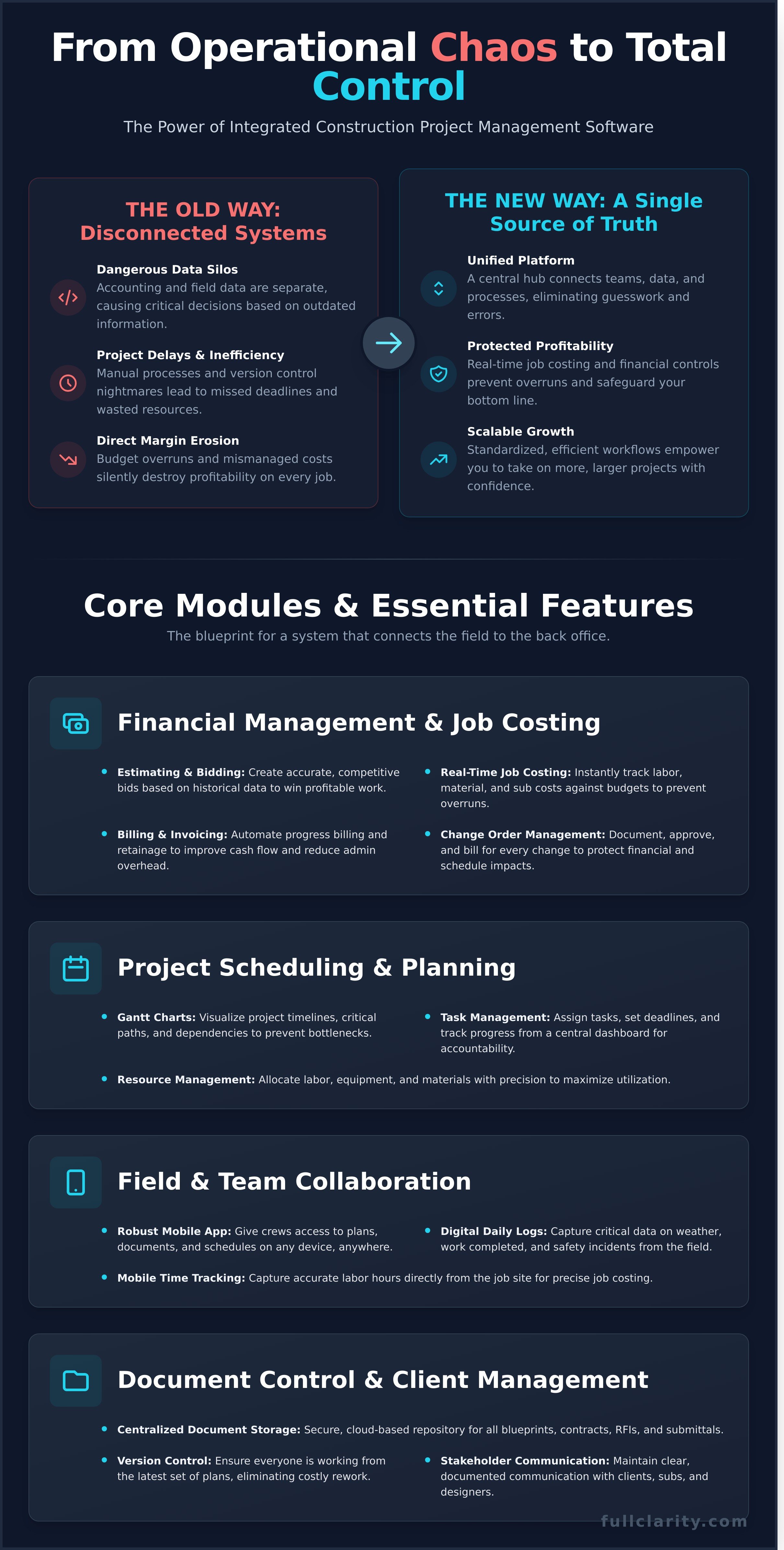
For decades, construction firms have relied on spreadsheets to track job costs, schedules, and change orders. But these tools were never built to handle the immense complexity and fast pace of modern projects. They create dangerous data silos, version control nightmares, and a complete lack of real-time visibility, making them a significant liability.
The True Cost of Disconnected Systems
When accounting and field operations run on separate, manually-updated spreadsheets, costly mistakes are inevitable. Data silos lead to critical decisions being made with outdated information, causing budget overruns and mismanaged resources. This slow, fragmented approach to job costing directly causes margin erosion, threatening the profitability and financial health of your projects before you even realize there's a problem.
Key Benefits of a Centralized Platform
The solution is a powerful, integrated platform that establishes a single source of truth for all project information. By replacing fragmented spreadsheets and disconnected applications with a unified system, construction firms unlock powerful, tangible benefits that drive efficiency and protect profits.
- Real-time Visibility: Gain instant, accurate insight into project health, cash flow, and profitability with intelligent dashboards, not outdated reports.
- Improved Collaboration: Seamlessly connect office staff with field crews, ensuring everyone has access to the latest plans, change orders, and communications.
- Standardized Processes: Enforce best practices and create repeatable, scalable workflows for bidding, scheduling, RFI management, and billing.
- Enhanced Decision-Making: Empower leadership to make confident, strategic choices based on up-to-the-minute data, not unreliable guesswork.
Core Modules & Features to Demand in Your Software
Evaluating construction project management software goes beyond a simple feature-for-feature comparison. The most robust platforms are structured around core business functions, providing a single source of truth that connects the field to the back office. By assessing solutions through this lens, you can build a requirements checklist that directly addresses your most critical operational and financial challenges, ensuring you select a tool that drives tangible results.
Financial Management and Job Costing
Protecting profitability is the primary directive. Your software must provide granular, real-time financial controls to prevent margin erosion and empower data-driven decisions. Look for a seamlessly integrated financial suite that offers:
- Estimating and Bidding: Move beyond spreadsheets to create accurate, competitive bids based on historical data, ensuring you win more profitable work from the start.
- Real-Time Job Costing: Gain immediate visibility into how labor, materials, and subcontractor costs are tracking against your budget to proactively address overruns.
- Billing & Invoicing: Automate complex processes like progress billing and retainage management to improve cash flow and reduce administrative overhead.
- Change Order Management: Instantly see the financial and schedule impact of every change order, ensuring all adjustments are documented, approved, and billed correctly.
Project Scheduling and Planning
Effective project execution hinges on meticulous planning and coordination. As the U.S. Bureau of Labor Statistics notes, the core role of Construction Managers involves supervising every phase of a project. The right software empowers this role by transforming complex plans into actionable schedules. Essential features include:
- Gantt Charts: Visualize project timelines, critical path activities, and task dependencies to anticipate bottlenecks before they cause costly delays.
- Resource Management: Allocate labor, equipment, and materials with precision to maximize utilization and prevent costly downtime or resource conflicts.
- Task Management: Assign specific tasks to team members, set deadlines, and track progress from a centralized dashboard to drive accountability and keep projects on schedule.
Field and Team Collaboration Tools
Bridging the gap between the office and the job site is non-negotiable for modern construction firms. An effective construction project management software solution must empower your field teams with tools that sync directly with the central system. Demand these capabilities:
- A Robust Mobile App: Give crews access to the latest plans, documents, and schedules on any device, while enabling them to submit daily logs, time cards, and photos from the field.
- Digital Daily Logs: Replace paper logs with standardized digital forms to capture crucial data on weather, work completed, safety incidents, and on-site visitors.
- Mobile Time Tracking: Capture accurate labor hours directly from the job site to ensure precise job costing and streamlined payroll processing.
Document Control and Client Management
Mismanaged information creates significant risk and erodes client trust. A centralized system for all project documentation is essential for mitigating liability and maintaining clear communication with all stakeholders. Key features are:
- Centralized Document Storage: A secure, cloud-based repository for all blueprints, contracts, RFIs, and submittals ensures the entire team is working from the most current versions.
- RFI & Submittal Management: Streamline and track these critical communication workflows to reduce response times and create a complete, searchable audit trail.
- Client Portal: Provide clients with a professional, transparent window into project progress, approvals, and key documents to enhance satisfaction and build stronger relationships.
Standalone Apps vs. Integrated ERP Platforms: A Critical Decision
When selecting a construction project management software, one of the most fundamental decisions your team will make is choosing between a standalone application and a fully integrated platform. Standalone tools focus exclusively on project operations, while integrated solutions are built upon a core financial ERP. The right path depends entirely on your company's current complexity, operational needs, and long-term growth ambitions.
The Case for Standalone Project Management Apps
Standalone applications, such as Buildertrend or Procore, are designed with a singular focus on field and project team workflows. For smaller contractors or those with simple financial processes, they can be an attractive option.
- Pros: They are often faster to implement and may have a lower initial subscription cost. Their specialized nature means they can be highly intuitive for specific tasks like daily logs or RFI management.
- Cons: Their greatest strength is also their critical weakness. They create a dangerous data silo between project operations and company financials. This separation requires manual data reentry or reliance on fragile, third-party integrations, leading to delays, errors, and a complete lack of real-time job cost visibility.
The Power of a Natively Integrated ERP Solution
For growing and established construction firms, managing projects and financials in separate systems is unsustainable. An integrated platform built on a robust ERP like NetSuite provides a powerful, unified foundation for the entire business.
- A Single Source of Truth: All data-from change orders and subcontractor invoices to payroll and WIP reports-resides in one system. This eliminates discrepancies and empowers every department with the same accurate information.
- Real-Time Financial Control: Double entry is completely eliminated. As costs are incurred in the field, they are instantly reflected in the project's financials, giving you an accurate, up-to-the-minute view of profitability and preventing margin erosion.
- Unmatched Scalability: An ERP-based system is designed to grow with you, easily handling more complex projects, additional business units, and evolving reporting requirements without forcing a costly migration down the road.
Ultimately, connecting every aspect of your business provides the clarity and control needed to protect profits and scale effectively. See how an integrated construction solution connects finance and operations into one powerful platform.
How to Choose the Right Construction Software: An Evaluation Framework
Selecting the right technology is one of the most critical business decisions you will make. The goal isn’t to find the “best” software on the market, but to identify the best-fit solution that directly addresses your operational challenges and financial goals. A structured evaluation process eliminates guesswork and ensures your investment delivers a powerful return. Follow this four-step framework to choose the right construction project management software for your business.
Step 1: Assess Your Current Workflows and Pain Points
Before you can find the right solution, you must deeply understand the problem. Map your current processes from bid to cash, involving key stakeholders from finance, operations, and the field. Identify the most significant bottlenecks, communication gaps, and sources of margin leakage. Is it slow change order approvals? Inaccurate job costing? Disconnected data between the office and the job site? Documenting these pain points provides the foundation for your entire evaluation.
Step 2: Define Your Must-Have Features and Goals
Using your pain points as a guide, create a prioritized list of "must-have" features. Go beyond a simple checklist and set specific, measurable goals for what you need the software to achieve. Vague goals like "improve efficiency" are not enough. Instead, aim for concrete targets:
- Reduce budget overruns by 10% within 12 months.
- Decrease the time to process RFIs and submittals by 40%.
- Achieve real-time project cost visibility to eliminate reporting delays.
Step 3: Consider Scalability and Total Cost of Ownership
The ideal platform must be robust enough for today and scalable for tomorrow. Look beyond the monthly subscription fee to understand the Total Cost of Ownership (TCO), which includes implementation, data migration, training, and ongoing support. Ask vendors about their product roadmap to ensure their vision aligns with your growth trajectory. A low-cost solution that can't grow with you is not a solution-it's a future problem.
Step 4: Schedule Demos and Check References
Armed with your requirements, request personalized demos that address your specific use cases. Do not settle for a generic sales pitch. Prepare detailed questions and have your team participate. Finally, ask for references from companies of a similar size and in a similar trade. Speaking directly with current customers provides invaluable, unfiltered insight into the software's real-world performance and the vendor’s post-sale support. When you're ready to see how a truly integrated solution built on NetSuite can provide a single source of truth, we're here to help.
Build Your Blueprint for Profitability and Control
Moving beyond spreadsheets is no longer a choice-it's a strategic imperative for survival and growth. As this guide has shown, the most critical decision you'll make is choosing between disjointed standalone apps and a unified platform that connects every aspect of your business. The right construction project management software provides a robust foundation, not just for managing projects, but for protecting your bottom line.
This is where an integrated system becomes a powerful competitive advantage. Trusted by leading construction firms, FullClarity is natively built on the Oracle NetSuite platform to eliminate margin erosion and provide a real-time 'single source of truth' for your finance and operations teams. Stop wrestling with inaccurate data and gain the visibility you need to drive profitability on every job.
Ready to build on a foundation of certainty? Request a demo to see how FullClarity provides a single source of truth on NetSuite. Your future of streamlined operations and protected margins starts here.
Frequently Asked Questions
What is the average cost of construction project management software?
The cost varies based on users, features, and deployment model. Entry-level tools may start around $50 per user per month, while robust, enterprise-level systems can be several hundred. It is critical to view this not as an expense, but as an investment in efficiency and visibility. A powerful platform eliminates data silos and protects against margin erosion, delivering a significant return on investment by providing a single source of truth for all project financials and operations.
How long does it take to implement new construction management software?
Implementation timelines depend on your company's size and the complexity of data migration, typically ranging from 4 to 12 weeks. A structured process is key to success, involving system configuration, transferring historical job costing data, and comprehensive team training. Partnering with an experienced provider ensures a seamless transition, minimizing operational disruption and accelerating your path to achieving greater efficiency and control over every project outcome.
Is cloud-based or on-premise software better for a construction company?
For most modern construction firms, a cloud-based solution is the superior, future-proof choice. It offers unparalleled accessibility, allowing your teams to access critical project data from the job site or office. Cloud platforms provide robust security, automatic updates, and superior scalability without the significant upfront investment and ongoing IT maintenance required for on-premise servers. This model empowers your business with the real-time visibility and agility needed in a dynamic market.
How important is a mobile app for construction management software?
A mobile app is an operational necessity. It empowers your field teams to submit daily reports, RFIs, photos, and change orders directly from the job site, eliminating costly delays and manual data entry. This real-time information flow from the field to the office provides project managers and financial leaders with immediate visibility into project health. A powerful mobile component is essential for maintaining accurate job costing and enabling proactive, data-driven decision-making.
Can this software integrate with my existing accounting system like QuickBooks?
Absolutely. Best-in-class construction project management software is designed to seamlessly integrate with leading accounting systems like QuickBooks, Sage, or enterprise-level ERPs. This integration is critical for creating a single source of truth for all financial data. It eliminates redundant data entry, reduces human error, and ensures that project managers and accounting teams are always working with the same, up-to-the-minute information on job costs, change orders, and invoicing.
What kind of training and support is typically provided with the software?
Reputable software providers view training and support as a cornerstone of your success. This typically includes a structured onboarding process, live training sessions for your team, and a dedicated support specialist. Look for providers that offer a comprehensive online knowledge base, video tutorials, and ongoing customer support to ensure high user adoption. This partnership is vital for maximizing your return on investment and leveraging the full power of the platform.