

NetSuite Job Costing: The Ultimate Guide to Project Profitability
The final project report hits your desk, and your stomach sinks. Another job with razor-thin margins-or worse, a loss. For project-based businesses, especially in complex industries like construction, this painful scenario often stems from inaccurate bids and financial data scattered across disparate spreadsheets and accounting tools. Mastering NetSuite job costing is the only way to stop this cycle. It provides the powerful, integrated framework needed to move beyond reactive damage control and into proactive, data-driven decision-making, establishing a true single source of truth for all your project financials.
This ultimate guide is your roadmap to achieving that control. We will walk you through the essential strategies and best practices to leverage NetSuite for powerful, real-time project accounting. You will learn precisely how to eliminate margin erosion before it gets out of control, create consistently accurate bids, and gain the complete visibility needed to guarantee every single project is profitable. It's time to stop guessing and start knowing the true financial health of every job.
What is Job Costing and Why is it Critical in NetSuite?
For any project-based business, from construction firms to professional services agencies, profitability isn't a high-level guess-it's a number calculated one job at a time. This is the essence of job costing: a powerful accounting method for tracking every cost associated with a specific project or job. Unlike generalized accounting, this granular approach assigns direct materials, labor, and overhead to individual projects, moving your financial analysis from guesswork to a precise science. To truly understand its fundamentals, one can explore the question of What is Job Costing?, but its core purpose remains constant: to reveal the true profitability of every engagement.
Without this detailed insight, you're operating in the dark. This is why an integrated cloud ERP like NetSuite is the ideal platform. By consolidating financials, project management, inventory, and payroll, NetSuite eliminates the dangerous data silos that plague businesses using disconnected systems. It creates a robust, real-time 'single source of truth' for all project data, providing unparalleled visibility and control.
The Dangers of Inaccurate Job Costing
Failing to accurately track job costs isn't just a minor oversight; it's a direct threat to your company's survival. The consequences are severe and compound over time:
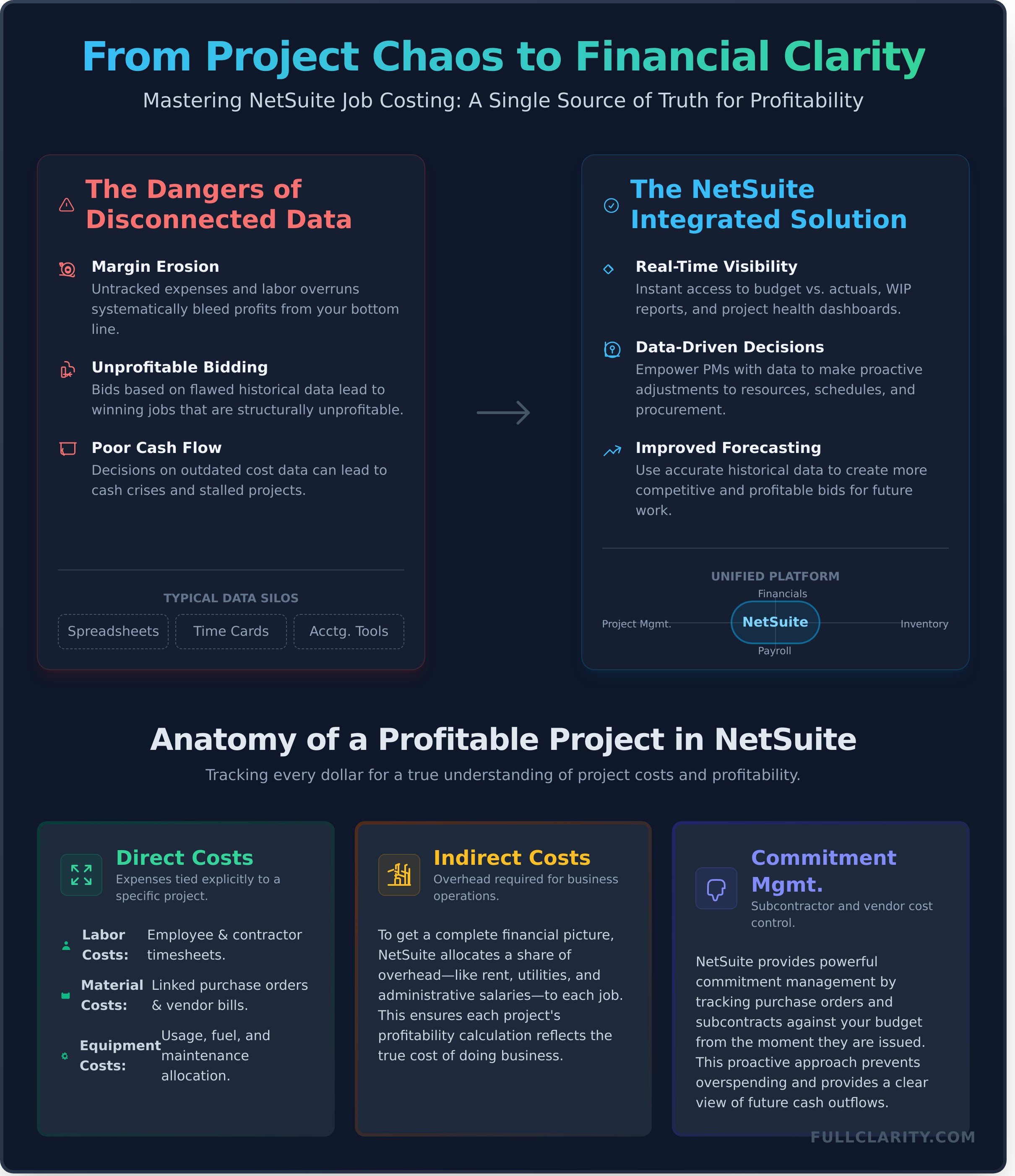
- Margin Erosion: Small, untracked expenses and labor overruns seem insignificant individually, but they systematically bleed profits from your bottom line, project by project.
- Unprofitable Bidding: When bids are based on flawed historical data, you risk winning jobs that are structurally unprofitable from day one.
- Poor Cash Flow Management: Making critical financial decisions based on outdated or incomplete cost data can lead to cash flow crises and stalled projects.
Key Benefits of Mastering NetSuite Job Costing
Conversely, leveraging a powerful NetSuite job costing system transforms your operations, turning data into your most valuable asset. The benefits are immediate and foundational to scalable growth:
- Real-time Visibility: Gain instant access to budget vs. actuals, work-in-progress (WIP) reports, and project health dashboards to identify issues before they escalate.
- Data-Driven Decision-Making: Empower project managers to make proactive adjustments to resource allocation, scheduling, and procurement to keep projects on track and on budget.
- Improved Forecasting: Use accurate historical project data to create more competitive and profitable bids for future work.
- Increased Accountability: When costs and progress are transparent, project managers and teams are empowered to take ownership of financial outcomes.
Core Components of Job Costing within the NetSuite Platform
To truly master project profitability, you must first understand the financial anatomy of a job. Effective NetSuite job costing is built on a foundation of detailed cost tracking, where every dollar is categorized and accounted for. Because NetSuite is a unified platform, project-related transactions-from timesheets to vendor bills-seamlessly update the general ledger in real time. This creates a powerful, single source of truth that eliminates data silos and provides unparalleled visibility into your project's financial health.
Accurately categorizing every expense is not just an accounting exercise; it is the key to unlocking actionable insights and protecting your margins from erosion. It allows you to see precisely where your money is going and whether your projects are on a path to success or failure.
Tracking Direct Costs: Labor, Materials, and Equipment
Direct costs are expenses tied explicitly to a specific project. NetSuite provides a robust framework for capturing these critical data points with precision, ensuring every cost is assigned directly to the correct job.
- Labor Costs: Capture employee and contractor hours directly against project tasks through integrated timesheets. This provides granular detail on where your labor budget is being spent.
- Material Costs: Seamlessly link purchase orders and vendor bills to projects, giving you real-time visibility into material expenses and preventing budget overruns.
- Equipment Costs: Allocate equipment usage, fuel, maintenance, and even depreciation to the jobs that use them, reflecting the true cost of your assets.
Managing Indirect Costs and Overhead Allocation
Indirect costs, or overhead, include expenses like rent, utilities, and administrative salaries that are not tied to a single project but are essential for business operations. To gain a complete financial picture, businesses must account for every expense. As recognized by publications like Forbes, the Core Components of Job Costing in any powerful accounting platform must include robust methods for allocating these indirect costs. NetSuite allows you to apply overhead to jobs based on intelligent allocation methods (e.g., as a percentage of labor costs), ensuring each project’s profitability calculation reflects its share of the true cost of doing business.
Subcontractor and Commitment Management
For many project-based businesses, especially in construction, subcontractors represent a significant portion of job costs. NetSuite enables you to track subcontractor invoices, payments, and compliance documentation against project budgets. More importantly, it provides powerful commitment management, tracking purchase orders and subcontracts as commitments against your budget from the moment they are issued. This proactive approach prevents overspending and provides a clear view of future cash outflows, including industry-specific needs like managing retainage.
Native NetSuite Job Costing vs. Enhanced Industry Solutions
Oracle NetSuite is an undisputed powerhouse, providing a robust platform for financial and operational management. However, when it comes to the highly specific demands of project-driven industries, it is critical to distinguish between its standard capabilities and a truly specialized solution. The native 'Projects' module offers a starting point, but growing businesses quickly encounter a ceiling that can limit visibility and control.
Capabilities of the Standard NetSuite Projects Module
Out of the box, NetSuite provides a solid foundation for basic project accounting. The standard module enables you to create project records, establish simple work breakdown structures (WBS), and track time and expenses against those projects. This allows businesses to apply foundational job costing concepts and gain initial visibility into budget vs. actuals through standard reporting, making it suitable for companies with straightforward project needs.
Where Native Functionality Falls Short for Construction
For industries like construction, where razor-thin margins and complex contracts are the norm, the standard functionality reveals critical gaps. A generalist tool cannot effectively manage the unique financial and operational workflows that define construction projects. This is where a generic NetSuite job costing setup struggles, leading to manual workarounds, data silos, and margin erosion.
- Complex Change Orders: Native tools lack the robust workflow for creating, approving, and tracking the financial impact of change orders on both cost and revenue.
- Subcontractor & Retainage Management: Managing compliance, pay applications, and retainage for multiple subcontractors is a significant challenge without specialized functionality.
- Inflexible Budgeting: Construction budgets require granular detail and specific structures (e.g., AIA G702/703 billing) that are not standard in NetSuite.
- WIP Reporting: The absence of detailed, real-time Work-in-Progress reporting makes it nearly impossible to accurately recognize revenue and project future profitability.
The FullClarity Advantage: Construction for NetSuite
This is precisely why solutions 'Built on NetSuite' are essential for growth. Unlike fragile third-party integrations, a native application like FullClarity works seamlessly within your ERP. It doesn't just connect to NetSuite; it extends its power. We fill the functionality gaps with powerful, construction-specific tools for everything from advanced budgeting to automated retainage management. This empowers you to achieve a true 'single source of truth' for all project financial data, eliminating guesswork and driving predictable profitability. See how FullClarity enhances NetSuite for construction.
Advanced Strategies with FullClarity to Eliminate Margin Erosion
Standard job costing tells you what happened. A powerful, integrated system shows you what's happening right now-and what will happen next. By extending NetSuite with FullClarity, you move from reactive problem-solving to proactive profit protection. This is how you eliminate margin erosion before it starts, turning your financial data from a historical record into a strategic asset that safeguards your bottom line on every single job.
Automating key processes and leveraging real-time data empowers your project managers with the information they need to succeed, dramatically reducing administrative overhead and the risk of costly manual errors.
Achieve Real-Time Budget vs. Actual (BvA) Reporting
Gain instant, granular visibility into project health. With a real-time BvA dashboard, you can immediately see where your project stands against its budget. Drill down into specific cost codes to pinpoint variances the moment they occur, empowering your team to make immediate, data-driven adjustments that prevent minor issues from becoming major cost overruns. This is control, not hindsight.
Seamlessly Manage Change Orders and Commitments
Stop letting change orders and unrecorded commitments create surprise expenses. Our robust solution allows you to track the full financial and timeline impact of every change order seamlessly. More importantly, you gain full visibility into all committed costs-like purchase orders not yet invoiced-giving you a true, forward-looking picture of your project's financial obligations and protecting your margins from unexpected hits.
Automate Work-in-Progress (WIP) and Profitability Reports
Manual WIP reporting is slow, error-prone, and a drain on your finance team. Automate the generation of accurate, reliable WIP reports that are essential for construction accounting and stakeholder confidence. Understand true project profitability at any stage of the lifecycle, not just at the end. Provide leadership with the clear, concise, and up-to-the-minute financial data needed for strategic decision-making.
Ultimately, a best-in-class NetSuite job costing system becomes a powerful competitive advantage. When your teams are equipped with a real-time 'single source of truth,' they can consistently deliver projects on time and on budget, building a reputation for reliability and excellence. Discover how the NetSuite + FullClarity platform transforms project data into predictable profitability at fullclarity.com.
Implementing a Powerful Job Costing System in NetSuite
Transitioning to a robust job costing system is a strategic project, not just a software update. A successful implementation hinges on a clear methodology that aligns technology with your business processes. The goal is to create a single source of truth that empowers your team with real-time financial visibility and control over project profitability from day one.
Step 1: Define Your Cost Structure and Project Templates
The foundation of effective NetSuite job costing is a well-defined framework. Before configuring the system, you must standardize how you classify and track expenses. This upfront planning ensures consistency across all projects and delivers the accurate, granular data you need to protect margins.
- Map Your Cost Breakdown Structure (CBS): Document every potential cost category, from labor and materials to subcontractor fees, equipment rentals, and overhead allocations.
- Standardize Your Work Breakdown Structure (WBS): Create a uniform hierarchy of project phases, tasks, and deliverables that will be used for every job.
- Build Project Templates: Use your WBS and CBS to build project templates directly in NetSuite. This automates project creation, enforces consistency, and dramatically accelerates setup time.
Step 2: Data Migration and System Configuration
With your structure defined, the next phase focuses on configuring the platform and populating it with essential data. This technical step is critical for ensuring the system reflects your unique operational workflows and provides historical context for future estimates. Key actions include planning the migration of past project data for analysis, configuring approval workflows, and ensuring NetSuite seamlessly integrates with vital modules like Payroll, Inventory, and Purchasing to automate cost capture.
Step 3: Training, Go-Live, and Continuous Improvement
Technology is only as powerful as the team using it. Driving user adoption is non-negotiable for data accuracy. This requires comprehensive training for all stakeholders, from project managers entering time to accounting staff processing invoices. A carefully managed go-live, supported by experts, minimizes disruption. Post-launch, the focus shifts to leveraging NetSuite’s powerful reporting to analyze performance, identify trends, and continuously refine your project management and costing processes. Partner with experts for a seamless implementation.
From Data to Decisions: The Future of Your Project Profitability
In today's competitive landscape, protecting your margins is non-negotiable. As we've explored, true project profitability moves beyond basic accounting to a dynamic, real-time financial overview. While NetSuite provides a powerful ERP foundation, achieving the granular visibility needed to eliminate margin erosion requires a specialized, robust solution. Mastering NetSuite job costing is not just about tracking expenses-it's about gaining strategic command over every project's financial health.
Don't let data silos and hidden costs dictate your success. See firsthand how FullClarity’s Construction for NetSuite, trusted by leading firms, delivers a real-time 'single source of truth' for all project financials. Natively built on the NetSuite platform, our solution guarantees a seamless, powerful, and unified experience that drives efficiency and protects your bottom line.
Ready to transform your project management and build a more profitable future? Request a personalized demo of Construction for NetSuite today.
Frequently Asked Questions
Can NetSuite's standard Projects module handle construction job costing?
While NetSuite's standard Projects module is effective for basic project management, it lacks the robust, industry-specific functionality required for complex construction job costing. It falls short in critical areas such as managing retainage, detailed change orders, and producing accurate Work-in-Progress (WIP) reports. For true financial control and visibility, construction firms require a specialized solution that extends NetSuite's core capabilities to meet their unique costing and reporting demands.
What is the difference between project accounting and job costing in NetSuite?
Project accounting provides a high-level financial overview of a project, tracking overall revenues, expenses, and profitability. Job costing is a more granular discipline within project accounting. It focuses on meticulously tracking and analyzing every cost-labor, materials, subcontractors, and equipment-against specific budget line items. This detailed approach is essential for identifying potential margin erosion early and making informed decisions to keep projects profitable.
How does NetSuite job costing integrate with payroll and accounts payable?
A powerful NetSuite job costing solution seamlessly integrates these critical functions to create a single source of truth. When an invoice is processed in Accounts Payable, it can be coded directly to a specific job and cost code. Likewise, when payroll is run, employee time is automatically allocated as a direct labor cost to the corresponding projects. This eliminates manual data entry, ensures real-time cost visibility, and provides an accurate, up-to-the-minute view of project financial health.
What are the most important job costing reports I should be running in NetSuite?
To maintain control over project profitability, you should regularly run several key reports. The most critical include the Job Cost Detail report (comparing actuals vs. budget by cost code), the Work-in-Progress (WIP) schedule for bonding and banking, and Cost-to-Complete reports to forecast final project costs accurately. These reports provide the essential visibility needed to manage cash flow, prevent budget overruns, and protect your margins on every job.
How long does it take to implement an advanced job costing solution like FullClarity?
Implementation is measured in weeks, not months. Because FullClarity is built natively on the NetSuite platform, the process is significantly streamlined. We leverage your existing NetSuite data and configurations, which eliminates the complex and time-consuming integration work required by external third-party applications. Our focus is on configuring the solution to your specific business processes and providing comprehensive user training, ensuring a rapid and successful deployment.
Is FullClarity's solution built inside NetSuite or is it a separate application?
FullClarity is a 100% Built-for-NetSuite application, meaning it operates natively within your NetSuite environment. It is not a separate application that requires clunky integrations or data syncing. This native design provides a unified user experience, leverages NetSuite’s robust security, and ensures all your project financial data exists in a single, real-time database. This gives your team a powerful, seamless "single source of truth" for all project and financial information.