

What is Construction Management? A Complete Guide
In the high-stakes world of construction, the gap between a profitable project and a financial disaster is razor-thin. Constant budget overruns, schedule delays, and chaotic communication between stakeholders aren't just headaches-they are direct threats to your bottom line, causing the kind of margin erosion that can cripple a company. Gaining control over these variables is the difference between survival and collapse, and it all comes down to one powerful discipline: effective construction management.
But what does success in this field truly look like today? This complete guide provides the clarity you need. We will explore the core principles and key project phases that form the foundation of every successful build. You will gain a robust understanding of modern challenges and discover the technology solutions that provide a single source of truth-empowering you to gain real-time visibility, streamline operations from bid to closeout, and consistently deliver projects on time and within budget.
What is Construction Management? Core Principles and Objectives
Construction Management is a professional service that provides robust, centralized oversight for a project's schedule, cost, and quality. At its core, construction management involves the detailed planning, coordination, and control of a project from its initial conception to its final closeout. A dedicated Construction Manager (CM) serves as the project owner's trusted representative, ensuring every decision is made to protect their interests and align with strategic goals.
The primary objective is to deliver a finished project that meets all requirements on time and within budget. This is achieved by implementing powerful processes that enhance visibility, improve efficiency, and mitigate risks, ultimately driving client satisfaction and maximizing return on investment.
The Project Management Triangle in Construction
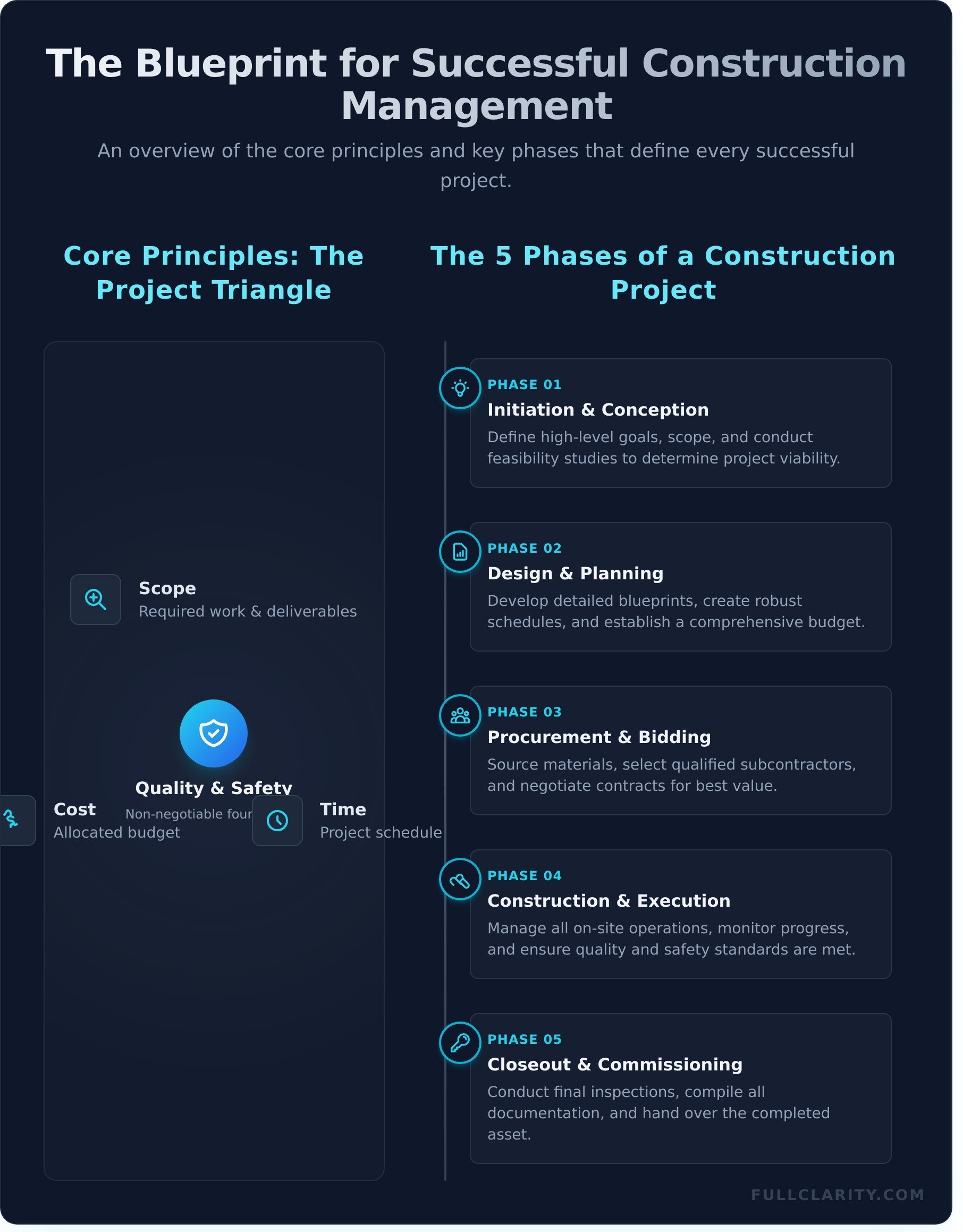
Effective project delivery hinges on expertly balancing the three primary constraints of the "Project Management Triangle." These competing demands must be managed seamlessly to prevent margin erosion and schedule delays.
- Scope: The specific work and deliverables required to complete the project.
- Cost: The budget allocated for all labor, materials, and overhead.
- Time: The schedule established for project completion and key milestones.
A change in one of these constraints directly impacts the others. For example, expanding the project scope will almost certainly increase costs and extend the schedule. Underpinning this entire framework are the non-negotiable foundations of Quality and Safety, which must be upheld at all times.
The 5 Key Phases of a Construction Project Lifecycle
A project’s journey from idea to reality follows a structured, five-phase lifecycle. Gaining real-time visibility into each stage is critical for maintaining control and ensuring a profitable outcome.
- Initiation & Conception: Defining high-level project goals, scope, and conducting feasibility studies to determine viability and secure stakeholder buy-in.
- Design & Planning: Developing detailed blueprints, creating robust project schedules, and establishing a comprehensive budget and job costing framework.
- Procurement & Bidding: Sourcing materials, selecting qualified subcontractors, and negotiating contracts to secure the best value and performance.
- Construction & Execution: Managing all on-site operations, monitoring progress against the plan, resolving issues, and ensuring quality and safety standards are met.
- Closeout & Commissioning: Conducting final inspections, compiling all project documentation (as-builts, warranties), and officially handing over the completed asset to the owner.
Key Functions and Responsibilities of a Construction Manager
A Construction Manager (CM) orchestrates every facet of a project, from pre-construction planning to final closeout. They are the single point of accountability, responsible for translating an owner's vision into a tangible asset while controlling time, cost, and quality. The official list of Construction Manager job duties from the Bureau of Labor Statistics underscores the role's complexity, which is built on four core pillars of successful project delivery.
Financial Management: Cost Estimation, Budgeting, and Job Costing
Protecting project profitability is a non-negotiable function. This involves creating robust initial estimates, establishing a detailed budget, and meticulously tracking every dollar spent through powerful job costing. By assigning every expense-from labor to materials-to a specific project code, a CM gains real-time visibility into financial performance. This data-driven approach is essential to proactively prevent margin erosion and ensure the project remains financially viable.
Project Scheduling and Time Management
Effective Construction Management hinges on mastering the project timeline. This begins with developing a master schedule, often visualized with Gantt charts, that outlines every task, dependency, and deadline. The CM allocates resources-labor, equipment, and materials-to ensure they are available precisely when needed. Utilizing the critical path method, they identify the sequence of tasks that directly impacts the project's completion date, enabling them to focus on what matters most to prevent costly delays.
Quality Control and Safety Management
The Construction Manager is the ultimate guardian of project quality and on-site safety. They implement stringent quality assurance processes, conducting regular site inspections to ensure all work meets or exceeds architectural specifications and building codes. Simultaneously, they are responsible for creating and enforcing a robust safety program, ensuring compliance with all OSHA regulations to protect every worker on site and mitigate project risk and liability.
Contract Administration and Stakeholder Communication
Serving as the project's central communication hub, the CM ensures seamless information flow between the owner, architects, engineers, and subcontractors. This critical role includes:
- Managing contracts with all vendors and subcontractors.
- Processing submittals and Requests for Information (RFIs) efficiently.
- Documenting all decisions and communications to create a clear project record.
- Handling the change order process by evaluating impacts on budget and schedule.
Modern Challenges Facing the Construction Industry
While the scale and ambition of building projects have evolved, the operational tools used to manage them have often lagged behind. This disconnect creates significant friction, turning manageable issues into critical threats to profitability and project timelines. For today’s leaders, effective Construction Management is less about overcoming a single obstacle and more about fighting a war on multiple fronts against inefficiency. Traditional, fragmented methods are no longer a viable strategy for survival, let alone growth.
Data Silos: The Problem with Disconnected Information
The most fundamental challenge is a lack of centralized data. When finance operates in an ERP and project managers rely on separate systems or outdated spreadsheets, chaos is inevitable. Decisions are made with incomplete or conflicting information, leading to costly mistakes. Without a real-time ‘single source of truth,’ teams cannot gain the clear visibility needed to accurately track progress, manage resources, or mitigate risks proactively.
Margin Erosion and Lack of Financial Visibility
Every disconnected data point creates a blind spot where profits disappear. Hidden costs, unexpected delays, and scope creep slowly erode project margins. The inability to track real-time budget vs. actuals means financial forecasting becomes guesswork. This lack of visibility exposes companies to severe cash flow problems and makes it impossible to understand true job-cost profitability until it’s too late to make corrections.
Productivity Gaps and Labor Shortages
The construction industry has long struggled with a productivity gap, with studies showing its labor-productivity growth has averaged only 1 percent a year over the past two decades. This is a direct result of inefficient, manual processes that waste valuable time on the job site and in the back office. Compounding this issue is a persistent labor shortage, which drives up costs and extends timelines. In this environment, maximizing the efficiency of every team member is not just an advantage-it's a necessity.
Increasing Complexity and Regulatory Burdens
Modern projects are more complex than ever, demanding sophisticated coordination and meticulous documentation. The administrative burden, from tracking change orders to managing certified payroll, is immense. Furthermore, the skills required to navigate these challenges are expanding; a modern construction management curriculum now emphasizes data analytics and technology alongside traditional practices. Failure to keep pace with these demands and maintain compliance exposes firms to significant legal and financial penalties, adding another layer of risk to an already high-stakes industry.
The Solution: Technology and Software in Modern Construction Management
The immense complexity of modern projects exposes the critical limitations of traditional methods. To overcome challenges like margin erosion, communication gaps, and schedule delays, leading firms are turning to specialized software. The right technology transforms Construction Management from a reactive discipline into a proactive, data-driven engine for profitability and control. By automating routine tasks, centralizing critical data, and integrating disparate functions, software provides the visibility needed to make intelligent, real-time decisions.
The Evolution from Spreadsheets to Specialized Software
For decades, spreadsheets and manual ledgers were the industry standard. While familiar, they are notoriously prone to human error, create version control nightmares, and offer zero real-time insight. Specialized tools for bidding, scheduling, and project management were a major step forward, but they often operate in isolation. This creates new data silos, forcing teams to waste valuable time on manual data re-entry and reconciliation, leaving decision-makers with a fragmented and outdated view of project health.
The Power of an Integrated Construction ERP
This is where a true Enterprise Resource Planning (ERP) system built for construction provides a powerful advantage. An ERP platform unifies every aspect of the business-from accounting and robust job costing to project management, equipment, and HR-into one cohesive system. It establishes a real-time ‘single source of truth’ for all project data. When your financial data seamlessly integrates with your operational progress, you gain unparalleled visibility into job profitability, cash flow, and risk, eliminating guesswork entirely.
Why a Cloud-Based Platform is a Game-Changer
Placing this integrated power in the cloud magnifies its impact. A cloud-based platform liberates your data from on-premise servers, providing secure access to anyone, anywhere, on any device. This is essential for an industry where key stakeholders are split between the office and the job site. The benefits are immediate and substantial:
- Real-Time Collaboration: Field supervisors can update progress, submit change orders, and access plans instantly, ensuring the back office always has current information.
- Ultimate Scalability: A cloud solution grows with your business, adapting to more complex projects without requiring costly IT infrastructure overhauls.
- Enhanced Security & Reliability: Leverage enterprise-grade security and automatic backups, protecting your most critical business data without the IT headache.
This total visibility is the foundation of modern, profitable Construction Management. See how a cloud solution built on NetSuite provides a robust, single platform to run your entire business.
Building a Foundation for Success: What's Next?
Understanding the principles of construction management is the first critical step. The next is to transform that knowledge into a powerful competitive advantage. The core functions we've explored-from initial planning and resource allocation to budget control and risk mitigation-are the pillars of profitable, scalable operations. The modern challenge is to move beyond simply managing projects to strategically commanding them, using real-time data to protect margins and drive predictable growth.
To thrive, your organization must adopt a proactive mindset, supported by the right skills and technology.
Key Skills for the Modern Construction Manager
The role of the construction manager has evolved. Success today demands a powerful blend of classic leadership and modern technical skill. To lead effectively, managers must cultivate:
- Technology Proficiency: Mastery of software for scheduling, job costing, and collaboration is no longer optional. It is the foundation of efficient leadership.
- Data-Driven Decision-Making: The ability to analyze project data to identify trends, forecast outcomes, and optimize performance is crucial for eliminating margin erosion.
- Financial Acumen: A deep understanding of project finance, from cash flow management to complex job costing and risk assessment, directly impacts profitability.
How to Evaluate Construction Management Solutions
Your technology stack can either be a source of strength or a source of chaos. As you evaluate solutions, look beyond standalone features and prioritize platforms that deliver a unified operational view. Avoid fragmented tools that create data silos and instead seek an integrated system that provides a single source of truth.
The most robust solutions offer native integration with a core cloud ERP, ensuring financial and operational data are always in sync. A truly future-proof platform must be scalable, growing with your business without requiring costly and complex migrations. True operational control comes from total visibility. Learn about FullClarity's integrated approach to see how a solution built natively on NetSuite can provide a real-time, single source of truth for your entire project portfolio.
Building Your Foundation for Project Success
As we've explored, effective Construction Management is the critical discipline that balances project scope, budget, and schedule. In today's complex landscape, however, traditional methods are no longer enough to combat rising costs and supply chain volatility. The key to navigating these challenges and ensuring profitability is leveraging technology for complete operational visibility.
This is where a powerful, integrated solution becomes essential. By providing a real-time ‘single source of truth’ for all project data, you can move from reactive problem-solving to proactive control. FullClarity, built natively on the world's #1 Cloud ERP, NetSuite, delivers the powerful job costing tools needed to stop margin erosion in its tracks.
Take control of your projects and start building a more profitable, predictable future.
Frequently Asked Questions About Construction Management
What is the difference between a project manager and a construction manager?
While the roles overlap, a Project Manager oversees the entire project lifecycle from conception to completion, managing stakeholders, finances, and high-level strategy. A Construction Manager’s role is more specialized, focusing on the day-to-day execution of the construction phase. They manage on-site operations, subcontractors, safety protocols, and quality control, ensuring the project is built according to plan, on time, and within budget. Both roles are critical for project success.
What are the most important stages of construction project management?
Effective construction project management is built on four critical stages. The process begins with Pre-construction, covering feasibility, design, and planning. Next is Procurement, where materials, equipment, and labor are secured. The third stage is Construction, the active building phase where plans are executed. Finally, Post-construction involves project closeout, final inspections, and handover. Mastering each stage provides the visibility needed to ensure project profitability and on-time delivery.
What software is essential for modern construction management?
Modern construction management relies on a suite of integrated software to drive efficiency and provide a single source of truth. A robust ERP system, like NetSuite, forms the financial backbone for job costing and accounting. This is complemented by specialized project management platforms for scheduling and collaboration, Building Information Modeling (BIM) for 3D design, and advanced estimating tools. Seamless integration between these systems is essential for real-time visibility and control.
How does construction management help control project costs?
Effective construction management is the primary defense against margin erosion. It controls costs through precise initial estimating, real-time job costing, and proactive budget tracking. This financial visibility allows managers to identify potential overruns before they escalate. Furthermore, it streamlines change order management and optimizes resource allocation, ensuring that every dollar is accounted for and contributes directly to project profitability. It transforms financial data into actionable intelligence for smarter decision-making.
What are the biggest trends shaping the future of construction management?
The future of the industry is being shaped by powerful technological and methodological trends. Key developments include the widespread adoption of digital tools like AI, drones, and robotics for enhanced safety and efficiency. Sustainability and green building practices are becoming standard requirements. Additionally, off-site and modular construction is gaining traction to reduce timelines and improve quality control, while data analytics is providing unprecedented insights for predictive project management.
How do you become a certified construction manager?
Becoming a certified construction manager typically requires a combination of education, experience, and examination. The most common path begins with a bachelor’s degree in construction management, civil engineering, or a related field. This is followed by several years of hands-on experience in the industry. Aspiring managers can then pursue professional credentials, such as the Certified Construction Manager (CCM) designation from the Construction Management Association of America (CMAA), by passing a comprehensive exam.