

Construction Accounting Software: The Ultimate Guide to Protecting Your Margins
Margin erosion is the silent threat that can undermine even the most successful construction projects. When financial data is scattered across disconnected spreadsheets and generic tools, you lose visibility into true job costs. Standard accounting platforms simply can't handle the complexities of job costing, AIA billing, and retainage, making the search for the right construction accounting software a high-stakes decision. This lack of a central system leaves you asking the same frustrating question at the end of every job: “Where did our profit go?”
The answer isn't working harder; it's gaining total control with a powerful, real-time “single source of truth.” This ultimate guide is designed to provide that clarity. We will explore the essential, non-negotiable features your software must have, compare different solution types to find your perfect fit, and arm you with the critical questions to ask vendors. Get ready to eliminate guesswork, streamline complex financial operations, and find a scalable solution that protects your margins today and for the future.
Why Generic Accounting Software Fails in Construction
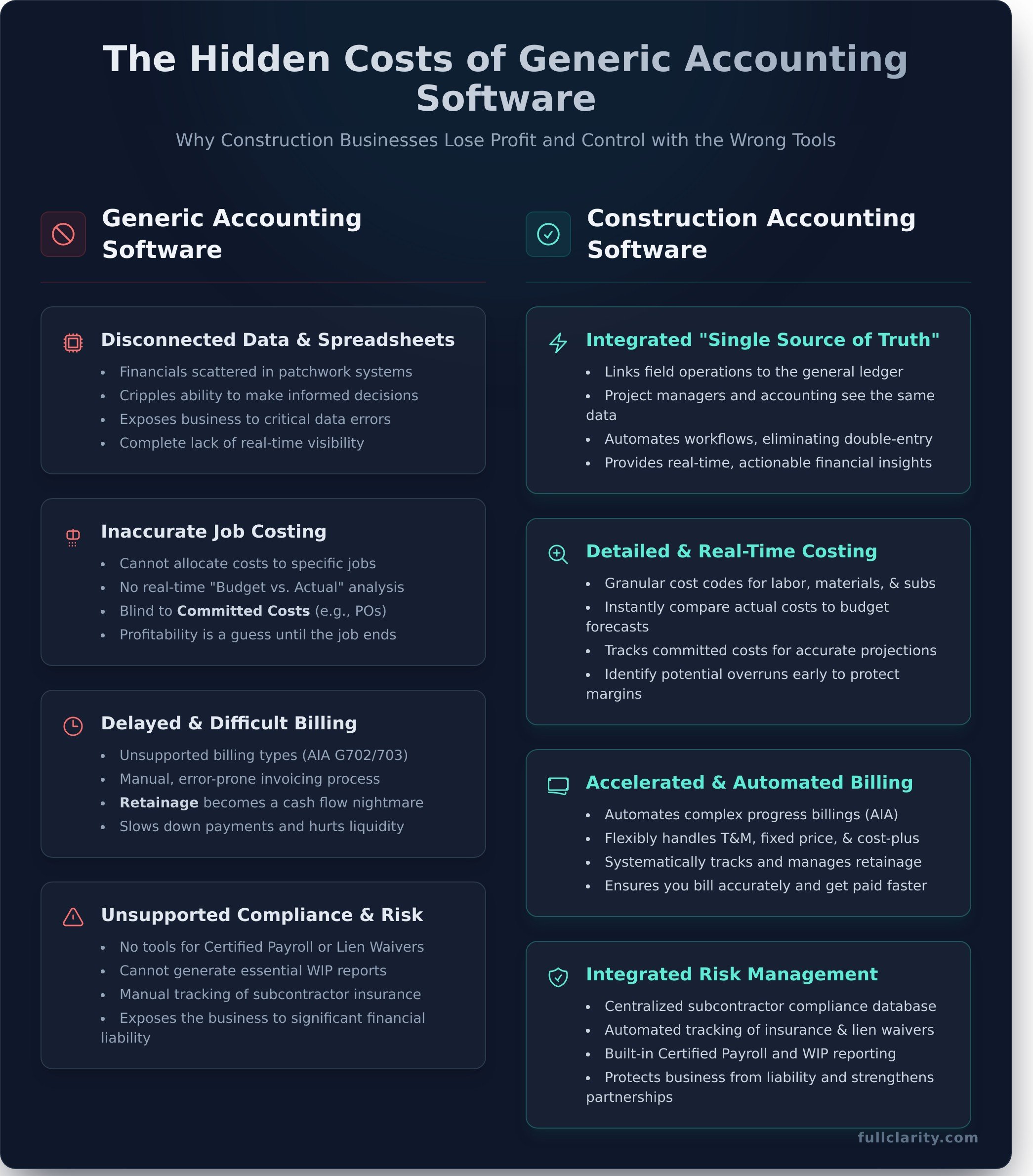
Attempting to manage a construction business with generic accounting software is like trying to build a skyscraper with a homeowner's toolkit-it’s simply not designed for the job. While platforms like QuickBooks or Xero excel at standard bookkeeping, they lack the project-centric architecture required for construction. This forces contractors to rely on a patchwork of disconnected spreadsheets, exposing them to critical data errors, security risks, and a complete lack of real-time financial visibility.
In construction, finance isn't just about balancing the books; it's about managing project profitability minute by minute. Using the wrong tools creates data silos, cripples your ability to make informed decisions, and ultimately leads to margin erosion.
The Challenge of Complex Job Costing
True job costing is the practice of tracking every single cost-labor, materials, equipment, and subcontractor fees-back to a specific project. Generic software can log an expense, but it can't accurately allocate it across multiple jobs or provide a real-time budget vs. actual analysis. This system fails to track committed costs (like purchase orders not yet invoiced), leaving you blind to future financial obligations and unable to forecast project profitability with any confidence.
Unique Billing and Revenue Recognition Needs
Construction billing is fundamentally different from standard invoicing. Contractors rely on complex methods like progress billing (e.g., AIA G702/703 forms), cost-plus contracts, and time-and-materials billing. These unique invoicing methods are fundamental to Construction Accounting Principles and are completely unsupported by off-the-shelf software. Furthermore, managing retainage-a percentage of payment held back until project completion-becomes a cash flow nightmare in a system not built to track it, making it difficult to manage and collect what you're owed.
Compliance, Reporting, and Risk Management
A robust construction accounting software solution provides powerful tools for mitigating risk and ensuring compliance, areas where generic systems offer no support. Key functions that are impossible to manage effectively without a purpose-built system include:
- Certified Payroll: Generating government-mandated reports for prevailing wage jobs is a complex, manual process without specialized software.
- Lien Waivers: Tracking the collection and issuance of lien waivers from subcontractors is critical for mitigating financial risk.
- WIP Reporting: Work-in-Progress (WIP) reports are essential for accurate financial statements and bonding capacity, yet they are a foreign concept to generic accounting tools.
- Subcontractor Compliance: Managing insurance certificates, licenses, and other compliance documents to ensure every partner on site is properly vetted.
Core Features of True Construction Accounting Software
Generic accounting platforms fail because they lack the industry-specific functionality needed to manage the complex flow of money and information in construction. When evaluating solutions, treat the following capabilities as a non-negotiable checklist. True construction accounting software moves beyond simple bookkeeping to provide a real-time, single source of truth that gives you complete visibility and control over project profitability.
Detailed Job Costing and Budgeting
Gain granular control over every dollar. A robust system allows you to create multi-level budgets with detailed cost codes, tracking labor, materials, and equipment with precision. This enables real-time monitoring of actual costs against budget forecasts and provides powerful tools for projecting cost-to-complete. The direct benefit is the ability to identify potential overruns early, protect thin margins, and make proactive decisions to keep projects profitable.
Integrated Project Management and Accounting
Eliminate the dangerous disconnect between the field and the office. An integrated platform seamlessly links project management activities-like purchase orders, subcontracts, and change orders-directly to the general ledger. This automates workflows and ensures that both project managers and accounting teams are working from the same data. This unified view is critical, as the impact of technology in construction is most profound when it breaks down data silos and fosters collaboration.
Advanced Billing and Invoicing
Accelerate your cash flow with billing tools built for the industry. Your software must automate the generation of AIA G702/G703 style progress billings and flexibly support various contract types, including Time & Materials, fixed price, and cost-plus. Furthermore, systematic tracking and management of customer retainage is essential. This ensures you bill accurately, reduce administrative overhead, and get paid faster for the work you complete.
Subcontractor and Compliance Management
Mitigate risk and streamline a critical part of your operations. A proper construction accounting software solution provides a centralized database for all subcontractor information. This includes tracking crucial compliance documents like insurance certificates, licenses, and lien waivers to ensure everyone on your job site is covered. Automating subcontractor payment processing based on these compliance checks protects your business from liability and strengthens partner relationships.
Point Solutions vs. Integrated ERP Platforms: A Critical Choice
When selecting your construction accounting software, the most critical strategic decision you'll make is choosing your software architecture. This isn't just a technical choice; it's a foundational business decision that dictates your company's potential for growth, efficiency, and profitability. The unique demands of the industry, from complex job costing to retainage, are well-documented in authoritative literature on Construction accounting, and your software architecture must be robust enough to handle this complexity.
Think of it like building a house. You could buy a separate hammer, saw, and drill from different stores-these are your 'point solutions.' Or, you could invest in a fully-equipped, automated workshop where every tool works together seamlessly-that’s an integrated platform. While the first approach seems simpler, the second delivers superior, scalable results.
The Standalone 'Point Solution' Approach
This model involves using separate, specialized software for each business function-one for accounting, another for project management, and a third for estimating. While these tools can seem cheaper upfront and easier to adopt for a single department, they create significant long-term challenges and hidden costs.
- Data Silos: Information gets trapped in separate systems, preventing a unified view of project financial health.
- Manual Double-Entry: Teams waste countless hours re-entering the same data into multiple programs, dramatically increasing the risk of costly errors.
- Integration Headaches: Connecting disparate systems is often brittle, expensive, and prone to breaking when one system updates.
- Conflicting Reports: Finance and operations pull reports from different data sets, leading to confusion, mistrust, and poor strategic decision-making.
The Power of an Integrated ERP Platform
In contrast, an integrated platform operates from a single, centralized database, creating a powerful 'single source of truth' for the entire organization. A modern construction accounting software solution like FullClarity, built natively on NetSuite, exemplifies this approach by unifying every business function on one robust platform. With everyone-from the field to the back office-working from the same real-time information, you eliminate guesswork and empower proactive management.
This intelligent architecture delivers seamless workflows from bid to closeout, provides complete financial visibility, and is fully scalable to support your company's growth. Discover how an integrated platform eliminates data silos.
The Business Impact: How the Right Software Protects Your Margins
While features and functions are important, the true value of best-in-class construction accounting software is measured in tangible business outcomes. It’s about shifting from reactive problem-solving to proactive profit protection. When your project management, job costing, and financials operate from a real-time 'single source of truth,' you gain the visibility and control needed to defend your bottom line on every project.
Eliminate Margin Erosion with Real-Time Data
Profit fade is the silent killer of construction projects. With disconnected systems, you often don't see a budget overrun until weeks after it occurs-far too late to fix it. A unified platform provides real-time job cost reports that allow project managers to spot issues instantly. For example, if material costs on a specific phase jump 10% overnight, a PM can immediately act to source from an alternate supplier or approve a change order, preserving the project's margin before it erodes.
Improve Cash Flow and Financial Predictability
In construction, cash is king. The right software transforms your financial operations from a liability into a strategic advantage. It streamlines complex billing processes and ensures you are paid faster, improving working capital and reducing the need for costly credit lines. Key benefits include:
- Accelerated Payments: Automate complex AIA billing and retainage tracking to ensure accurate, on-time submissions.
- Accurate Forecasting: Gain clear visibility into committed costs and cash projections to make smarter financial decisions.
- Stronger Subcontractor Relationships: Efficiently manage lien waivers and pay applications to ensure your partners are paid promptly, leading to better pricing and loyalty on future bids.
Scale Your Business Without Scaling Chaos
Growth should be an opportunity, not an operational nightmare. A robust construction accounting software platform provides the foundation to expand your business without a proportional increase in administrative headcount. Standardized workflows reduce errors and slash training time for new staff. This operational efficiency gives you the power to confidently take on more complex projects, manage joint ventures, and scale your operations with control and predictability. True financial clarity is achieved when your systems provide a single source of truth, a core principle behind the solutions at FullClarity.
How to Choose Your Software: A 5-Step Evaluation Framework
Selecting the right construction accounting software is a critical business decision that directly impacts profitability and scalability. A structured evaluation process eliminates guesswork and ensures you invest in a solution that solves your most pressing challenges. This five-step framework empowers you to lead a confident and effective selection process.
Step 1: Assess Your Current Pains and Processes
Before you can find the right solution, you must deeply understand the problem. Map your current financial and project management workflows, from bidding to closeout. Interview key staff in accounting, project management, and field operations to identify bottlenecks, data silos, and sources of margin erosion. Distill this research into a clear document outlining the top 3-5 problems your new software must solve.
Step 2: Define Your Must-Have vs. Nice-to-Have Features
Using your problem statement from Step 1, create a prioritized feature list. Separate non-negotiable "must-haves" (e.g., real-time job costing, AIA billing) from "nice-to-haves" (e.g., advanced CRM integration). Critically, consider your future needs. Will you be expanding into new regions or require multi-company accounting? Choose a platform that can scale with your ambition, not just solve today's issues.
Step 3: Research Vendors and Platform Types
Your research should focus on two key areas: the vendor's expertise and their technology. Look for vendors with a proven track record specifically in the construction industry. Decide if a standalone point solution is sufficient or if an integrated ERP platform will provide a more robust, single source of truth. Legacy systems often struggle with integration, while modern cloud platforms provide a scalable foundation for growth. See why FullClarity's NetSuite-native solution is built for the future.
Step 4: Conduct Targeted Demonstrations
Enter every vendor demo with a clear agenda and a list of critical questions. Do not let the vendor lead with a generic presentation; ask them to demonstrate how their software solves your specific problems from Step 1. Key questions to ask include:
- How does your system handle job costing and Work-in-Progress (WIP) reporting in real time?
- Can you walk us through the entire change order management workflow?
- What does the implementation and data migration process look like for a company our size?
- How does your platform scale to support multi-entity or multi-company growth?
Step 5: Verify Claims and Make Your Decision
After the demos, your choice may seem clear, but the final step is verification. Request and contact customer references that are similar to your company in size and scope. Carefully review proposals, paying close attention to implementation costs, support plans, and long-term subscription fees. Your final decision on a construction accounting software should be based not just on features, but on a partnership that provides long-term value and a foundation for profitable growth.
Secure Your Margins with a Future-Proof Foundation
In the high-stakes world of construction, relying on generic accounting tools or siloed point solutions is a direct threat to your profitability. The path to financial control and margin protection lies in adopting a platform built for the industry's unique complexities. Choosing the right construction accounting software is not an IT upgrade; it's a foundational business strategy for sustainable growth.
FullClarity delivers this robust foundation. Built natively on the #1 Cloud ERP, Oracle NetSuite, our platform is the complete solution for accounting, project management, and compliance. We provide the real-time job costing and "single source of truth" you need to eliminate margin erosion and gain total visibility over every project.
Ready to move from financial uncertainty to complete confidence? Request a demo to see how FullClarity provides a single source of truth for construction. Build a more profitable future, one project at a time.
Frequently Asked Questions About Construction Accounting Software
How much does construction accounting software cost?
The cost of construction accounting software varies based on your company's size, required features, and number of users. Entry-level options may start around $50-$200 per user per month. More robust, scalable systems for growing firms often involve annual subscriptions ranging from a few thousand to tens of thousands of dollars. Enterprise-level solutions with custom integrations are quoted based on specific business needs, ensuring you invest in the powerful functionality you require to drive efficiency.
Is QuickBooks Contractor good enough for a growing construction business?
QuickBooks Contractor is a capable starting point for small contractors. However, as your business grows and projects become more complex, its limitations in areas like multi-phase job costing, change order management, and retainage tracking become apparent. Growing firms require a more powerful, integrated system to gain true visibility into project profitability and avoid margin erosion. A scalable solution provides the single source of truth needed to manage growth effectively and confidently.
What is the difference between construction accounting and regular accounting?
The primary difference lies in project-centric financial management. While regular accounting focuses on the overall business, construction accounting drills down to the job level. It incorporates industry-specific functions like detailed job costing, tracking subcontractor compliance, managing retainage, and producing specialized reports like the Work-in-Progress (WIP). This granular focus provides the critical visibility needed to ensure every single project remains profitable and on budget, which standard systems cannot offer.
How long does it take to implement new construction accounting software?
Implementation time depends on system complexity and your team's readiness. A straightforward, out-of-the-box system might take 4-8 weeks. A more comprehensive ERP integration, including data migration from legacy systems and custom workflows, can range from 3 to 6 months. A successful deployment hinges on a clear plan, dedicated resources, and a strong implementation partner to ensure a seamless transition and maximize your return on investment from your new construction accounting software.
What is a WIP (Work-in-Progress) report and why is it important?
A Work-in-Progress (WIP) report is a foundational financial statement in construction that measures the profitability of ongoing projects. It compares the percentage of work completed against the actual costs incurred and the total budgeted amount. This report is critical because it provides an accurate, real-time snapshot of your company’s financial health, allowing you to identify potential profit fade or cost overruns long before a project is complete and enabling proactive decision-making.
Should I choose a cloud-based or on-premise solution?
On-premise solutions offer direct control over your data but require significant upfront investment in hardware and ongoing IT maintenance. In contrast, cloud-based software provides superior accessibility, automatic updates, and predictable subscription costs, making it highly scalable. For dynamic construction businesses that need real-time data flow between the office and the field, a robust cloud solution delivers the efficiency and single source of truth necessary to stay competitive and future-proof your operations.